
• Wrong document? Swap it for free
  • Written by students who passed
  • Immediately available after payment
  • Read online or as PDF
Sell
Where do you study
Your language
Document preview thumbnail
Preview 4 out of 367 pages
Exam (elaborations)

2026 Test Bank for Basic & Applied Concepts of Blood Banking and Transfusion Practices, 6th Edition – 720 Exam Questions with Detailed Rationales & Answers (Howard & Hicks)

Document preview thumbnail
Preview 4 out of 367 pages

Conquer Your Blood Banking & Transfusion Medicine Exams with Confidence This comprehensive test bank is the ultimate study companion for students, educators, and professionals preparing for exams in immunohematology, blood banking, and transfusion practices. Designed to accompany the 6th Edition of "Basic & Applied Concepts of Blood Banking and Transfusion Practices" by Paula R. Howard & Wyenona A. Hicks, this resource provides a complete and rigorous review of every key concept. Test Bank Basic & Applied Concepts of Blood Banking and Transfusion Practices (6th Edition) Latest Update |A Comprehensive Sample of 720 Multichoice Questions Covering Full Scope of the Textbook| Each Question Includes the Correct Answer with a Detailed Rationale| Table of Contents Chapter Title Questions PART I: QUALITY AND SAFETY ISSUES 1 Quality Management, Regulation, and Safety in Blood Banks and Transfusion Services 1–45 PART II: FOUNDATIONS: BASIC SCIENCES AND REAGENTS 2 Immunology: Basic Principles and Applications in the Blood Bank 46–90 3 Blood Banking Reagents: Overview and Applications 91–130 4 Blood Banking Genetics 131–165 PART III: OVERVIEW OF THE MAJOR BLOOD GROUPS 5 ABO and H Blood Group Systems and Secretor Status 166–225 6 Rh Blood Group System 226–280 7 Other Red Cell Blood Group Systems, Human Leukocyte Antigens, and Human Platelet Antigens 281–340 PART IV: ESSENTIALS OF PRETRANSFUSION TESTING 8 Antibody Detection and Identification 341–395 9 Compatibility Testing 396–440 10 Blood Bank Automation for Transfusion Services 441–475 PART V: CLINICAL CONSIDERATIONS IN IMMUNOHEMATOLOGY 11 Transfusion Reactions and Other Adverse Events 476–525 12 Hemolytic Disease of the Fetus and Newborn 526–565 PART VI: BLOOD COLLECTING AND TESTING 13 Donor Selection and Phlebotomy 566–605 14 Testing of Donor Blood 606–640 PART VII: BLOOD COMPONENT PREPARATION AND TRANSFUSION THERAPY 15 Blood Component Preparation and Therapy 641–680 16 Transfusion Therapy in Selected Patients 681–720 ________________________________________ PART I: QUALITY AND SAFETY ISSUES Chapter 1: Quality Management, Regulation, and Safety in Blood Banks and Transfusion Services 1. Which agency is responsible for the federal regulation of blood banks and transfusion services in the United States? A. CDC B. FDA C. OSHA D. CMS Correct Answer: B Rationale: The U.S. Food and Drug Administration (FDA) is the primary federal agency responsible for regulating blood banks, transfusion services, and blood products under the authority of the Public Health Service Act and the Federal Food, Drug, and Cosmetic Act. The FDA establishes standards for donor eligibility, blood testing, component preparation, and labeling. The CDC tracks transfusion-related infections, OSHA governs workplace safety, and CMS administers Medicare/Medicaid conditions of participation. DIF: Easy KEY: FDA regulation MSC: Regulatory agencies NOT: Recall of federal oversight ________________________________________ 2. Which organization publishes the Standards for Blood Banks and Transfusion Services, which are widely used as the basis for accreditation? A. CAP B. AABB C. Joint Commission D. FDA Correct Answer: B Rationale: The AABB (formerly the American Association of Blood Banks) publishes the Standards for Blood Banks and Transfusion Services, which are comprehensive quality and operational requirements used for accreditation. While CAP (College of American Pathologists) also accredits laboratories, the AABB Standards are specifically focused on blood banking and transfusion medicine. The Joint Commission accredits hospitals, and the FDA enforces federal regulations. DIF: Easy KEY: AABB Standards MSC: Accreditation NOT: Recall of standard-setting bodies ________________________________________ 3. Which of the following is a key element of a quality management system in a blood bank? A. Only performing quality control when problems arise B. Documenting all procedures, training, and corrective actions C. Relying solely on FDA inspections for quality assurance D. Limiting quality checks to blood components only Correct Answer: B Rationale: A quality management system (QMS) requires comprehensive documentation of all processes, including standard operating procedures (SOPs), training records, equipment maintenance, quality control results, and corrective and preventive actions (CAPA). Quality is proactive and continuous, not reactive. FDA inspections are external audits, not the foundation of an internal QMS. Quality checks apply to all aspects of blood banking, including donor selection, testing, component preparation, and transfusion. DIF: Medium KEY: QMS elements MSC: Quality management NOT: Application of QMS principles

Content preview

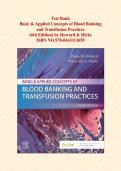
Test Bank
Basic & Applied Concepts of Blood Banking
and Transfusion Practices
(6th Edition) by Howard & Hicks
ISBN NO.978-0443113659

, Test Bank Basic & Applied Concepts of Blood
Banking and Transfusion Practices (6th Edition)
Latest Update |A Comprehensive Sample of 720
Multichoice Questions Covering Full Scope of the
Textbook| Each Question Includes the Correct
Answer with a Detailed Rationale|


Table of Contents
Chapter Title Questions

PART I: QUALITY AND SAFETY
ISSUES

Quality Management, Regulation,
1 and Safety in Blood Banks and 1–45
Transfusion Services

PART II: FOUNDATIONS: BASIC
SCIENCES AND REAGENTS

Immunology: Basic Principles
2 and Applications in the Blood 46–90
Bank

Blood Banking Reagents:
3 91–130
Overview and Applications

,Chapter Title Questions

4 Blood Banking Genetics 131–165

PART III: OVERVIEW OF THE MAJOR
BLOOD GROUPS

ABO and H Blood Group
5 166–225
Systems and Secretor Status

6 Rh Blood Group System 226–280

Other Red Cell Blood Group
Systems, Human Leukocyte
7 281–340
Antigens, and Human Platelet
Antigens

PART IV: ESSENTIALS OF
PRETRANSFUSION TESTING

Antibody Detection and
8 341–395
Identification

9 Compatibility Testing 396–440

Blood Bank Automation for
10 441–475
Transfusion Services

PART V: CLINICAL
CONSIDERATIONS IN
IMMUNOHEMATOLOGY

, Chapter Title Questions

Transfusion Reactions and Other
11 476–525
Adverse Events

Hemolytic Disease of the Fetus
12 526–565
and Newborn

PART VI: BLOOD COLLECTING AND
TESTING

13 Donor Selection and Phlebotomy 566–605

14 Testing of Donor Blood 606–640

PART VII: BLOOD COMPONENT
PREPARATION AND TRANSFUSION
THERAPY

Blood Component Preparation
15 641–680
and Therapy

Transfusion Therapy in Selected
16 681–720
Patients

Connected book
 image
Publisher: 2024 ISBN: 9780443113659 Edition: Unknown

Document information

Uploaded on
September 14, 2026
Number of pages
367
Written in
2026/2027
Type
Exam (elaborations)
Contains
Questions & answers
$16.49

Wrong document? Swap it for free Within 14 days of purchase and before downloading, you can choose a different document. You can simply spend the amount again.
Written by students who passed
Immediately available after payment
Read online or as PDF

Seller avatar
Reputation scores are based on the amount of documents a seller has sold for a fee and the reviews they have received for those documents. There are three levels: Bronze, Silver and Gold. The better the reputation, the more your can rely on the quality of the sellers work.
TutorGeoff
3.8
(17)
Sold
88
Followers
2
Items
943
Last sold
1 day ago


Why students choose Stuvia

Created by fellow students, verified by reviews

Quality you can trust: written by students who passed their tests and reviewed by others who've used these notes.

Didn't get what you expected? Choose another document

No worries! You can instantly pick a different document that better fits what you're looking for.

Pay as you like, start learning right away

No subscription, no commitments. Pay the way you're used to via credit card and download your PDF document instantly.

Student with book image

“Bought, downloaded, and aced it. It really can be that simple.”

Alisha Student

Working on your references?

Create accurate citations in APA, MLA and Harvard with our free citation generator.

Working on your references?

Frequently asked questions

