
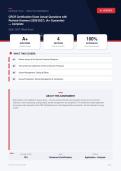
REVENUE CYCLE · OBJECTIVE ASSESSMENT A+ VERIFIED
CRCR Certification Exam Actual Questions with
Revised Answers (2026/2027), (A+ Guarantee)
— Complete
Official Exam
A+ Verified Questions Full Rationales Verified Answers
A+ 4 100%
QUESTIONS SECTIONS RATIONALES
Complete coverage Core exam domains Every answer explained
WHAT THIS COVERS
01 Patient Access & Pre-Service Financial Clearance
02 Time-of-Service Collections & Point-of-Service Processes
03 Claims Management, Coding & Billing
04 Account Resolution, Denials Management & Compliance
ABOUT THIS ASSESSMENT
Build mastery in the healthcare revenue cycle — from pre-service financial care and patient access to time-of-service
collections, claims processing, coding integrity, denials management, and compliance. This assessment targets application
and analysis skills required for the HFMA Certified Revenue Cycle Representative certification, with full rationales for every
answer.
PASSING SCORE LEVEL FORMAT
70% Advanced (Certification) Application / Analysis
STUVIA ACTUAL EXAM Page 1
, SECTION 1: Patient Access & Pre-Service Financial Clearance
Q1. A patient access representative is registering a scheduled outpatient procedure for a Medicare beneficiary. The scheduler
notes that the patient’s Medicare Part B is active but no secondary insurance is listed. Which action most effectively
supports accurate pre-service financial clearance?
A. Verify Medicare eligibility in real time and query the patient about any Medigap or secondary policies before finalizing the
account
B. Proceed with registration and bill Medicare only, assuming no secondary coverage exists
C. Delay the procedure until the patient brings paper copies of all insurance cards
D. Assign the account to self-pay and request full payment at registration
Correct Answer: A
Rationale:
Real-time eligibility verification combined with a targeted secondary-coverage inquiry captures Medigap or other secondary policies that affect
residual liability. Assuming no secondary coverage or converting to self-pay without investigation increases denial risk and patient surprise bills.
Q2. During pre-registration for an elective knee arthroscopy, the financial counselor discovers the patient’s commercial plan
requires prior authorization and the authorization number is missing. The procedure is scheduled for five days later. Which
next step best protects both revenue and patient experience?
A. Cancel the procedure immediately and reschedule only after authorization is obtained
B. Contact the ordering provider’s office and the payer to initiate or confirm authorization while keeping the patient informed of
status
C. Proceed without authorization and appeal any denial after the claim is submitted
D. Convert the case to self-pay and collect the full estimated amount up front
Correct Answer: B
Rationale:
Proactive coordination with the provider and payer to secure authorization before service reduces denial risk while maintaining the scheduled date
when possible. Automatic cancellation or post-service appeals create avoidable patient inconvenience and administrative cost.
Q3. A hospital’s patient access team is redesigning its script for collecting demographic and insurance data. Which element,
when consistently captured at pre-registration, most reduces downstream claim denials related to eligibility?
A. Preferred pharmacy and primary-care physician only
B. Patient’s email address and mobile phone number exclusively
C. Complete subscriber information, relationship to patient, group number, and real-time eligibility response including coverage
dates
D. Employer name without policy or group identifiers
Correct Answer: C
Rationale:
Accurate subscriber demographics, relationship codes, group numbers, and verified coverage dates are foundational for clean claims. Missing or
incorrect eligibility data is a leading cause of front-end denials.
Q4. An uninsured patient presents for a medically necessary but non-emergent MRI. The facility has a documented
financial-assistance policy that includes a sliding-scale discount. Which approach aligns with best-practice pre-service
financial clearance?
A. Refuse the MRI until the patient pays 100 percent of charges
B. Perform the MRI and then bill the patient the full chargemaster rate
C. Require the patient to apply for Medicaid and delay the MRI indefinitely
D. Screen the patient for financial-assistance eligibility, provide a clear estimate of discounted liability, and arrange a payment
plan or charity application before service when clinically appropriate
Correct Answer: D
Rationale:
Pre-service screening for financial assistance, transparent estimates, and payment arrangements support both revenue integrity and
patient-centered care. Blanket refusal or post-service full billing without screening violates many state and federal expectations for
financial-assistance policies.
STUVIA ACTUAL EXAM · Page 2
, SECTION 1: Patient Access & Pre-Service Financial Clearance
Q5. A scheduler receives an order for a high-cost injectable administered in the infusion center. The patient’s plan is a
Medicare Advantage HMO that requires a referral from the primary-care physician. Which pre-service action is most
critical?
A. Obtain and document a valid referral (or authorization) from the PCP before the service date and confirm it is active in the
payer portal
B. Schedule the infusion and rely on the claim to trigger a retrospective referral request
C. Convert the account to original Medicare and bill Part B directly
D. Collect the full self-pay rate and later refund if the referral is approved
Correct Answer: A
Rationale:
Medicare Advantage plans commonly require referrals or authorizations; missing them is a frequent denial reason. Confirming the referral before
service prevents avoidable write-offs and patient billing disputes.
Q6. During pre-registration, a patient states that coverage was recently terminated and they are now in a COBRA election
period. Which documentation should the patient-access staff request to complete financial clearance?
A. Only the expired insurance card
B. Written evidence of COBRA election and the new COBRA policy identification once elected, or clear self-pay arrangements if
election is declined
C. A verbal statement that COBRA will be elected later
D. Nothing further; treat the account as insured under the prior plan
Correct Answer: B
Rationale:
COBRA coverage is not automatic; election and payment are required. Documenting the election status and obtaining the new policy identifiers (or
establishing self-pay terms) prevents eligibility denials and incorrect payer routing.
Q7. A facility’s average pre-service authorization denial rate for elective imaging is 12 percent. Which process change is most
likely to reduce that rate?
A. Submitting all imaging claims without authorization numbers and appealing later
B. Eliminating authorization requirements for all commercial payers
C. Implementing a real-time authorization-status check in the scheduling workflow and escalating missing or expired
authorizations to a dedicated clearance team before the service date
D. Collecting full payment from every patient and refunding after the claim pays
Correct Answer: C
Rationale:
Embedding real-time authorization verification into the pre-service workflow and resolving gaps before service is a proven high-impact control.
Post-service appeals and full self-pay collection are less efficient and damage patient experience.
Q8. A patient access representative is preparing an estimate for an outpatient surgical procedure. The chargemaster rate is
$18,400; the patient’s commercial plan has a $2,500 remaining deductible and 20 percent coinsurance after deductible.
Which estimate most accurately reflects the patient’s expected out-of-pocket responsibility (assuming the plan’s allowed
amount equals the contracted rate of $9,200)?
A. $18,400
B. $9,200
C. $0 because the procedure is elective
D. $2,500 + 20 percent of ($9,200 − $2,500) = $3,840
Correct Answer: D
Rationale:
Patient liability is calculated on the allowed/contracted amount, not the chargemaster. Remaining deductible plus coinsurance on the balance after
deductible produces the expected patient responsibility of $3,840.
STUVIA ACTUAL EXAM · Page 3
CRCR Certification Exam Actual Questions with
Revised Answers (2026/2027), (A+ Guarantee)
— Complete
Official Exam
A+ Verified Questions Full Rationales Verified Answers
A+ 4 100%
QUESTIONS SECTIONS RATIONALES
Complete coverage Core exam domains Every answer explained
WHAT THIS COVERS
01 Patient Access & Pre-Service Financial Clearance
02 Time-of-Service Collections & Point-of-Service Processes
03 Claims Management, Coding & Billing
04 Account Resolution, Denials Management & Compliance
ABOUT THIS ASSESSMENT
Build mastery in the healthcare revenue cycle — from pre-service financial care and patient access to time-of-service
collections, claims processing, coding integrity, denials management, and compliance. This assessment targets application
and analysis skills required for the HFMA Certified Revenue Cycle Representative certification, with full rationales for every
answer.
PASSING SCORE LEVEL FORMAT
70% Advanced (Certification) Application / Analysis
STUVIA ACTUAL EXAM Page 1
, SECTION 1: Patient Access & Pre-Service Financial Clearance
Q1. A patient access representative is registering a scheduled outpatient procedure for a Medicare beneficiary. The scheduler
notes that the patient’s Medicare Part B is active but no secondary insurance is listed. Which action most effectively
supports accurate pre-service financial clearance?
A. Verify Medicare eligibility in real time and query the patient about any Medigap or secondary policies before finalizing the
account
B. Proceed with registration and bill Medicare only, assuming no secondary coverage exists
C. Delay the procedure until the patient brings paper copies of all insurance cards
D. Assign the account to self-pay and request full payment at registration
Correct Answer: A
Rationale:
Real-time eligibility verification combined with a targeted secondary-coverage inquiry captures Medigap or other secondary policies that affect
residual liability. Assuming no secondary coverage or converting to self-pay without investigation increases denial risk and patient surprise bills.
Q2. During pre-registration for an elective knee arthroscopy, the financial counselor discovers the patient’s commercial plan
requires prior authorization and the authorization number is missing. The procedure is scheduled for five days later. Which
next step best protects both revenue and patient experience?
A. Cancel the procedure immediately and reschedule only after authorization is obtained
B. Contact the ordering provider’s office and the payer to initiate or confirm authorization while keeping the patient informed of
status
C. Proceed without authorization and appeal any denial after the claim is submitted
D. Convert the case to self-pay and collect the full estimated amount up front
Correct Answer: B
Rationale:
Proactive coordination with the provider and payer to secure authorization before service reduces denial risk while maintaining the scheduled date
when possible. Automatic cancellation or post-service appeals create avoidable patient inconvenience and administrative cost.
Q3. A hospital’s patient access team is redesigning its script for collecting demographic and insurance data. Which element,
when consistently captured at pre-registration, most reduces downstream claim denials related to eligibility?
A. Preferred pharmacy and primary-care physician only
B. Patient’s email address and mobile phone number exclusively
C. Complete subscriber information, relationship to patient, group number, and real-time eligibility response including coverage
dates
D. Employer name without policy or group identifiers
Correct Answer: C
Rationale:
Accurate subscriber demographics, relationship codes, group numbers, and verified coverage dates are foundational for clean claims. Missing or
incorrect eligibility data is a leading cause of front-end denials.
Q4. An uninsured patient presents for a medically necessary but non-emergent MRI. The facility has a documented
financial-assistance policy that includes a sliding-scale discount. Which approach aligns with best-practice pre-service
financial clearance?
A. Refuse the MRI until the patient pays 100 percent of charges
B. Perform the MRI and then bill the patient the full chargemaster rate
C. Require the patient to apply for Medicaid and delay the MRI indefinitely
D. Screen the patient for financial-assistance eligibility, provide a clear estimate of discounted liability, and arrange a payment
plan or charity application before service when clinically appropriate
Correct Answer: D
Rationale:
Pre-service screening for financial assistance, transparent estimates, and payment arrangements support both revenue integrity and
patient-centered care. Blanket refusal or post-service full billing without screening violates many state and federal expectations for
financial-assistance policies.
STUVIA ACTUAL EXAM · Page 2
, SECTION 1: Patient Access & Pre-Service Financial Clearance
Q5. A scheduler receives an order for a high-cost injectable administered in the infusion center. The patient’s plan is a
Medicare Advantage HMO that requires a referral from the primary-care physician. Which pre-service action is most
critical?
A. Obtain and document a valid referral (or authorization) from the PCP before the service date and confirm it is active in the
payer portal
B. Schedule the infusion and rely on the claim to trigger a retrospective referral request
C. Convert the account to original Medicare and bill Part B directly
D. Collect the full self-pay rate and later refund if the referral is approved
Correct Answer: A
Rationale:
Medicare Advantage plans commonly require referrals or authorizations; missing them is a frequent denial reason. Confirming the referral before
service prevents avoidable write-offs and patient billing disputes.
Q6. During pre-registration, a patient states that coverage was recently terminated and they are now in a COBRA election
period. Which documentation should the patient-access staff request to complete financial clearance?
A. Only the expired insurance card
B. Written evidence of COBRA election and the new COBRA policy identification once elected, or clear self-pay arrangements if
election is declined
C. A verbal statement that COBRA will be elected later
D. Nothing further; treat the account as insured under the prior plan
Correct Answer: B
Rationale:
COBRA coverage is not automatic; election and payment are required. Documenting the election status and obtaining the new policy identifiers (or
establishing self-pay terms) prevents eligibility denials and incorrect payer routing.
Q7. A facility’s average pre-service authorization denial rate for elective imaging is 12 percent. Which process change is most
likely to reduce that rate?
A. Submitting all imaging claims without authorization numbers and appealing later
B. Eliminating authorization requirements for all commercial payers
C. Implementing a real-time authorization-status check in the scheduling workflow and escalating missing or expired
authorizations to a dedicated clearance team before the service date
D. Collecting full payment from every patient and refunding after the claim pays
Correct Answer: C
Rationale:
Embedding real-time authorization verification into the pre-service workflow and resolving gaps before service is a proven high-impact control.
Post-service appeals and full self-pay collection are less efficient and damage patient experience.
Q8. A patient access representative is preparing an estimate for an outpatient surgical procedure. The chargemaster rate is
$18,400; the patient’s commercial plan has a $2,500 remaining deductible and 20 percent coinsurance after deductible.
Which estimate most accurately reflects the patient’s expected out-of-pocket responsibility (assuming the plan’s allowed
amount equals the contracted rate of $9,200)?
A. $18,400
B. $9,200
C. $0 because the procedure is elective
D. $2,500 + 20 percent of ($9,200 − $2,500) = $3,840
Correct Answer: D
Rationale:
Patient liability is calculated on the allowed/contracted amount, not the chargemaster. Remaining deductible plus coinsurance on the balance after
deductible produces the expected patient responsibility of $3,840.
STUVIA ACTUAL EXAM · Page 3


