
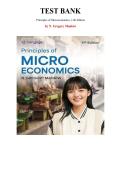
TEST BANK
Principles of Microeconomics, 11th Edition
by N. Gregory Mankiw
SC
O
R
EG
U
ID
ES
, Table of Content
Part I. Introduction
Chapter 1. Ten Principles of Economics
Chapter 2. Thinking Like an Economist
Chapter 3. Interdependence and the Gains from Trade
Part II. How Markets Work
Chapter 4. The Market Forces of Supply and Demand
Chapter 5. Elasticity and Its Application
SC
Chapter 6. Supply, Demand, and Government Policies
Part III. Markets and Welfare
Chapter 7. Consumers, Producers, and the Efficiency Of Markets
Chapter 8. Application: The Costs of Taxation
Chapter 9. Application: International Trade
O
Part IV. The Economics of the Public Sector
Chapter 10. Externalities
Chapter 11. Public Goods and Common Resources
R
Chapter 12. The Economics of Healthcare
Chapter 13. The Design of the Tax System
Part V. Firm Behavior and the Organization of Industry
EG
Chapter 14. The Costs of Production
Chapter 15. Firms in Competitive Markets
Chapter 16. Monopoly
Chapter 17. Monopolistic Competition
Chapter 18. Oligopoly
U
Part VI. The Economics of Labor Markets
Chapter 19. The Markets for the Factors of Production
Chapter 20. Earnings and Discrimination
ID
Chapter 21. Income Inequality and Poverty
Part VII. Topics for Further Study
Chapter 22. The Theory of Consumer Choice
Chapter 23. Frontiers of Microeconomics
ES
Chapter 24. Appendix: How Economists Use Data
,Name: Class: Date:
Ch 01: MC
1. Resources are
a. scarce for households but plentiful for economies.
b. plentiful for households but scarce for economies.
c. scarce for households and scarce for economies.
d. plentiful for households and plentiful for economies.
SC
ANSWER: c
2. Fundamentally, economics deals with
a. scarcity.
b. money.
c. poverty.
O
d. banking.
ANSWER: a
3. The overriding reason why households and societies face many decisions is that
R
a. resources are scarce.
b. goods and services are not scarce.
c. incomes fluctuate with business cycles.
EG
d. people, by nature, tend to disagree.
ANSWER: a
4. The phenomenon of scarcity stems from the fact that
a. most economies' production methods are not very good.
b. in most economies, wealthy people consume disproportionate quantities of goods and services.
U
c. governments restrict production of too many goods and services.
d. resources are limited.
ID
ANSWER: d
5. In most societies, resources are allocated by
a. a single central planner.
b. a small number of central planners.
ES
c. those firms that use resources to provide goods and services.
d. the combined actions of millions of households and firms.
ANSWER: d
, Name: Class: Date:
Ch 01: MC
6. Natural gas is widely used for heating and electricity, but it's considered to be a nonrenewable energy source. Which
of the following statements is correct?
a. Natural gas is an unlimited resource.
b. Natural gas is a scarce resource.
c. Natural gas is a nonscarce resource.
d. Natural gas is not a resource.
SC
ANSWER: b
7. Economics is the study of how society manages its
a. limited wants and unlimited resources.
b. unlimited wants and unlimited resources.
O
c. limited wants and limited resources.
d. unlimited wants and limited resources.
ANSWER: d
R
8. What term refers to the idea that society has limited resources and therefore cannot produce all the goods and
services people wish to have?
a. inefficiency
EG
b. inequality
c. scarcity
d. market failure
ANSWER: c
9. The adage, "There ain't no such thing as a free lunch," means
U
a. even people who receive TANF benefits have to pay for food.
b. the cost of living is always increasing.
c. people face tradeoffs.
ID
d. all costs are included in the price of a product.
ANSWER: c
10. Which of the following statements best represents the principle of the adage, "There ain't no such thing as a free
ES
lunch"?
a. Aaliyah can attend the concert only by carpooling with siblings.
b. Raj leaves wallet at home and misses lunch.
c. Amar must repair the bike tire before riding it to school.
d. Liam must decide between going to Florida or Brazil for spring break.
ANSWER: d
Principles of Microeconomics, 11th Edition
by N. Gregory Mankiw
SC
O
R
EG
U
ID
ES
, Table of Content
Part I. Introduction
Chapter 1. Ten Principles of Economics
Chapter 2. Thinking Like an Economist
Chapter 3. Interdependence and the Gains from Trade
Part II. How Markets Work
Chapter 4. The Market Forces of Supply and Demand
Chapter 5. Elasticity and Its Application
SC
Chapter 6. Supply, Demand, and Government Policies
Part III. Markets and Welfare
Chapter 7. Consumers, Producers, and the Efficiency Of Markets
Chapter 8. Application: The Costs of Taxation
Chapter 9. Application: International Trade
O
Part IV. The Economics of the Public Sector
Chapter 10. Externalities
Chapter 11. Public Goods and Common Resources
R
Chapter 12. The Economics of Healthcare
Chapter 13. The Design of the Tax System
Part V. Firm Behavior and the Organization of Industry
EG
Chapter 14. The Costs of Production
Chapter 15. Firms in Competitive Markets
Chapter 16. Monopoly
Chapter 17. Monopolistic Competition
Chapter 18. Oligopoly
U
Part VI. The Economics of Labor Markets
Chapter 19. The Markets for the Factors of Production
Chapter 20. Earnings and Discrimination
ID
Chapter 21. Income Inequality and Poverty
Part VII. Topics for Further Study
Chapter 22. The Theory of Consumer Choice
Chapter 23. Frontiers of Microeconomics
ES
Chapter 24. Appendix: How Economists Use Data
,Name: Class: Date:
Ch 01: MC
1. Resources are
a. scarce for households but plentiful for economies.
b. plentiful for households but scarce for economies.
c. scarce for households and scarce for economies.
d. plentiful for households and plentiful for economies.
SC
ANSWER: c
2. Fundamentally, economics deals with
a. scarcity.
b. money.
c. poverty.
O
d. banking.
ANSWER: a
3. The overriding reason why households and societies face many decisions is that
R
a. resources are scarce.
b. goods and services are not scarce.
c. incomes fluctuate with business cycles.
EG
d. people, by nature, tend to disagree.
ANSWER: a
4. The phenomenon of scarcity stems from the fact that
a. most economies' production methods are not very good.
b. in most economies, wealthy people consume disproportionate quantities of goods and services.
U
c. governments restrict production of too many goods and services.
d. resources are limited.
ID
ANSWER: d
5. In most societies, resources are allocated by
a. a single central planner.
b. a small number of central planners.
ES
c. those firms that use resources to provide goods and services.
d. the combined actions of millions of households and firms.
ANSWER: d
, Name: Class: Date:
Ch 01: MC
6. Natural gas is widely used for heating and electricity, but it's considered to be a nonrenewable energy source. Which
of the following statements is correct?
a. Natural gas is an unlimited resource.
b. Natural gas is a scarce resource.
c. Natural gas is a nonscarce resource.
d. Natural gas is not a resource.
SC
ANSWER: b
7. Economics is the study of how society manages its
a. limited wants and unlimited resources.
b. unlimited wants and unlimited resources.
O
c. limited wants and limited resources.
d. unlimited wants and limited resources.
ANSWER: d
R
8. What term refers to the idea that society has limited resources and therefore cannot produce all the goods and
services people wish to have?
a. inefficiency
EG
b. inequality
c. scarcity
d. market failure
ANSWER: c
9. The adage, "There ain't no such thing as a free lunch," means
U
a. even people who receive TANF benefits have to pay for food.
b. the cost of living is always increasing.
c. people face tradeoffs.
ID
d. all costs are included in the price of a product.
ANSWER: c
10. Which of the following statements best represents the principle of the adage, "There ain't no such thing as a free
ES
lunch"?
a. Aaliyah can attend the concert only by carpooling with siblings.
b. Raj leaves wallet at home and misses lunch.
c. Amar must repair the bike tire before riding it to school.
d. Liam must decide between going to Florida or Brazil for spring break.
ANSWER: d


