
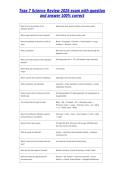
Teas 7 Science Review 2026 exam with question
and answer 100% correct
What is the main function of the Break down food, absorb nutrients, and remove waste.
digestive system?
Which organ absorbs the most nutrients? Small intestine (villi increase surface area).
Name the pathway of food from mouth to Mouth → Esophagus → Stomach → Small Intestine → Large
anus. Intestine → Rectum → Anus.
What is peristalsis? Wave-like muscular contractions that move food through the
digestive tract.
What is the main function of the respiratory Exchange gases (O₂ in, CO₂ out) between lungs and blood.
system?
Where does gas exchange occur in the In the alveoli.
lungs?
Which muscles are involved in breathing? Diaphragm and intercostal muscles.
Define inspiration and expiration. Inspiration = inhale (diaphragm contracts), Expiration = exhale
(diaphragm relaxes).
Name the four heart chambers and their RA (deoxygenated), RV (deoxygenated), LA (oxygenated), LV
blood type. (oxygenated).
Trace blood flow through the heart. Body → RA → Tricuspid → RV → Pulmonary valve →
Pulmonary artery → Lungs → Pulmonary veins → LA → Mitral
→ LV → Aortic valve → Body.
What is the difference between systemic Pulmonary = heart → lungs → heart; Systemic = heart → body
and pulmonary circulation? → heart.
Name the four heart valves. Tricuspid (RA→RV), Pulmonary (RV→lungs), Mitral/Bicuspid
(LA→LV), Aortic (LV→body).
What is systole and diastole? Systole = contraction (blood ejected), Diastole = relaxation
(chambers fill).
Which ventricle has the thickest wall and Left ventricle; pumps blood to entire body.
why?
What are the three types of muscles? Skeletal (voluntary), Smooth (involuntary), Cardiac (heart).
Name key endocrine glands and one Pituitary → GH; Thyroid → Thyroxine; Pancreas → Insulin;
hormone each. Adrenal → Cortisol; Ovaries/Testes → Estrogen/Testosterone.
and answer 100% correct
What is the main function of the Break down food, absorb nutrients, and remove waste.
digestive system?
Which organ absorbs the most nutrients? Small intestine (villi increase surface area).
Name the pathway of food from mouth to Mouth → Esophagus → Stomach → Small Intestine → Large
anus. Intestine → Rectum → Anus.
What is peristalsis? Wave-like muscular contractions that move food through the
digestive tract.
What is the main function of the respiratory Exchange gases (O₂ in, CO₂ out) between lungs and blood.
system?
Where does gas exchange occur in the In the alveoli.
lungs?
Which muscles are involved in breathing? Diaphragm and intercostal muscles.
Define inspiration and expiration. Inspiration = inhale (diaphragm contracts), Expiration = exhale
(diaphragm relaxes).
Name the four heart chambers and their RA (deoxygenated), RV (deoxygenated), LA (oxygenated), LV
blood type. (oxygenated).
Trace blood flow through the heart. Body → RA → Tricuspid → RV → Pulmonary valve →
Pulmonary artery → Lungs → Pulmonary veins → LA → Mitral
→ LV → Aortic valve → Body.
What is the difference between systemic Pulmonary = heart → lungs → heart; Systemic = heart → body
and pulmonary circulation? → heart.
Name the four heart valves. Tricuspid (RA→RV), Pulmonary (RV→lungs), Mitral/Bicuspid
(LA→LV), Aortic (LV→body).
What is systole and diastole? Systole = contraction (blood ejected), Diastole = relaxation
(chambers fill).
Which ventricle has the thickest wall and Left ventricle; pumps blood to entire body.
why?
What are the three types of muscles? Skeletal (voluntary), Smooth (involuntary), Cardiac (heart).
Name key endocrine glands and one Pituitary → GH; Thyroid → Thyroxine; Pancreas → Insulin;
hormone each. Adrenal → Cortisol; Ovaries/Testes → Estrogen/Testosterone.


