

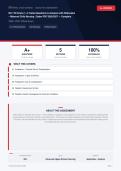
MATERNAL CHILD NURSING · OBJECTIVE ASSESSMENT A+ VERIFIED
NU 170 Exams 1–4 Tested Questions & Answers with Rationales
– Maternal Child Nursing | Galen PDF 2026/2027 — Complete
Official Exam
A+ Verified Questions Full Rationales Verified Answers
A+ 5 100%
QUESTIONS SECTIONS RATIONALES
Complete coverage Core exam domains Every answer explained
WHAT THIS COVERS
01 Antepartum / Prenatal Care & Complications
02 Intrapartum / Labor & Delivery
03 Postpartum Care & Complications
04 Newborn Assessment & Care
05 Pediatric Growth, Development & Common Conditions
ABOUT THIS ASSESSMENT
Build mastery in maternal child nursing — from antepartum, intrapartum, and postpartum care to newborn assessment, pediatric growth
and development, and family-centered nursing interventions. This assessment targets application and analysis skills required for the NU
170 exams, with full rationales for every answer. Content aligns to the course blueprint and emphasizes clinical decision-making across
the childbearing and child-rearing continuum.
PASSING SCORE LEVEL FORMAT
80% Advanced (Upper-Division Nursing) Application / Analysis
STUVIA ACTUAL EXAM Page 1
, SECTION 1: Antepartum / Prenatal Care & Complications
Q1. A 28-year-old primigravida at 32 weeks gestation reports sudden severe headache, visual changes, and epigastric pain.
Blood pressure is 168/110 mm Hg and proteinuria is 3+. Which complication does the nurse prioritize assessment for?
A. Gestational diabetes mellitus
B. Preeclampsia with severe features
C. Placenta previa
D. Hyperemesis gravidarum
Correct Answer: B
Rationale: Severe-range blood pressure, proteinuria, headache, visual changes, and epigastric pain are classic markers of preeclampsia with severe
features. Immediate assessment for end-organ involvement and possible progression to eclampsia is required.
Q2. A client at 10 weeks gestation asks why the provider ordered a prenatal panel including blood type, Rh, CBC, and
rubella titer. Which response by the nurse is most accurate?
A. These tests determine the exact due date.
B. The panel is only required for clients older than 35 years.
C. Results are used solely for research purposes.
D. Early laboratory data identify risks that can affect maternal and fetal health so interventions can begin promptly.
Correct Answer: D
Rationale: First-trimester laboratory screening establishes baseline values and detects conditions (anemia, isoimmunization risk, immunity status) that
influence prenatal management. Early identification allows timely treatment or prophylaxis.
Q3. A client at 28 weeks gestation with gestational diabetes is learning home blood-glucose monitoring. Which teaching
point is essential?
A. Check glucose only once daily after the largest meal.
B. Insulin is never needed if diet is followed perfectly.
C. Target fasting glucose is generally less than 95 mg/dL and 1-hour postprandial less than 140 mg/dL as directed by the provider.
D. Ketone testing replaces glucose monitoring.
Correct Answer: C
Rationale: Standard glycemic targets for gestational diabetes include fasting <95 mg/dL and postprandial limits that reduce fetal macrosomia risk.
Consistent monitoring guides diet, activity, and possible pharmacologic therapy.
Q4. A pregnant client at 34 weeks reports painless bright-red vaginal bleeding. The nurse places the client on bed rest and
prepares for which diagnostic evaluation?
A. Immediate digital cervical examination
B. Amniocentesis for lung maturity
C. Nonstress test only
D. Transabdominal or transvaginal ultrasound to locate the placenta
Correct Answer: D
Rationale: Painless third-trimester bleeding raises concern for placenta previa. Ultrasound confirms placental location before any digital examination
that could provoke hemorrhage.
Q5. A client at 24 weeks gestation has a 1-hour glucose challenge result of 158 mg/dL. What is the nurse’s next action?
A. Reassure the client that the value is normal.
B. Schedule a 3-hour oral glucose tolerance test for diagnostic confirmation.
C. Begin insulin therapy immediately.
D. Recommend delivery at 37 weeks.
Correct Answer: B
Rationale: A 1-hour screen ≥140 mg/dL (or institutional threshold) is abnormal and requires the diagnostic 3-hour OGTT. Treatment decisions follow
confirmed gestational diabetes.
Q6. A Rh-negative client at 28 weeks gestation has a negative antibody screen. Which medication does the nurse anticipate
administering?
A. Hepatitis B vaccine booster
B. Rho(D) immune globulin (RhoGAM) 300 mcg IM
C. Tdap vaccine only
D. No medication is indicated until after delivery
Correct Answer: B
Rationale: Routine antenatal RhoGAM at approximately 28STUVIA
weeks prevents
ACTUALmaternal sensitization
EXAM · Page 2 in Rh-negative clients with a negative antibody
screen. Postpartum dosing follows if the newborn is Rh-positive.
, SECTION 1: Antepartum / Prenatal Care & Complications
Q7. A client with chronic hypertension is 12 weeks pregnant. The nurse reinforces which lifestyle teaching?
A. Increase sodium intake to maintain blood volume.
B. Stop all blood-pressure medication immediately.
C. Restrict fluid intake to 1 L per day.
D. Monitor blood pressure at home, continue prescribed antihypertensives safe in pregnancy, and report severe headache or visual
changes.
Correct Answer: D
Rationale: Preexisting hypertension requires ongoing monitoring and medication review for fetal safety. Clients must recognize warning signs of
superimposed preeclampsia.
Q8. A primigravida at 8 weeks reports severe nausea and vomiting with weight loss of 5 % of pre-pregnancy weight and
ketonuria. Which diagnosis is most consistent?
A. Normal first-trimester nausea
B. Hyperemesis gravidarum
C. Appendicitis
D. Preeclampsia
Correct Answer: B
Rationale: Hyperemesis gravidarum is characterized by intractable vomiting, significant weight loss, dehydration, and electrolyte or metabolic
disturbances beyond typical morning sickness.
Q9. A client at 36 weeks gestation reports decreased fetal movement. After a nonstress test is nonreactive, the nurse
anticipates which follow-up test?
A. Immediate cesarean delivery without further testing
B. Contraction stress test or biophysical profile
C. Amniocentesis for genetic analysis
D. Repeat ultrasound for dating only
Correct Answer: B
Rationale: A nonreactive NST warrants further evaluation of fetal well-being with a biophysical profile or contraction stress test to assess oxygenation
and reserve.
Q10. A pregnant client asks about the purpose of the alpha-fetoprotein (AFP) screening performed at 16–18 weeks. The
nurse explains that elevated levels may indicate:
A. Down syndrome only
B. Open neural-tube defects or abdominal-wall defects; low levels may be associated with chromosomal anomalies
C. Gestational diabetes
D. Placental abruption
Correct Answer: B
Rationale: Maternal serum AFP is a screening tool; elevated values prompt evaluation for neural-tube or ventral-wall defects, while low values raise
concern for aneuploidy. Diagnostic testing follows abnormal screens.
Q11. A client at 30 weeks with preterm labor is receiving magnesium sulfate. Which assessment finding requires immediate
intervention?
A. Deep tendon reflexes 2+ bilaterally
B. Respiratory rate of 10 breaths/min and absent deep tendon reflexes
C. Mild flushing and a warm sensation
D. Urine output of 40 mL/hour
Correct Answer: B
Rationale: Magnesium toxicity is evidenced by respiratory depression, loss of deep tendon reflexes, and decreased urine output. Calcium gluconate is
the antidote and respiratory support is priority.
Q12. A client with placenta previa is admitted at 32 weeks with light bleeding. Which nursing action is appropriate?
A. Perform a sterile vaginal examination to assess dilation.
B. Encourage ambulation to promote placental migration.
C. Maintain bed rest, monitor bleeding and fetal heart rate, and prepare for possible transfusion.
D. Initiate oxytocin induction immediately.
Correct Answer: C
Rationale: Expectant management of placenta previa includes activity restriction, surveillance for hemorrhage, and readiness for emergency delivery if
STUVIA ACTUAL EXAM · Page 3
bleeding becomes severe. Digital exams are contraindicated.
NU 170 Exams 1–4 Tested Questions & Answers with Rationales
– Maternal Child Nursing | Galen PDF 2026/2027 — Complete
Official Exam
A+ Verified Questions Full Rationales Verified Answers
A+ 5 100%
QUESTIONS SECTIONS RATIONALES
Complete coverage Core exam domains Every answer explained
WHAT THIS COVERS
01 Antepartum / Prenatal Care & Complications
02 Intrapartum / Labor & Delivery
03 Postpartum Care & Complications
04 Newborn Assessment & Care
05 Pediatric Growth, Development & Common Conditions
ABOUT THIS ASSESSMENT
Build mastery in maternal child nursing — from antepartum, intrapartum, and postpartum care to newborn assessment, pediatric growth
and development, and family-centered nursing interventions. This assessment targets application and analysis skills required for the NU
170 exams, with full rationales for every answer. Content aligns to the course blueprint and emphasizes clinical decision-making across
the childbearing and child-rearing continuum.
PASSING SCORE LEVEL FORMAT
80% Advanced (Upper-Division Nursing) Application / Analysis
STUVIA ACTUAL EXAM Page 1
, SECTION 1: Antepartum / Prenatal Care & Complications
Q1. A 28-year-old primigravida at 32 weeks gestation reports sudden severe headache, visual changes, and epigastric pain.
Blood pressure is 168/110 mm Hg and proteinuria is 3+. Which complication does the nurse prioritize assessment for?
A. Gestational diabetes mellitus
B. Preeclampsia with severe features
C. Placenta previa
D. Hyperemesis gravidarum
Correct Answer: B
Rationale: Severe-range blood pressure, proteinuria, headache, visual changes, and epigastric pain are classic markers of preeclampsia with severe
features. Immediate assessment for end-organ involvement and possible progression to eclampsia is required.
Q2. A client at 10 weeks gestation asks why the provider ordered a prenatal panel including blood type, Rh, CBC, and
rubella titer. Which response by the nurse is most accurate?
A. These tests determine the exact due date.
B. The panel is only required for clients older than 35 years.
C. Results are used solely for research purposes.
D. Early laboratory data identify risks that can affect maternal and fetal health so interventions can begin promptly.
Correct Answer: D
Rationale: First-trimester laboratory screening establishes baseline values and detects conditions (anemia, isoimmunization risk, immunity status) that
influence prenatal management. Early identification allows timely treatment or prophylaxis.
Q3. A client at 28 weeks gestation with gestational diabetes is learning home blood-glucose monitoring. Which teaching
point is essential?
A. Check glucose only once daily after the largest meal.
B. Insulin is never needed if diet is followed perfectly.
C. Target fasting glucose is generally less than 95 mg/dL and 1-hour postprandial less than 140 mg/dL as directed by the provider.
D. Ketone testing replaces glucose monitoring.
Correct Answer: C
Rationale: Standard glycemic targets for gestational diabetes include fasting <95 mg/dL and postprandial limits that reduce fetal macrosomia risk.
Consistent monitoring guides diet, activity, and possible pharmacologic therapy.
Q4. A pregnant client at 34 weeks reports painless bright-red vaginal bleeding. The nurse places the client on bed rest and
prepares for which diagnostic evaluation?
A. Immediate digital cervical examination
B. Amniocentesis for lung maturity
C. Nonstress test only
D. Transabdominal or transvaginal ultrasound to locate the placenta
Correct Answer: D
Rationale: Painless third-trimester bleeding raises concern for placenta previa. Ultrasound confirms placental location before any digital examination
that could provoke hemorrhage.
Q5. A client at 24 weeks gestation has a 1-hour glucose challenge result of 158 mg/dL. What is the nurse’s next action?
A. Reassure the client that the value is normal.
B. Schedule a 3-hour oral glucose tolerance test for diagnostic confirmation.
C. Begin insulin therapy immediately.
D. Recommend delivery at 37 weeks.
Correct Answer: B
Rationale: A 1-hour screen ≥140 mg/dL (or institutional threshold) is abnormal and requires the diagnostic 3-hour OGTT. Treatment decisions follow
confirmed gestational diabetes.
Q6. A Rh-negative client at 28 weeks gestation has a negative antibody screen. Which medication does the nurse anticipate
administering?
A. Hepatitis B vaccine booster
B. Rho(D) immune globulin (RhoGAM) 300 mcg IM
C. Tdap vaccine only
D. No medication is indicated until after delivery
Correct Answer: B
Rationale: Routine antenatal RhoGAM at approximately 28STUVIA
weeks prevents
ACTUALmaternal sensitization
EXAM · Page 2 in Rh-negative clients with a negative antibody
screen. Postpartum dosing follows if the newborn is Rh-positive.
, SECTION 1: Antepartum / Prenatal Care & Complications
Q7. A client with chronic hypertension is 12 weeks pregnant. The nurse reinforces which lifestyle teaching?
A. Increase sodium intake to maintain blood volume.
B. Stop all blood-pressure medication immediately.
C. Restrict fluid intake to 1 L per day.
D. Monitor blood pressure at home, continue prescribed antihypertensives safe in pregnancy, and report severe headache or visual
changes.
Correct Answer: D
Rationale: Preexisting hypertension requires ongoing monitoring and medication review for fetal safety. Clients must recognize warning signs of
superimposed preeclampsia.
Q8. A primigravida at 8 weeks reports severe nausea and vomiting with weight loss of 5 % of pre-pregnancy weight and
ketonuria. Which diagnosis is most consistent?
A. Normal first-trimester nausea
B. Hyperemesis gravidarum
C. Appendicitis
D. Preeclampsia
Correct Answer: B
Rationale: Hyperemesis gravidarum is characterized by intractable vomiting, significant weight loss, dehydration, and electrolyte or metabolic
disturbances beyond typical morning sickness.
Q9. A client at 36 weeks gestation reports decreased fetal movement. After a nonstress test is nonreactive, the nurse
anticipates which follow-up test?
A. Immediate cesarean delivery without further testing
B. Contraction stress test or biophysical profile
C. Amniocentesis for genetic analysis
D. Repeat ultrasound for dating only
Correct Answer: B
Rationale: A nonreactive NST warrants further evaluation of fetal well-being with a biophysical profile or contraction stress test to assess oxygenation
and reserve.
Q10. A pregnant client asks about the purpose of the alpha-fetoprotein (AFP) screening performed at 16–18 weeks. The
nurse explains that elevated levels may indicate:
A. Down syndrome only
B. Open neural-tube defects or abdominal-wall defects; low levels may be associated with chromosomal anomalies
C. Gestational diabetes
D. Placental abruption
Correct Answer: B
Rationale: Maternal serum AFP is a screening tool; elevated values prompt evaluation for neural-tube or ventral-wall defects, while low values raise
concern for aneuploidy. Diagnostic testing follows abnormal screens.
Q11. A client at 30 weeks with preterm labor is receiving magnesium sulfate. Which assessment finding requires immediate
intervention?
A. Deep tendon reflexes 2+ bilaterally
B. Respiratory rate of 10 breaths/min and absent deep tendon reflexes
C. Mild flushing and a warm sensation
D. Urine output of 40 mL/hour
Correct Answer: B
Rationale: Magnesium toxicity is evidenced by respiratory depression, loss of deep tendon reflexes, and decreased urine output. Calcium gluconate is
the antidote and respiratory support is priority.
Q12. A client with placenta previa is admitted at 32 weeks with light bleeding. Which nursing action is appropriate?
A. Perform a sterile vaginal examination to assess dilation.
B. Encourage ambulation to promote placental migration.
C. Maintain bed rest, monitor bleeding and fetal heart rate, and prepare for possible transfusion.
D. Initiate oxytocin induction immediately.
Correct Answer: C
Rationale: Expectant management of placenta previa includes activity restriction, surveillance for hemorrhage, and readiness for emergency delivery if
STUVIA ACTUAL EXAM · Page 3
bleeding becomes severe. Digital exams are contraindicated.


