
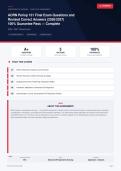
A+ VERIFIED
PERIOPERATIVE NURSING · OBJECTIVE ASSESSMENT
AORN Periop 101 Final Exam Questions and
Revised Correct Answers (2026/2027)
100% Guarantee Pass — Complete
Official Exam
A+ Verified Questions Full Rationales Verified Answers
A+ 5 100%
QUESTIONS SECTIONS RATIONALES
Complete coverage Core exam domains Every answer explained
WHAT THIS COVERS
01 Patient Assessment, Safety & Communication
02 Infection Prevention, Sterile Technique & Asepsis
03 Surgical Environment, Positioning & Equipment Safety
04 Anesthesia, Medications, Hemostasis & Emergencies
05 Instrumentation, Counts, Documentation & Professional Practice
ABOUT THIS ASSESSMENT
Build mastery in perioperative nursing — from patient assessment, infection control, and sterile technique to surgical positioning, anesthesia
considerations, hemostasis, and professional documentation standards. This assessment targets application and analysis skills required for
the AORN Periop 101 Final Exam, with full rationales for every answer. Content is aligned to core perioperative domains and emphasizes
high-yield patient safety and clinical decision-making competencies.
PASSING SCORE LEVEL FORMAT
80% Advanced (Perioperative Nursing) Application / Analysis
STUVIA ACTUAL EXAM Page 1
, SECTION 1: PATIENT ASSESSMENT, SAFETY & COMMUNICATION
Q1. A 68-year-old patient scheduled for elective total knee arthroplasty arrives in the preoperative holding area. The circulating nurse
reviews the medical record and notes the patient takes metformin and has a history of type 2 diabetes. The most recent fasting blood
glucose is 142 mg/dL. The surgeon has not yet marked the surgical site. Which action should the nurse take first?
A. Proceed with the surgical safety checklist once the surgeon arrives and marks the site
B. Administer the scheduled metformin dose with a sip of water to maintain glycemic control
C. Notify the anesthesia provider of the glucose result and verify site marking is completed before transport
D. Document the glucose value and proceed because the level is within acceptable preoperative range
Correct Answer: C
Rationale:
Site marking by the surgeon and communication of relevant laboratory values are critical safety steps before the patient leaves the holding area. Metformin is
typically held perioperatively due to risk of lactic acidosis, and a glucose of 142 mg/dL requires awareness but does not alone dictate delay. The nurse must
ensure both marking and provider notification occur before transport.
Q2. During the preoperative interview, a patient scheduled for laparoscopic cholecystectomy reports an allergy to latex that previously
caused facial swelling and difficulty breathing. The circulating nurse observes that the scheduled procedure room contains
latex-containing gloves and tubing. What is the priority intervention?
A. Replace only the gloves with non-latex alternatives and proceed with the scheduled room
B. Notify the charge nurse and request a latex-free environment and supplies before patient transport
C. Document the allergy and continue preparation because the patient will be under general anesthesia
D. Ask the patient whether mild exposure has been tolerated in the past to determine necessity of changes
Correct Answer: B
Rationale:
A history of anaphylactic-type reaction to latex requires a fully latex-free environment. Partial substitution is insufficient. Documentation alone does not mitigate
risk, and past tolerance does not predict future response. The charge nurse must be notified to arrange appropriate room and supplies before the patient enters
the OR.
Q3. A patient is scheduled for urgent appendectomy. The preoperative nurse discovers the consent form lists the procedure as 'exploratory
laparotomy' rather than appendectomy. The surgeon is already scrubbed in another room. What is the most appropriate next step?
A. Correct the consent form by writing 'appendectomy' and have the patient initial the change
B. Proceed because the circulating nurse can clarify the procedure during the time-out
C. Have the patient sign a new blank consent form and complete it after the surgeon is available
D. Delay transport until the surgeon can review and correct the consent with the patient
Correct Answer: D
Rationale:
Informed consent must accurately describe the planned procedure. Altering an existing form or relying on the time-out is not acceptable. The surgeon must
personally ensure the consent is correct and the patient understands the procedure before anesthesia induction. Transport should be delayed until this is
resolved.
Q4. While performing the preoperative assessment, the nurse notes the patient has a body mass index of 42 and reports obstructive sleep
apnea treated with CPAP at home. The patient is scheduled for shoulder arthroscopy under general anesthesia in the beach-chair
position. Which concern should the nurse communicate to the anesthesia and surgical teams during the briefing?
A. Likelihood that the procedure will be converted to open surgery due to body habitus
B. Risk of difficult airway management and potential need for specialized positioning aids
C. Need to discontinue CPAP use for 24 hours before surgery to reduce aspiration risk
D. Expectation that local anesthesia with sedation will be safer than general anesthesia
Correct Answer: B
Rationale:
Obesity and OSA increase the risk of difficult mask ventilation and intubation. Beach-chair positioning further complicates airway access and hemodynamics.
The team must plan for potential difficult airway equipment and careful positioning. CPAP is typically continued; conversion risk and anesthetic choice are
determined by the providers, not assumed by the nurse.
STUVIA ACTUAL EXAM · Page 2
, SECTION 1: PATIENT ASSESSMENT, SAFETY & COMMUNICATION
Q5. A 45-year-old patient arrives for outpatient hernia repair. The nurse reviews the history and notes the patient last ate a full meal six
hours ago and drank clear liquids four hours ago. The facility policy follows ASA fasting guidelines. How should the nurse interpret this
information?
A. The patient must wait an additional two hours because solids require eight hours of fasting
B. The patient meets current ASA recommendations for both solids and clear liquids
C. Clear liquids within four hours require cancellation of the elective procedure
D. Only the solid food intake is relevant; clear liquids may be consumed until two hours prior
Correct Answer: B
Rationale:
ASA guidelines allow clear liquids up to two hours and solid foods up to six hours before elective procedures requiring anesthesia. The patient’s intake is within
these limits. No additional waiting or cancellation is indicated based solely on fasting status.
Q6. During the preoperative verification process, the circulating nurse discovers that the patient’s identification band displays a different
medical record number than the one on the surgical schedule and consent form. The patient correctly states their name and date of
birth. What is the correct action?
A. Replace the identification band with a new one matching the schedule and proceed
B. Ask the patient which number is correct and update the documents accordingly
C. Stop the process, notify the charge nurse and registration, and resolve the discrepancy before continuing
D. Document the discrepancy and continue because name and date of birth match
Correct Answer: C
Rationale:
Any discrepancy in patient identifiers must be resolved before proceeding. Matching name and date of birth alone is insufficient when the medical record number
differs. Registration and the charge nurse must investigate and correct the error to prevent wrong-patient events.
Q7. A patient scheduled for mastectomy expresses anxiety about possible cancer diagnosis and asks the circulating nurse whether the
surgeon will remove lymph nodes. The nurse has reviewed the consent, which lists 'right mastectomy with possible sentinel node
biopsy.' What is the most appropriate response?
A. Reassure the patient that lymph node removal is routine and will not affect recovery time
B. Explain that the consent includes possible sentinel node biopsy and encourage the patient to ask the surgeon for details
C. State that the final decision will be made during surgery based on frozen section results
D. Tell the patient that only the breast tissue will be removed unless cancer is confirmed
Correct Answer: B
Rationale:
The nurse should reinforce the information already on the consent and direct the patient to the surgeon for specific procedural questions. Providing medical
opinions or definitive statements about intraoperative decisions is outside the nursing role and may create false expectations.
Q8. The preoperative nurse is preparing a patient who takes warfarin for atrial fibrillation. The patient’s last dose was three days ago, and
the current INR is 1.3. The surgeon has ordered the procedure to proceed. Which statement best reflects the nurse’s responsibility?
A. Insist that the procedure be postponed until the INR returns to the therapeutic range of 2.0–3.0
B. Administer vitamin K as a standing order to further normalize coagulation before incision
C. Confirm that the anesthesia provider and surgeon are aware of the INR result and recent warfarin history
D. Document the INR and proceed without further discussion because the value is near normal
Correct Answer: C
Rationale:
An INR of 1.3 is generally acceptable for most elective procedures after holding warfarin. The nurse’s role is to ensure the team is informed of the coagulation
status and medication history so that any additional precautions (e.g., hemostatic agents) can be planned. Unilateral postponement or medication administration
without orders is inappropriate.
STUVIA ACTUAL EXAM · Page 3
PERIOPERATIVE NURSING · OBJECTIVE ASSESSMENT
AORN Periop 101 Final Exam Questions and
Revised Correct Answers (2026/2027)
100% Guarantee Pass — Complete
Official Exam
A+ Verified Questions Full Rationales Verified Answers
A+ 5 100%
QUESTIONS SECTIONS RATIONALES
Complete coverage Core exam domains Every answer explained
WHAT THIS COVERS
01 Patient Assessment, Safety & Communication
02 Infection Prevention, Sterile Technique & Asepsis
03 Surgical Environment, Positioning & Equipment Safety
04 Anesthesia, Medications, Hemostasis & Emergencies
05 Instrumentation, Counts, Documentation & Professional Practice
ABOUT THIS ASSESSMENT
Build mastery in perioperative nursing — from patient assessment, infection control, and sterile technique to surgical positioning, anesthesia
considerations, hemostasis, and professional documentation standards. This assessment targets application and analysis skills required for
the AORN Periop 101 Final Exam, with full rationales for every answer. Content is aligned to core perioperative domains and emphasizes
high-yield patient safety and clinical decision-making competencies.
PASSING SCORE LEVEL FORMAT
80% Advanced (Perioperative Nursing) Application / Analysis
STUVIA ACTUAL EXAM Page 1
, SECTION 1: PATIENT ASSESSMENT, SAFETY & COMMUNICATION
Q1. A 68-year-old patient scheduled for elective total knee arthroplasty arrives in the preoperative holding area. The circulating nurse
reviews the medical record and notes the patient takes metformin and has a history of type 2 diabetes. The most recent fasting blood
glucose is 142 mg/dL. The surgeon has not yet marked the surgical site. Which action should the nurse take first?
A. Proceed with the surgical safety checklist once the surgeon arrives and marks the site
B. Administer the scheduled metformin dose with a sip of water to maintain glycemic control
C. Notify the anesthesia provider of the glucose result and verify site marking is completed before transport
D. Document the glucose value and proceed because the level is within acceptable preoperative range
Correct Answer: C
Rationale:
Site marking by the surgeon and communication of relevant laboratory values are critical safety steps before the patient leaves the holding area. Metformin is
typically held perioperatively due to risk of lactic acidosis, and a glucose of 142 mg/dL requires awareness but does not alone dictate delay. The nurse must
ensure both marking and provider notification occur before transport.
Q2. During the preoperative interview, a patient scheduled for laparoscopic cholecystectomy reports an allergy to latex that previously
caused facial swelling and difficulty breathing. The circulating nurse observes that the scheduled procedure room contains
latex-containing gloves and tubing. What is the priority intervention?
A. Replace only the gloves with non-latex alternatives and proceed with the scheduled room
B. Notify the charge nurse and request a latex-free environment and supplies before patient transport
C. Document the allergy and continue preparation because the patient will be under general anesthesia
D. Ask the patient whether mild exposure has been tolerated in the past to determine necessity of changes
Correct Answer: B
Rationale:
A history of anaphylactic-type reaction to latex requires a fully latex-free environment. Partial substitution is insufficient. Documentation alone does not mitigate
risk, and past tolerance does not predict future response. The charge nurse must be notified to arrange appropriate room and supplies before the patient enters
the OR.
Q3. A patient is scheduled for urgent appendectomy. The preoperative nurse discovers the consent form lists the procedure as 'exploratory
laparotomy' rather than appendectomy. The surgeon is already scrubbed in another room. What is the most appropriate next step?
A. Correct the consent form by writing 'appendectomy' and have the patient initial the change
B. Proceed because the circulating nurse can clarify the procedure during the time-out
C. Have the patient sign a new blank consent form and complete it after the surgeon is available
D. Delay transport until the surgeon can review and correct the consent with the patient
Correct Answer: D
Rationale:
Informed consent must accurately describe the planned procedure. Altering an existing form or relying on the time-out is not acceptable. The surgeon must
personally ensure the consent is correct and the patient understands the procedure before anesthesia induction. Transport should be delayed until this is
resolved.
Q4. While performing the preoperative assessment, the nurse notes the patient has a body mass index of 42 and reports obstructive sleep
apnea treated with CPAP at home. The patient is scheduled for shoulder arthroscopy under general anesthesia in the beach-chair
position. Which concern should the nurse communicate to the anesthesia and surgical teams during the briefing?
A. Likelihood that the procedure will be converted to open surgery due to body habitus
B. Risk of difficult airway management and potential need for specialized positioning aids
C. Need to discontinue CPAP use for 24 hours before surgery to reduce aspiration risk
D. Expectation that local anesthesia with sedation will be safer than general anesthesia
Correct Answer: B
Rationale:
Obesity and OSA increase the risk of difficult mask ventilation and intubation. Beach-chair positioning further complicates airway access and hemodynamics.
The team must plan for potential difficult airway equipment and careful positioning. CPAP is typically continued; conversion risk and anesthetic choice are
determined by the providers, not assumed by the nurse.
STUVIA ACTUAL EXAM · Page 2
, SECTION 1: PATIENT ASSESSMENT, SAFETY & COMMUNICATION
Q5. A 45-year-old patient arrives for outpatient hernia repair. The nurse reviews the history and notes the patient last ate a full meal six
hours ago and drank clear liquids four hours ago. The facility policy follows ASA fasting guidelines. How should the nurse interpret this
information?
A. The patient must wait an additional two hours because solids require eight hours of fasting
B. The patient meets current ASA recommendations for both solids and clear liquids
C. Clear liquids within four hours require cancellation of the elective procedure
D. Only the solid food intake is relevant; clear liquids may be consumed until two hours prior
Correct Answer: B
Rationale:
ASA guidelines allow clear liquids up to two hours and solid foods up to six hours before elective procedures requiring anesthesia. The patient’s intake is within
these limits. No additional waiting or cancellation is indicated based solely on fasting status.
Q6. During the preoperative verification process, the circulating nurse discovers that the patient’s identification band displays a different
medical record number than the one on the surgical schedule and consent form. The patient correctly states their name and date of
birth. What is the correct action?
A. Replace the identification band with a new one matching the schedule and proceed
B. Ask the patient which number is correct and update the documents accordingly
C. Stop the process, notify the charge nurse and registration, and resolve the discrepancy before continuing
D. Document the discrepancy and continue because name and date of birth match
Correct Answer: C
Rationale:
Any discrepancy in patient identifiers must be resolved before proceeding. Matching name and date of birth alone is insufficient when the medical record number
differs. Registration and the charge nurse must investigate and correct the error to prevent wrong-patient events.
Q7. A patient scheduled for mastectomy expresses anxiety about possible cancer diagnosis and asks the circulating nurse whether the
surgeon will remove lymph nodes. The nurse has reviewed the consent, which lists 'right mastectomy with possible sentinel node
biopsy.' What is the most appropriate response?
A. Reassure the patient that lymph node removal is routine and will not affect recovery time
B. Explain that the consent includes possible sentinel node biopsy and encourage the patient to ask the surgeon for details
C. State that the final decision will be made during surgery based on frozen section results
D. Tell the patient that only the breast tissue will be removed unless cancer is confirmed
Correct Answer: B
Rationale:
The nurse should reinforce the information already on the consent and direct the patient to the surgeon for specific procedural questions. Providing medical
opinions or definitive statements about intraoperative decisions is outside the nursing role and may create false expectations.
Q8. The preoperative nurse is preparing a patient who takes warfarin for atrial fibrillation. The patient’s last dose was three days ago, and
the current INR is 1.3. The surgeon has ordered the procedure to proceed. Which statement best reflects the nurse’s responsibility?
A. Insist that the procedure be postponed until the INR returns to the therapeutic range of 2.0–3.0
B. Administer vitamin K as a standing order to further normalize coagulation before incision
C. Confirm that the anesthesia provider and surgeon are aware of the INR result and recent warfarin history
D. Document the INR and proceed without further discussion because the value is near normal
Correct Answer: C
Rationale:
An INR of 1.3 is generally acceptable for most elective procedures after holding warfarin. The nurse’s role is to ensure the team is informed of the coagulation
status and medication history so that any additional precautions (e.g., hemostatic agents) can be planned. Unilateral postponement or medication administration
without orders is inappropriate.
STUVIA ACTUAL EXAM · Page 3


