Neurologic Infections, Autoimmune Disorders, and Neuropathies
Neurologic Infections, Autoimmune Disorders, and Neuropathies
Study online at https://quizlet.com/_68a5ey
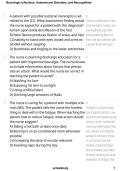
1. A patient with possible bacterial meningitis is ad- B
mitted to the ICU. What assessment finding would (Clinical manifestations of bac-
the nurse expect for a patient with this diagnosis? terial meningitis include a pos-
A) Pain upon ankle dorsiflexion of the foot itive Brudzinskis sign. Neck
B) Neck flexion produces flexion of knees and hips flexion producing flexion of
C) Inability to stand with eyes closed and arms ex- knees and hips correlates with
tended without swaying a positive Brudzinskis sign)
D) Numbness and tingling in the lower extremities
2. The nurse is planning discharge education for a A
patient with trigeminal neuralgia. The nurse knows
to include information about factors that precipi-
tate an attack. What would the nurse be correct in
teaching the patient to avoid?
A) Washing his face
B) Exposing his skin to sunlight
C) Using artificial tears
D) Drinking large amounts of fluids
3. The nurse is caring for a patient with multiple scle- B
rosis (MS). The patient tells the nurse the hardest (Fatigue is a common symp-
thing to deal with is the fatigue. When teaching the tom of patients with MS. Low-
patient how to reduce fatigue, what action should ering the body temperature by
the nurse suggest? resting in an air- conditioned
A) Taking a hot bath at least once daily room may relieve fatigue; how-
B) Resting in an air-conditioned room whenever ever, extreme cold should be
possible avoided. A hot bath or show-
C) Increasing the dose of muscle relaxants er can increase body tem-
D) Avoiding naps during the day perature, producing fatigue.
Muscle relaxants, prescribed
to reduce spasticity, can cause
drowsiness and fatigue. Plan-
actualstudy 1
, Neurologic Infections, Autoimmune Disorders, and Neuropathies
Neurologic Infections, Autoimmune Disorders, and Neuropathies
Study online at https://quizlet.com/_68a5ey
ning for frequent rest peri-
ods and naps can relieve fa-
tigue. Other measures to re-
duce fatigue in the patient with
MS include treating depres-
sion, using occupational ther-
apy to learn energy conserva-
tion techniques, and reducing
spasticity.)
4. A patient with Guillain-Barr syndrome has experi- C
enced a sharp decline in vital capacity. What is the (For the patient with Guil-
nurses most appropriate action? lain-Barr syndrome, mechan-
A) Administer bronchodilators as ordered. ical ventilation is required if
B) Remind the patient of the importance of deep the vital capacity falls, making
breathing and coughing exercises. spontaneous breathing im-
C) Prepare to assist with intubation. possible and tissue oxygena-
D) Administer supplementary oxygen by nasal can- tion inadequate. Each of the
nula. other listed actions is likely in-
sufficient to meet the patients
oxygenation needs.)
5. A patient diagnosed with Bells palsy is being cared A
for on an outpatient basis. During health education,
the nurse should promote which of the following
actions?
A) Applying a protective eye shield at night
B) Chewing on the affected side to prevent unilater-
al neglect
C) Avoiding the use of analgesics whenever possi-
ble
D) Avoiding brushing the teeth
actualstudy 2
Neurologic Infections, Autoimmune Disorders, and Neuropathies
Study online at https://quizlet.com/_68a5ey
1. A patient with possible bacterial meningitis is ad- B
mitted to the ICU. What assessment finding would (Clinical manifestations of bac-
the nurse expect for a patient with this diagnosis? terial meningitis include a pos-
A) Pain upon ankle dorsiflexion of the foot itive Brudzinskis sign. Neck
B) Neck flexion produces flexion of knees and hips flexion producing flexion of
C) Inability to stand with eyes closed and arms ex- knees and hips correlates with
tended without swaying a positive Brudzinskis sign)
D) Numbness and tingling in the lower extremities
2. The nurse is planning discharge education for a A
patient with trigeminal neuralgia. The nurse knows
to include information about factors that precipi-
tate an attack. What would the nurse be correct in
teaching the patient to avoid?
A) Washing his face
B) Exposing his skin to sunlight
C) Using artificial tears
D) Drinking large amounts of fluids
3. The nurse is caring for a patient with multiple scle- B
rosis (MS). The patient tells the nurse the hardest (Fatigue is a common symp-
thing to deal with is the fatigue. When teaching the tom of patients with MS. Low-
patient how to reduce fatigue, what action should ering the body temperature by
the nurse suggest? resting in an air- conditioned
A) Taking a hot bath at least once daily room may relieve fatigue; how-
B) Resting in an air-conditioned room whenever ever, extreme cold should be
possible avoided. A hot bath or show-
C) Increasing the dose of muscle relaxants er can increase body tem-
D) Avoiding naps during the day perature, producing fatigue.
Muscle relaxants, prescribed
to reduce spasticity, can cause
drowsiness and fatigue. Plan-
actualstudy 1
, Neurologic Infections, Autoimmune Disorders, and Neuropathies
Neurologic Infections, Autoimmune Disorders, and Neuropathies
Study online at https://quizlet.com/_68a5ey
ning for frequent rest peri-
ods and naps can relieve fa-
tigue. Other measures to re-
duce fatigue in the patient with
MS include treating depres-
sion, using occupational ther-
apy to learn energy conserva-
tion techniques, and reducing
spasticity.)
4. A patient with Guillain-Barr syndrome has experi- C
enced a sharp decline in vital capacity. What is the (For the patient with Guil-
nurses most appropriate action? lain-Barr syndrome, mechan-
A) Administer bronchodilators as ordered. ical ventilation is required if
B) Remind the patient of the importance of deep the vital capacity falls, making
breathing and coughing exercises. spontaneous breathing im-
C) Prepare to assist with intubation. possible and tissue oxygena-
D) Administer supplementary oxygen by nasal can- tion inadequate. Each of the
nula. other listed actions is likely in-
sufficient to meet the patients
oxygenation needs.)
5. A patient diagnosed with Bells palsy is being cared A
for on an outpatient basis. During health education,
the nurse should promote which of the following
actions?
A) Applying a protective eye shield at night
B) Chewing on the affected side to prevent unilater-
al neglect
C) Avoiding the use of analgesics whenever possi-
ble
D) Avoiding brushing the teeth
actualstudy 2