Nervous System NCLEX Questions- Exam 3
Nervous System NCLEX Questions- Exam 3
Study online at https://quizlet.com/_7dp0z9
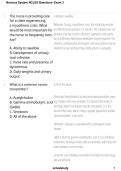
1. The nurse is providing care A. Ability to swallow
for a client experiencing
a myasthenic crisis. What Rationale: During a myasthenic crisis, the respiratory muscles
would be most important for are affected and aspiration is a concern. This compromises res-
the nurse to frequently mon- pirations and may result in infections, aspiration, and respira-
itor? tory insufficiency. Mechanical ventilation may be required. The
immune, cardiovascular, and hepatic and renal systems may be
A. Ability to swallow involved but are not the primary body systems in jeopardy.
B. Development of urinary
tract infection
C. Pulse rate and presence of
dystrthmias
D. Daily weights and urinary
output
2. What is a common neuro- D. All of the above
transmitter?
A. Acetylcholine -Rationale: Acetylcholine is an excitatory neurotransmitter, mean-
B. Gamma-aminobutyric acid ing it makes cells more excitable. It is found in the nerves in
(GABA) the body, where it stimulates muscles and glands. It is also
C. Serotonin found in the brain, where it helps regulate dopamine (another
D. All of the above neurotransmitter) in the brain.
Alzheimer's disease is associated with a shortage of acetyl-
choline.
GABA is short for gamma-aminobutyric acid. It is an inhibitory
transmitter, meaning it makes cells less excitable, and it helps the
brain maintain muscle control.
Serotonin is an inhibitory transmitter that helps the brain regu-
late acetylcholine.
1/8
actualstudy 1
, Nervous System NCLEX Questions- Exam 3
Nervous System NCLEX Questions- Exam 3
Study online at https://quizlet.com/_7dp0z9
3. Acetylcholine(ACh) is a neu- A. Myasthenia gravis
rotransmitter that provides
for communication between Rationale: In myasthenia gravis, the immune system creates an
muscles and nerves. When antibody that attacks acetylcholine receptors of the muscle cells.
there is a problem with the When acetylcholine binds to the acetylcholine receptors of the
interaction between acetyl- muscle cells, it causes them to contract. When an antibody blocks
choline and the acetylcholine this binding, the cell fails to contract or contracts only weakly.
receptor sites on the mus- This can cause drooping eyelids, weak eye muscles, and fatigue
cles, which condition(s) can of affected muscles after exercise.
occur?
A. Myasthenia gravis
B. Botulism
C. Multiple sclerosis
D. A and B
4. Dopamine is an important C. Parkinson's disease
neurotransmitter. Which dis-
ease or disorder results when Rationale: Parkinson's is the result of the loss of dopamine-pro-
the neurons in the brain that ducing brain cells. Dopamine is a chemical messenger responsi-
produce dopamine die? ble for transmitting signals within the brain. Parkinson's disease
occurs when certain nerve cells, or neurons, die or become
A. Multiple sclerosis (MS) impaired. Normally, these neurons produce dopamine. Loss of
B. Lou Gehrig's disease (amy- dopamine causes the nerve cells to fire out of control, leaving
otrophic lateral sclerosis) patients unable to direct or control their movement in a normal
C. Parkinson's disease manner.
D. Seizure disorder
5. A client is admitted with B. These are common symptoms of Parkinson's disease that pro-
Parkinson's disease. The duce an undesired façade of an alert and responsive individual
client's face is expressionless,
and the client's speech is mo- Rationale: The nurse should recognize that these are common
2/8
actualstudy 2
Nervous System NCLEX Questions- Exam 3
Study online at https://quizlet.com/_7dp0z9
1. The nurse is providing care A. Ability to swallow
for a client experiencing
a myasthenic crisis. What Rationale: During a myasthenic crisis, the respiratory muscles
would be most important for are affected and aspiration is a concern. This compromises res-
the nurse to frequently mon- pirations and may result in infections, aspiration, and respira-
itor? tory insufficiency. Mechanical ventilation may be required. The
immune, cardiovascular, and hepatic and renal systems may be
A. Ability to swallow involved but are not the primary body systems in jeopardy.
B. Development of urinary
tract infection
C. Pulse rate and presence of
dystrthmias
D. Daily weights and urinary
output
2. What is a common neuro- D. All of the above
transmitter?
A. Acetylcholine -Rationale: Acetylcholine is an excitatory neurotransmitter, mean-
B. Gamma-aminobutyric acid ing it makes cells more excitable. It is found in the nerves in
(GABA) the body, where it stimulates muscles and glands. It is also
C. Serotonin found in the brain, where it helps regulate dopamine (another
D. All of the above neurotransmitter) in the brain.
Alzheimer's disease is associated with a shortage of acetyl-
choline.
GABA is short for gamma-aminobutyric acid. It is an inhibitory
transmitter, meaning it makes cells less excitable, and it helps the
brain maintain muscle control.
Serotonin is an inhibitory transmitter that helps the brain regu-
late acetylcholine.
1/8
actualstudy 1
, Nervous System NCLEX Questions- Exam 3
Nervous System NCLEX Questions- Exam 3
Study online at https://quizlet.com/_7dp0z9
3. Acetylcholine(ACh) is a neu- A. Myasthenia gravis
rotransmitter that provides
for communication between Rationale: In myasthenia gravis, the immune system creates an
muscles and nerves. When antibody that attacks acetylcholine receptors of the muscle cells.
there is a problem with the When acetylcholine binds to the acetylcholine receptors of the
interaction between acetyl- muscle cells, it causes them to contract. When an antibody blocks
choline and the acetylcholine this binding, the cell fails to contract or contracts only weakly.
receptor sites on the mus- This can cause drooping eyelids, weak eye muscles, and fatigue
cles, which condition(s) can of affected muscles after exercise.
occur?
A. Myasthenia gravis
B. Botulism
C. Multiple sclerosis
D. A and B
4. Dopamine is an important C. Parkinson's disease
neurotransmitter. Which dis-
ease or disorder results when Rationale: Parkinson's is the result of the loss of dopamine-pro-
the neurons in the brain that ducing brain cells. Dopamine is a chemical messenger responsi-
produce dopamine die? ble for transmitting signals within the brain. Parkinson's disease
occurs when certain nerve cells, or neurons, die or become
A. Multiple sclerosis (MS) impaired. Normally, these neurons produce dopamine. Loss of
B. Lou Gehrig's disease (amy- dopamine causes the nerve cells to fire out of control, leaving
otrophic lateral sclerosis) patients unable to direct or control their movement in a normal
C. Parkinson's disease manner.
D. Seizure disorder
5. A client is admitted with B. These are common symptoms of Parkinson's disease that pro-
Parkinson's disease. The duce an undesired façade of an alert and responsive individual
client's face is expressionless,
and the client's speech is mo- Rationale: The nurse should recognize that these are common
2/8
actualstudy 2