
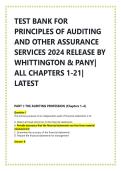
TEST BANK FOR
PRINCIPLES OF AUDITING
AND OTHER ASSURANCE
SERVICES 2024 RELEASE BY
WHITTINGTON & PANY|
ALL CHAPTERS 1-21|
LATEST
PART I: THE AUDITING PROFESSION (Chapters 1–4)
Question 1
The primary purpose of an independent audit of financial statements is to:
A. Detect all fraud and errors in the financial statements
B. Provide assurance that the financial statements are free from material
misstatement
C. Guarantee the accuracy of the financial statements
D. Prepare the financial statements for management
Answer: B
,Rationale: The primary purpose of an independent audit is to provide reasonable
assurance that the financial statements are free from material misstatement, whether
due to fraud or error. Audits do not guarantee accuracy or detect all fraud .
Question 2
Which of the following best describes the relationship between the auditor and
management?
A. The auditor is an employee of management
B. The auditor is independent of management and reports to the shareholders
C. The auditor is responsible for preparing the financial statements
D. The auditor is a member of the board of directors
Answer: B
Rationale: The auditor is independent of management and reports to the shareholders
(or the audit committee of the board). Independence is a cornerstone of the auditing
profession .
Question 3
The "credibility crisis" in the early 2000s was largely caused by:
A. The passage of the Sarbanes-Oxley Act
B. Accounting irregularities and financial statement fraud at companies like Enron
and WorldCom
C. The creation of the PCAOB
D. The adoption of international financial reporting standards
Answer: B
Rationale: The credibility crisis (2000–2002) was driven by high-profile corporate
scandals (Enron, WorldCom, etc.) where companies restated previously issued financial
statements due to accounting irregularities and fraud .
,Question 4
Which of the following is NOT an objective of financial reporting?
A. Providing information useful for investment decisions
B. Providing information useful for credit decisions
C. Providing assurance that management is acting ethically
D. Providing information about the entity's resources and claims
Answer: C
Rationale: An independent audit provides multiple benefits, including reduced risk of
fraud, improved credibility of financial statements, and enhanced investor confidence in
the capital markets. Providing assurance that management is acting ethically is not an
objective of financial reporting .
Question 5
The Sarbanes-Oxley Act of 2002 was enacted primarily to:
A. Reduce corporate taxes
B. Improve corporate governance and financial reporting
C. Eliminate the audit profession
D. Increase auditor fees
Answer: B
Rationale: The Sarbanes-Oxley Act (SOX) was enacted to improve corporate
governance, strengthen internal controls, and enhance the accuracy and reliability of
financial reporting following the corporate scandals of the early 2000s .
Question 6
Which of the following is a major difference between audits of public companies and
private companies?
A. Public company audits are governed by PCAOB standards; private company
audits are governed by AICPA standards
B. Public company audits are not required
, C. Private company audits are governed by PCAOB standards
D. There is no difference
Answer: A
Rationale: Audits of public companies are governed by PCAOB standards, while audits
of private companies are governed by AICPA standards (generally accepted auditing
standards, GAAS) .
Question 7
The Public Company Accounting Oversight Board (PCAOB) has the authority to:
A. Establish or adopt auditing, quality control, ethics, and independence standards
for public companies
B. Set accounting standards for all companies
C. License CPAs in all states
D. Prepare financial statements for public companies
Answer: A
Rationale: The PCAOB has the authority to establish or adopt auditing, quality control,
ethics, independence, and other standards relating to the preparation of audit reports
for public companies. For non-public companies, the AICPA establishes auditing
standards through Statements on Auditing Standards (SASs) .
Question 8
Which of the following is NOT a category of Generally Accepted Auditing Standards?
A. General Standards
B. Standards of Field Work
C. Standards of Reporting
D. Standards of Evidence
Answer: D
PRINCIPLES OF AUDITING
AND OTHER ASSURANCE
SERVICES 2024 RELEASE BY
WHITTINGTON & PANY|
ALL CHAPTERS 1-21|
LATEST
PART I: THE AUDITING PROFESSION (Chapters 1–4)
Question 1
The primary purpose of an independent audit of financial statements is to:
A. Detect all fraud and errors in the financial statements
B. Provide assurance that the financial statements are free from material
misstatement
C. Guarantee the accuracy of the financial statements
D. Prepare the financial statements for management
Answer: B
,Rationale: The primary purpose of an independent audit is to provide reasonable
assurance that the financial statements are free from material misstatement, whether
due to fraud or error. Audits do not guarantee accuracy or detect all fraud .
Question 2
Which of the following best describes the relationship between the auditor and
management?
A. The auditor is an employee of management
B. The auditor is independent of management and reports to the shareholders
C. The auditor is responsible for preparing the financial statements
D. The auditor is a member of the board of directors
Answer: B
Rationale: The auditor is independent of management and reports to the shareholders
(or the audit committee of the board). Independence is a cornerstone of the auditing
profession .
Question 3
The "credibility crisis" in the early 2000s was largely caused by:
A. The passage of the Sarbanes-Oxley Act
B. Accounting irregularities and financial statement fraud at companies like Enron
and WorldCom
C. The creation of the PCAOB
D. The adoption of international financial reporting standards
Answer: B
Rationale: The credibility crisis (2000–2002) was driven by high-profile corporate
scandals (Enron, WorldCom, etc.) where companies restated previously issued financial
statements due to accounting irregularities and fraud .
,Question 4
Which of the following is NOT an objective of financial reporting?
A. Providing information useful for investment decisions
B. Providing information useful for credit decisions
C. Providing assurance that management is acting ethically
D. Providing information about the entity's resources and claims
Answer: C
Rationale: An independent audit provides multiple benefits, including reduced risk of
fraud, improved credibility of financial statements, and enhanced investor confidence in
the capital markets. Providing assurance that management is acting ethically is not an
objective of financial reporting .
Question 5
The Sarbanes-Oxley Act of 2002 was enacted primarily to:
A. Reduce corporate taxes
B. Improve corporate governance and financial reporting
C. Eliminate the audit profession
D. Increase auditor fees
Answer: B
Rationale: The Sarbanes-Oxley Act (SOX) was enacted to improve corporate
governance, strengthen internal controls, and enhance the accuracy and reliability of
financial reporting following the corporate scandals of the early 2000s .
Question 6
Which of the following is a major difference between audits of public companies and
private companies?
A. Public company audits are governed by PCAOB standards; private company
audits are governed by AICPA standards
B. Public company audits are not required
, C. Private company audits are governed by PCAOB standards
D. There is no difference
Answer: A
Rationale: Audits of public companies are governed by PCAOB standards, while audits
of private companies are governed by AICPA standards (generally accepted auditing
standards, GAAS) .
Question 7
The Public Company Accounting Oversight Board (PCAOB) has the authority to:
A. Establish or adopt auditing, quality control, ethics, and independence standards
for public companies
B. Set accounting standards for all companies
C. License CPAs in all states
D. Prepare financial statements for public companies
Answer: A
Rationale: The PCAOB has the authority to establish or adopt auditing, quality control,
ethics, independence, and other standards relating to the preparation of audit reports
for public companies. For non-public companies, the AICPA establishes auditing
standards through Statements on Auditing Standards (SASs) .
Question 8
Which of the following is NOT a category of Generally Accepted Auditing Standards?
A. General Standards
B. Standards of Field Work
C. Standards of Reporting
D. Standards of Evidence
Answer: D


