

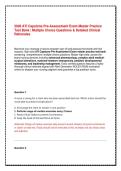
2026 ATI Capstone Pre-Assessment Exam Master Practice
Test Bank | Multiple Choice Questions & Detailed Clinical
Rationales
Maximize your chances of secure program sign-off and passing the boards with this
massive, high-yield ATI Capstone Pre-Assessment Exam master practice test bank
containing comprehensive multiple-choice questions. Master high-yield, across-the-
board nursing domains including advanced pharmacology, complex adult medical-
surgical alterations, maternal-newborn emergencies, pediatric developmental
milestones, and leadership management. Every verified question features a highly
thorough clinical rationale aligned with Next Generation NCLEX (NGN) evaluation
criteria to sharpen your nursing judgment and guarantee a top predictor score.
Question 1
A nurse is caring for a client who has been prescribed bed rest. Which action should the
nurse take to prevent complications?
A. Encourage the client to remain in one position
B. Perform range-of-motion exercises every 2 hours
C. Restrict fluid intake to prevent incontinence
D. Keep the head of the bed flat at all times
Rationale: Range-of-motion exercises help prevent muscle atrophy and joint contractures
in clients on bed rest. Fluids should not be restricted as this increases risk of urinary stasis
and infection.
Question 2
,A nurse is assessing a client who has dehydration. Which finding should the nurse
expect?
A. Bounding pulse
B. Poor skin turgor
C. Crackles in the lungs
D. Weight gain
Rationale: Poor skin turgor is a classic sign of dehydration due to loss of interstitial fluid.
Bounding pulse, crackles, and weight gain are signs of fluid overload.
Question 3
A nurse is preparing to administer digoxin to a client. Which finding should the nurse
report before giving the medication?
A. Heart rate of 88/min
B. Heart rate of 52/min
C. Blood pressure of 118/76 mm Hg
D. Respiratory rate of 18/min
Rationale: Digoxin should be withheld if the apical heart rate is below 60/min in adults
due to risk of bradycardia and toxicity.
Question 4
A nurse is teaching a client about a low-sodium diet. Which food should the nurse
instruct the client to avoid?
A. Fresh apples
B. Canned soup
C. Brown rice
D. Green beans
Rationale: Canned soups are high in sodium due to preservation processes. Fresh fruits,
whole grains, and fresh vegetables are low in sodium.
,Question 5
A nurse is caring for a client who has a new prescription for warfarin. Which laboratory
value should the nurse monitor?
A. aPTT
B. INR
C. Platelet count
D. Hemoglobin
Rationale: INR is the standard laboratory test used to monitor warfarin therapy.
Therapeutic range is typically 2.0 to 3.0.
Question 6
A nurse is assessing a client who has heart failure. Which finding indicates fluid
overload?
A. Crackles in the lungs
B. Dry mucous membranes
C. Decreased urine output
D. Flat neck veins
Rationale: Crackles indicate fluid accumulation in the alveoli. Dry mucous membranes
suggest dehydration, not overload.
Question 7
A nurse is caring for a client who is postoperative following abdominal surgery. Which
action should the nurse take first?
A. Administer pain medication
B. Assess the surgical dressing
, C. Ambulate the client
D. Encourage coughing
Rationale: Assessment is always the first step in the nursing process. The nurse must assess
the surgical site before intervening.
Question 8
A nurse is teaching a client about insulin administration. Which statement by the client
indicates understanding?
A. "I will store my insulin in the freezer."
B. "I will rotate injection sites to prevent tissue damage."
C. "I will only use my abdomen for injections."
D. "I will shake the insulin vigorously before use."
Rationale: Rotating injection sites prevents lipohypertrophy. Insulin should be stored in the
refrigerator, not the freezer, and should be rolled, not shaken.
Question 9
A nurse is assessing a client who has hypoxia. Which finding should the nurse expect?
A. Pink mucous membranes
B. Confusion and restlessness
C. Increased urine output
D. Bradycardia
Rationale: Early signs of hypoxia include confusion, restlessness, and anxiety due to
decreased oxygen to the brain. Tachycardia, not bradycardia, is common.
Question 10
Test Bank | Multiple Choice Questions & Detailed Clinical
Rationales
Maximize your chances of secure program sign-off and passing the boards with this
massive, high-yield ATI Capstone Pre-Assessment Exam master practice test bank
containing comprehensive multiple-choice questions. Master high-yield, across-the-
board nursing domains including advanced pharmacology, complex adult medical-
surgical alterations, maternal-newborn emergencies, pediatric developmental
milestones, and leadership management. Every verified question features a highly
thorough clinical rationale aligned with Next Generation NCLEX (NGN) evaluation
criteria to sharpen your nursing judgment and guarantee a top predictor score.
Question 1
A nurse is caring for a client who has been prescribed bed rest. Which action should the
nurse take to prevent complications?
A. Encourage the client to remain in one position
B. Perform range-of-motion exercises every 2 hours
C. Restrict fluid intake to prevent incontinence
D. Keep the head of the bed flat at all times
Rationale: Range-of-motion exercises help prevent muscle atrophy and joint contractures
in clients on bed rest. Fluids should not be restricted as this increases risk of urinary stasis
and infection.
Question 2
,A nurse is assessing a client who has dehydration. Which finding should the nurse
expect?
A. Bounding pulse
B. Poor skin turgor
C. Crackles in the lungs
D. Weight gain
Rationale: Poor skin turgor is a classic sign of dehydration due to loss of interstitial fluid.
Bounding pulse, crackles, and weight gain are signs of fluid overload.
Question 3
A nurse is preparing to administer digoxin to a client. Which finding should the nurse
report before giving the medication?
A. Heart rate of 88/min
B. Heart rate of 52/min
C. Blood pressure of 118/76 mm Hg
D. Respiratory rate of 18/min
Rationale: Digoxin should be withheld if the apical heart rate is below 60/min in adults
due to risk of bradycardia and toxicity.
Question 4
A nurse is teaching a client about a low-sodium diet. Which food should the nurse
instruct the client to avoid?
A. Fresh apples
B. Canned soup
C. Brown rice
D. Green beans
Rationale: Canned soups are high in sodium due to preservation processes. Fresh fruits,
whole grains, and fresh vegetables are low in sodium.
,Question 5
A nurse is caring for a client who has a new prescription for warfarin. Which laboratory
value should the nurse monitor?
A. aPTT
B. INR
C. Platelet count
D. Hemoglobin
Rationale: INR is the standard laboratory test used to monitor warfarin therapy.
Therapeutic range is typically 2.0 to 3.0.
Question 6
A nurse is assessing a client who has heart failure. Which finding indicates fluid
overload?
A. Crackles in the lungs
B. Dry mucous membranes
C. Decreased urine output
D. Flat neck veins
Rationale: Crackles indicate fluid accumulation in the alveoli. Dry mucous membranes
suggest dehydration, not overload.
Question 7
A nurse is caring for a client who is postoperative following abdominal surgery. Which
action should the nurse take first?
A. Administer pain medication
B. Assess the surgical dressing
, C. Ambulate the client
D. Encourage coughing
Rationale: Assessment is always the first step in the nursing process. The nurse must assess
the surgical site before intervening.
Question 8
A nurse is teaching a client about insulin administration. Which statement by the client
indicates understanding?
A. "I will store my insulin in the freezer."
B. "I will rotate injection sites to prevent tissue damage."
C. "I will only use my abdomen for injections."
D. "I will shake the insulin vigorously before use."
Rationale: Rotating injection sites prevents lipohypertrophy. Insulin should be stored in the
refrigerator, not the freezer, and should be rolled, not shaken.
Question 9
A nurse is assessing a client who has hypoxia. Which finding should the nurse expect?
A. Pink mucous membranes
B. Confusion and restlessness
C. Increased urine output
D. Bradycardia
Rationale: Early signs of hypoxia include confusion, restlessness, and anxiety due to
decreased oxygen to the brain. Tachycardia, not bradycardia, is common.
Question 10


