

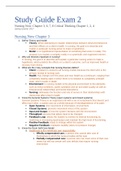
NURSING 2058-Study Guide Exam 2 Nursing Now: Chapter 3, 6, 7, 8 Critical Thinking Chapter 1, 2, 4
NURSING 2058-Study Guide Exam 2 Nursing Now: Chapter 3, 6, 7, 8 Critical Thinking Chapter 1, 2, 4 Nursing Now Chapter 3 1. Define Theory and model Theory: When attempting to explain relationships between observed behaviors and their effects on a client’s health. In nursing, the goal is to describe and explain a particular nursing action to make a hypothesis. Model: is a Hypothetical representation of something that exists in reality. The purpose is to explain a complex reality in a systematic and organized manner. 2. Why are theories important in nursing? In nursing, the goal is to describe and explain a particular nursing action to make a hypothesis, which predicts the effects on a client’s outcome, such as improved health or recovery from illness. 3. What are the 4 key concepts that nursing theories define? Client: or patient is central to all nursing models because the client who is the primary receipt of nursing care. Health: Has change over the years and now health as a continuum, ranging from completely healthy state in which there is no disease to completely unhealth state, which results in death. Environment: in nursing models is the physical environment to the elements such as living conditions, public sanitation and air and water quality as well as interpersonal relationships and social interactions. Nursing: delineates the function and role of nurses in their relationships with clients that affect client’s health 4. Know the General Systems Theory (open systems and closed systems) General Systems Theory is an organized unit with a set of components that interact and affect each other, a system acts as a whole because of interdependence of its parts Open Systems: free movement of information: environment Closed Systems: prevents movement in/out of the system Input and Output: is how the system interacts with the environment Throughput: process that allows input to be changed Feedback Loop: allows the System to monitor its internal functioning by restricting or increasing input/output and maintain the high level of functioning. Positive Feedback: leads to change within the system Negative Feedback: maintains stability (does not produce change) 5. Know the Orem Self-Care Model a. Healthcare is the individuals own responsibility i. Wholly compensated care: a person who cannot take care of themselves in which the nurse provides all the care ii. Partially compensated care: a person who can meet some of their own needs but still has certain self care deficits that require nursing intervention iii. Supportive developmental care: clients who can meet all their own needs and require few, if any nursing care iv. Promotes highest level of functioning 6. Know the King Model a. King model of goal attainment i. Environment: personal, social, interactional; nursing interacts in all three ii. Dynamic process 7. Know the Watson model of Human Caring Philosophical approach to balance impersonal aspects of nursing with humanistic belief in life. Only theorist that recognizes spirituality 8. Know the Neuman Health-Care Systems Model (including stressor and levels of intervention) Client and environment: systems theory: holistic view Primary, secondary and tertiary intervention 9. Know what Middle Range Theories are Concrete concepts that lie between a working hypothesis and a nursing theory; less comprehensive and more focused than the major nursing theories Nursing Now , Chapter 6: 1. Define the following terms: Values: are ideals or concepts that give meaning to life, come from societal norms, religion and family morals fundamental standards of right and wrong that an individual learns and internalizes, usually in the early stages of development. Often based on religion, although society may impact it. Laws: rules of social conduct made by humans to protect society, and these are based on fairness and justice Ethics: goes beyond the law, which has as its primary underlying principle the preservation of society. Usually a system of value behaviors and beliefs; they serve to protect the individual’s rights. Ethical code: is a written list of a profession’s values and standards of conduct. It provides a framework for decision making for the profession. ethical dilemma: situation that requires an individual to make a choice between two equally unfavorable alternatives ethical accountability: euthanasia: Painless killing of a patient that is suffering from fatal disease (good or peaceful death) autonomy: the right of self-determination, independence and freedom beneficence: primary goal of healthcare as doing good for clients under our care. Holistic approach nonmaleficence: that you do no harm to your client, either intentiona
Document information
- Uploaded on
- July 28, 2021
- Number of pages
- 11
- Written in
- 2020/2021
- Type
- Exam (elaborations)
- Contains
- Questions & answers


