Crystal Field Theory
Bonding Theories:
▪ Valence bond theory fails to explain colour and magnetism.
▪ There needs to be a bonding theory that explains these properties and explain
trends in lattice enthalpies and hydration enthalpies.
Crystal Field Theory:
▪ A very simple ionic model which
rationalises colour and
magnetism as well as lattice
and hydration enthalpies.
▪ Molecular orbital theory can
also be used but it a more
complex and comprehensive
theory.
▪ The theory focuses only on the
interactions of ligands with
metal d-orbitals. All other
Figure 1 d-orbitals
orbitals are ignored.
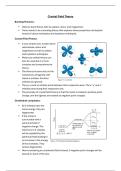
▪ The xy, xz and yz orbitals point between their respective axes. The x 2-y2 and z2
orbitals point along their respective axis.
▪ The principle of crystal field theory is that the metal is treated a positive point
charge, and the ligands are treated as negative point charges.
Octahedral complexes:
▪ All 5 orbitals have the
same energy, they are
degenerate.
▪ If the metal is
surrounded with a
spherical field of
negative charge. The
electrons in d-orbitals
will be repelled by the
spherical field leading to
an increase in the energy Figure 2 Octahedral Splitting Diagram
of the d orbitals. They
remain degenerate.
▪ Now considering an octahedral field instead, 6 negative point charges will be
placed on each of the axis.
, ▪ The lobes of the dx2-y2 and the dz2 orbitals lie directly along the axes. This means
they are closest to the point charges. This means they are raised in
energy/destabilised.
▪ The lobes of the other d orbitals point between the axes which means they are
lowered in energies / stabilised.
▪ This results in a splitting from the spherical field when moving to the octahedral
field. The stabilised dxy, dxz and the dyz orbitals are lowered in energy compared to
the spherical field and are called the t2g orbitals.
▪ The dx2-y2 and the dz2 orbitals are destabilised so are raised in energy relative to
the spherical field and are called the eg orbitals.
▪ There is a barycentre energy which is the zero reference point.
▪ The energy difference between two sets of orbitals is the crystal field splitting
energy, O. The eg orbitals are raised in energy by 3/5 O (+0.6 O) and the t2g
orbitals are lowered in energy by 2/5 O (-0.4 O).
▪ The net effect is to preserve the barycentre energy.
Tetrahedral Complexes:
▪ There are 5 degenerate orbitals and when
put in a spherical field will all be
destabilised but are still degenerate.
▪ Replacing the spherical field with the 4-
point charges, No orbitals point directly at
the ligands, but the xy, xz and yz orbitals
interact more strongly with the point
charges as they are closer to them. Figure 3 Tetrahedral Splitting Diagram
▪ This results in the dxy, dxz and the dyz orbitals
being destabilised so they become higher in energy (these are called the t2 set)
and the dx2-y2 and the dz2 orbitals are stabilised so they are lower in energy (these
are called the e set).
▪ The difference between the t2 orbitals and the e orbitals is T. The t2 orbitals are
raised in energy by 2/5 T (or +0.4T) and the e orbitals are lowered in energy by
3/5 T (or -0.6T) relative to the barycentre.
▪ T it always smaller than O.
▪ T = 4/9 O.
▪ T is smaller because there are only 4 ligands, not 6. This means that there is
less stabilisation and destabilisation. The ligands also don’t point directly at any
of the orbitals, again lowering the effect.
Bonding Theories:
▪ Valence bond theory fails to explain colour and magnetism.
▪ There needs to be a bonding theory that explains these properties and explain
trends in lattice enthalpies and hydration enthalpies.
Crystal Field Theory:
▪ A very simple ionic model which
rationalises colour and
magnetism as well as lattice
and hydration enthalpies.
▪ Molecular orbital theory can
also be used but it a more
complex and comprehensive
theory.
▪ The theory focuses only on the
interactions of ligands with
metal d-orbitals. All other
Figure 1 d-orbitals
orbitals are ignored.
▪ The xy, xz and yz orbitals point between their respective axes. The x 2-y2 and z2
orbitals point along their respective axis.
▪ The principle of crystal field theory is that the metal is treated a positive point
charge, and the ligands are treated as negative point charges.
Octahedral complexes:
▪ All 5 orbitals have the
same energy, they are
degenerate.
▪ If the metal is
surrounded with a
spherical field of
negative charge. The
electrons in d-orbitals
will be repelled by the
spherical field leading to
an increase in the energy Figure 2 Octahedral Splitting Diagram
of the d orbitals. They
remain degenerate.
▪ Now considering an octahedral field instead, 6 negative point charges will be
placed on each of the axis.
, ▪ The lobes of the dx2-y2 and the dz2 orbitals lie directly along the axes. This means
they are closest to the point charges. This means they are raised in
energy/destabilised.
▪ The lobes of the other d orbitals point between the axes which means they are
lowered in energies / stabilised.
▪ This results in a splitting from the spherical field when moving to the octahedral
field. The stabilised dxy, dxz and the dyz orbitals are lowered in energy compared to
the spherical field and are called the t2g orbitals.
▪ The dx2-y2 and the dz2 orbitals are destabilised so are raised in energy relative to
the spherical field and are called the eg orbitals.
▪ There is a barycentre energy which is the zero reference point.
▪ The energy difference between two sets of orbitals is the crystal field splitting
energy, O. The eg orbitals are raised in energy by 3/5 O (+0.6 O) and the t2g
orbitals are lowered in energy by 2/5 O (-0.4 O).
▪ The net effect is to preserve the barycentre energy.
Tetrahedral Complexes:
▪ There are 5 degenerate orbitals and when
put in a spherical field will all be
destabilised but are still degenerate.
▪ Replacing the spherical field with the 4-
point charges, No orbitals point directly at
the ligands, but the xy, xz and yz orbitals
interact more strongly with the point
charges as they are closer to them. Figure 3 Tetrahedral Splitting Diagram
▪ This results in the dxy, dxz and the dyz orbitals
being destabilised so they become higher in energy (these are called the t2 set)
and the dx2-y2 and the dz2 orbitals are stabilised so they are lower in energy (these
are called the e set).
▪ The difference between the t2 orbitals and the e orbitals is T. The t2 orbitals are
raised in energy by 2/5 T (or +0.4T) and the e orbitals are lowered in energy by
3/5 T (or -0.6T) relative to the barycentre.
▪ T it always smaller than O.
▪ T = 4/9 O.
▪ T is smaller because there are only 4 ligands, not 6. This means that there is
less stabilisation and destabilisation. The ligands also don’t point directly at any
of the orbitals, again lowering the effect.