
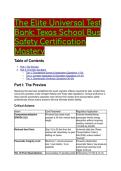
The Elite Universal Test
Bank: Texas School Bus
Safety Certification
Mastery
Table of Contents
1. Part I: The Preview
2. Part II: The Elite Test Bank
○ Tier 1: Foundational Syntax & Application (Questions 1–18)
○ Tier 2: Complex Application & Simulation (Questions 19–37)
○ Tier 3: Grandmaster Synthesis (Questions 38–55)
Part I: The Preview
Mastering this test bank establishes the exact cognitive reflexes required for elite, incident-free
school bus operation under stringent federal and Texas state regulations. Tactical proficiency in
these specific parameters separates mere drivers from master-level transportation safety
professionals whose actions preserve life and eliminate district liability.
Critical Axioms
Axiom Core Parameter Regulatory Application
Compartmentalization All school bus seats must Ensures forward-facing
(FMVSS 222) possess a 24-inch vertical back passenger kinetic energy
height. absorption without requiring
auxiliary restraints on buses
>10,000 lbs GVWR.
Railroad Hard Deck Stop 15 to 50 feet from the Universal state law (Texas
nearest rail; absolutely no gear Transportation Code §
shifting on tracks. 545.2535) unless marked
"exempt".
Pneumatic Integrity Limit Maximum 1-minute pressure Prevents catastrophic
loss: 3 psi (static) / 4 psi pneumatic failure; low-pressure
(applied). audio/visual warning must
trigger at 60 psi.
The 10-Point Neutralization Accumulating 10 penalty points Enforced by 37 TAC § 14.14;
,Axiom Core Parameter Regulatory Application
on the SBT-12 renders a driver crashes automatically assign 2
ineligible. points pending internal review.
WTORS Triangulation 4-point strap tiedown, 3-point Strict compliance with FMVSS
occupant restraint, 222 S5.4; unconditionally
forward-facing only. prohibits side-facing transport.
Part II: The Elite Test Bank
Tier 1: Foundational Syntax & Application
Q1: An operator drives a fully inspected commercial school bus on a United States numbered
highway located outside an urban district. Based on the principles of Texas Transportation Code
§ 545.352, which action is the MAXIMUM lawful speed limit? A) 50 miles per hour B) 55 miles
per hour C) 60 miles per hour D) 70 miles per hour
● Answer: C (60 miles per hour)
● Distractor Analysis:
○ A is incorrect: 50 mph applies only if the bus has not passed a commercial
inspection or is operating on a non-numbered highway.
○ B is incorrect: 55 mph is a legacy federal mandate that no longer dictates modern
Texas commercial speed limits.
○ D is incorrect: 70 mph applies strictly to standard passenger vehicles, never to
commercial school buses.
The Mentor's Analysis: Texas stratifies school bus speeds based on vehicle inspection status
and roadway classification. When facing highway routing, the immediate priority is locking your
speed at 60 mph on US/State highways for inspected commercial buses. By utilizing precise
vehicle classification, you bypass the common trap of generalized passenger highway speeds.
Professional Intuition: Always correlate maximum speed limits directly to your vehicle's
commercial inspection status and the highway's numerical designation.
Q2: A driver approaches a railroad grade crossing in a standard Type C school bus. Based on
the principles of Texas Transportation Code § 545.2535, which action is the REQUIRED
stopping distance parameter? A) Not closer than 10 feet or farther than 40 feet B) Not closer
than 15 feet or farther than 50 feet C) Not closer than 20 feet or farther than 60 feet D) Not
closer than 25 feet or farther than 75 feet
● Answer: B (Not closer than 15 feet or farther than 50 feet)
● Distractor Analysis:
○ A is incorrect: This range is entirely fabricated and places the vehicle dangerously
close to the dynamic envelope of the train.
○ C is incorrect: This represents a calculation error commonly confused with the
20-foot stop-arm radius required for passenger loading.
○ D is incorrect: This distance places the bus too far from the track to accurately
observe oncoming trains or clear the crossing efficiently.
The Mentor's Analysis: Railroad crossings demand absolute spatial precision to prevent
catastrophic lateral impacts. When facing an active crossing, the immediate priority is halting
within the strict 15-to-50-foot zone. By utilizing this precise measurement, you bypass the
common trap of stopping within the train's overhanging strike radius. Professional Intuition: The
15-50 foot boundary provides the optimal acoustic and visual angle for track clearance
without risking kinetic contact.
, Q3: A district evaluates a driver's motor vehicle record using the School Bus Driver Record
Evaluation (SBT-12). Based on the principles of the Penalty Point System, which conclusion is
CORRECT regarding mandatory disqualification? A) The driver is disqualified upon reaching 6
points. B) The driver is disqualified upon reaching 8 points. C) The driver is disqualified upon
reaching 10 points. D) The driver is disqualified upon reaching 12 points.
● Answer: C (The driver is disqualified upon reaching 10 points)
● Distractor Analysis:
○ A is incorrect: 6 points trigger a financial surcharge under the DPS Driver
Responsibility Program, not automatic operational disqualification.
○ B is incorrect: 8 points is a legacy metric used by certain private motor carriers, not
the statutory Texas state standard.
○ D is incorrect: 12 points applies to standard passenger license suspension
thresholds in other jurisdictions, delaying intervention too long.
The Mentor's Analysis: The SBT-12 penalty point system evaluates risk exposure objectively.
When facing record evaluations, the immediate priority is monitoring the hard 10-point
threshold. By utilizing proactive record monitoring, you bypass the common trap of discovering a
driver's ineligibility post-incident. Professional Intuition: 10 points equals immediate
administrative neutralization; there is no grace period for habitual risk.
Q4: An applicant undergoes a DOT physical examination to secure their medical card. Based on
the principles of 37 TAC § 14.12, which visual acuity is the MINIMUM acceptable Snellen
standard? A) 20/20 in both eyes, with a 50-degree field of vision B) 20/30 in the best eye, with a
60-degree field of vision C) 20/40 in both eyes, with a 70-degree field of vision D) 20/50 in the
best eye, with an 80-degree field of vision
● Answer: C (20/40 in both eyes, with a 70-degree field of vision)
● Distractor Analysis:
○ A is incorrect: 20/20 is optimal but not the regulatory baseline required by the
FMCSA.
○ B is incorrect: A 60-degree field fails the peripheral awareness mandate, which
requires 70 degrees.
○ D is incorrect: 20/50 visual acuity constitutes an automatic failure for unrestricted
commercial operation.
The Mentor's Analysis: Safe operation requires adequate focal and peripheral processing to
detect hazards in the danger zone. When facing physical certification, the immediate priority is
confirming 20/40 Snellen acuity and a 70-degree horizontal meridian. By utilizing exact DOT
standards, you bypass the common trap of relying on standard passenger license vision
metrics. Professional Intuition: Peripheral deficits are as disqualifying as central visual
acuity failures; both eyes must independently pass.
Q5: An operator performs an applied air brake leakage test on a Type D transit-style bus. Based
on the principles of the CDL Air Brake Test, which action is the MAXIMUM allowable pressure
drop over one minute? A) 2 psi B) 3 psi C) 4 psi D) 5 psi
● Answer: C (4 psi)
● Distractor Analysis:
○ A is incorrect: 2 psi applies to single-vehicle static tests in non-commercial contexts.
○ B is incorrect: 3 psi is the strict limit for a static test (valves pushed in, foot off the
brake).
○ D is incorrect: 5 psi exceeds the safe pneumatic loss tolerance for any heavy-duty
school bus configuration.
The Mentor's Analysis: Pneumatic integrity guarantees stopping power under maximum load.
Bank: Texas School Bus
Safety Certification
Mastery
Table of Contents
1. Part I: The Preview
2. Part II: The Elite Test Bank
○ Tier 1: Foundational Syntax & Application (Questions 1–18)
○ Tier 2: Complex Application & Simulation (Questions 19–37)
○ Tier 3: Grandmaster Synthesis (Questions 38–55)
Part I: The Preview
Mastering this test bank establishes the exact cognitive reflexes required for elite, incident-free
school bus operation under stringent federal and Texas state regulations. Tactical proficiency in
these specific parameters separates mere drivers from master-level transportation safety
professionals whose actions preserve life and eliminate district liability.
Critical Axioms
Axiom Core Parameter Regulatory Application
Compartmentalization All school bus seats must Ensures forward-facing
(FMVSS 222) possess a 24-inch vertical back passenger kinetic energy
height. absorption without requiring
auxiliary restraints on buses
>10,000 lbs GVWR.
Railroad Hard Deck Stop 15 to 50 feet from the Universal state law (Texas
nearest rail; absolutely no gear Transportation Code §
shifting on tracks. 545.2535) unless marked
"exempt".
Pneumatic Integrity Limit Maximum 1-minute pressure Prevents catastrophic
loss: 3 psi (static) / 4 psi pneumatic failure; low-pressure
(applied). audio/visual warning must
trigger at 60 psi.
The 10-Point Neutralization Accumulating 10 penalty points Enforced by 37 TAC § 14.14;
,Axiom Core Parameter Regulatory Application
on the SBT-12 renders a driver crashes automatically assign 2
ineligible. points pending internal review.
WTORS Triangulation 4-point strap tiedown, 3-point Strict compliance with FMVSS
occupant restraint, 222 S5.4; unconditionally
forward-facing only. prohibits side-facing transport.
Part II: The Elite Test Bank
Tier 1: Foundational Syntax & Application
Q1: An operator drives a fully inspected commercial school bus on a United States numbered
highway located outside an urban district. Based on the principles of Texas Transportation Code
§ 545.352, which action is the MAXIMUM lawful speed limit? A) 50 miles per hour B) 55 miles
per hour C) 60 miles per hour D) 70 miles per hour
● Answer: C (60 miles per hour)
● Distractor Analysis:
○ A is incorrect: 50 mph applies only if the bus has not passed a commercial
inspection or is operating on a non-numbered highway.
○ B is incorrect: 55 mph is a legacy federal mandate that no longer dictates modern
Texas commercial speed limits.
○ D is incorrect: 70 mph applies strictly to standard passenger vehicles, never to
commercial school buses.
The Mentor's Analysis: Texas stratifies school bus speeds based on vehicle inspection status
and roadway classification. When facing highway routing, the immediate priority is locking your
speed at 60 mph on US/State highways for inspected commercial buses. By utilizing precise
vehicle classification, you bypass the common trap of generalized passenger highway speeds.
Professional Intuition: Always correlate maximum speed limits directly to your vehicle's
commercial inspection status and the highway's numerical designation.
Q2: A driver approaches a railroad grade crossing in a standard Type C school bus. Based on
the principles of Texas Transportation Code § 545.2535, which action is the REQUIRED
stopping distance parameter? A) Not closer than 10 feet or farther than 40 feet B) Not closer
than 15 feet or farther than 50 feet C) Not closer than 20 feet or farther than 60 feet D) Not
closer than 25 feet or farther than 75 feet
● Answer: B (Not closer than 15 feet or farther than 50 feet)
● Distractor Analysis:
○ A is incorrect: This range is entirely fabricated and places the vehicle dangerously
close to the dynamic envelope of the train.
○ C is incorrect: This represents a calculation error commonly confused with the
20-foot stop-arm radius required for passenger loading.
○ D is incorrect: This distance places the bus too far from the track to accurately
observe oncoming trains or clear the crossing efficiently.
The Mentor's Analysis: Railroad crossings demand absolute spatial precision to prevent
catastrophic lateral impacts. When facing an active crossing, the immediate priority is halting
within the strict 15-to-50-foot zone. By utilizing this precise measurement, you bypass the
common trap of stopping within the train's overhanging strike radius. Professional Intuition: The
15-50 foot boundary provides the optimal acoustic and visual angle for track clearance
without risking kinetic contact.
, Q3: A district evaluates a driver's motor vehicle record using the School Bus Driver Record
Evaluation (SBT-12). Based on the principles of the Penalty Point System, which conclusion is
CORRECT regarding mandatory disqualification? A) The driver is disqualified upon reaching 6
points. B) The driver is disqualified upon reaching 8 points. C) The driver is disqualified upon
reaching 10 points. D) The driver is disqualified upon reaching 12 points.
● Answer: C (The driver is disqualified upon reaching 10 points)
● Distractor Analysis:
○ A is incorrect: 6 points trigger a financial surcharge under the DPS Driver
Responsibility Program, not automatic operational disqualification.
○ B is incorrect: 8 points is a legacy metric used by certain private motor carriers, not
the statutory Texas state standard.
○ D is incorrect: 12 points applies to standard passenger license suspension
thresholds in other jurisdictions, delaying intervention too long.
The Mentor's Analysis: The SBT-12 penalty point system evaluates risk exposure objectively.
When facing record evaluations, the immediate priority is monitoring the hard 10-point
threshold. By utilizing proactive record monitoring, you bypass the common trap of discovering a
driver's ineligibility post-incident. Professional Intuition: 10 points equals immediate
administrative neutralization; there is no grace period for habitual risk.
Q4: An applicant undergoes a DOT physical examination to secure their medical card. Based on
the principles of 37 TAC § 14.12, which visual acuity is the MINIMUM acceptable Snellen
standard? A) 20/20 in both eyes, with a 50-degree field of vision B) 20/30 in the best eye, with a
60-degree field of vision C) 20/40 in both eyes, with a 70-degree field of vision D) 20/50 in the
best eye, with an 80-degree field of vision
● Answer: C (20/40 in both eyes, with a 70-degree field of vision)
● Distractor Analysis:
○ A is incorrect: 20/20 is optimal but not the regulatory baseline required by the
FMCSA.
○ B is incorrect: A 60-degree field fails the peripheral awareness mandate, which
requires 70 degrees.
○ D is incorrect: 20/50 visual acuity constitutes an automatic failure for unrestricted
commercial operation.
The Mentor's Analysis: Safe operation requires adequate focal and peripheral processing to
detect hazards in the danger zone. When facing physical certification, the immediate priority is
confirming 20/40 Snellen acuity and a 70-degree horizontal meridian. By utilizing exact DOT
standards, you bypass the common trap of relying on standard passenger license vision
metrics. Professional Intuition: Peripheral deficits are as disqualifying as central visual
acuity failures; both eyes must independently pass.
Q5: An operator performs an applied air brake leakage test on a Type D transit-style bus. Based
on the principles of the CDL Air Brake Test, which action is the MAXIMUM allowable pressure
drop over one minute? A) 2 psi B) 3 psi C) 4 psi D) 5 psi
● Answer: C (4 psi)
● Distractor Analysis:
○ A is incorrect: 2 psi applies to single-vehicle static tests in non-commercial contexts.
○ B is incorrect: 3 psi is the strict limit for a static test (valves pushed in, foot off the
brake).
○ D is incorrect: 5 psi exceeds the safe pneumatic loss tolerance for any heavy-duty
school bus configuration.
The Mentor's Analysis: Pneumatic integrity guarantees stopping power under maximum load.


