
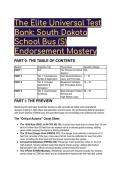
The Elite Universal Test
Bank: South Dakota
School Bus (S)
Endorsement Mastery
PART 0: THE TABLE OF CONTENTS
Section Cognitive Tier Focus Area Question Range
PART I N/A The Preview & Critical N/A
Axioms
PART II Tier 1: Foundational Hard Deck Definitions, 1 – 18
Syntax & Application Laws, and Formulas
PART II Tier 2: Complex Situational Variables 19 – 37
Application & and Immediate Action
Simulation
PART II Tier 3: Grandmaster Multi-Variable Problem 38 – 55
Synthesis Solving and
High-Stakes Logic
PART I: THE PREVIEW
Mastering this test bank translates directly to elite operational safety and unparalleled
decision-making in high-stress transportation environments. By synthesizing federal directives
with South Dakota codified laws, this gauntlet forges raw knowledge into professional intuition.
The "Critical Axioms" Cheat Sheet
● The 15/50 Rule (SDCL & 49 CFR 392.10): A school bus must stop no closer than 15 feet
and no further than 50 feet from the nearest rail at a railroad grade crossing; shifting
gears while crossing the tracks is strictly prohibited.
● The 12-Foot Danger Zone (FMVSS 111): The danger zone extends a minimum of 12
feet from all sides of the bus; cross-view mirrors must be calibrated to view this entire
zone, including the front tires and the ground surrounding the vehicle.
● Compartmentalization (FMVSS 222): Passenger crash protection relies on 24-inch
high-backed, heavily padded seats that absorb kinetic energy; adding aftermarket
lap/shoulder belts without structural testing compromises this system.
● The 4-Point WTORS Mandate: Wheelchair securement requires exactly four tiedown
points (rated at 2,500 lbs each) and an independent lap/shoulder belt restraint; partial
, securement is a severe compliance failure.
● The Motorist 15-Foot Perimeter (SDCL 32-32-6): Operators of approaching vehicles
must reduce speed to 15 mph or less when amber lights flash, and must come to a
complete stop at least 15 feet away when red signal lights are activated.
Core Regulatory Frameworks
Standard/Statute Primary Function Operational Implication
FMVSS 111 Rear and Danger Zone Visibility Dictates specific overlapping
coverage for cross-view and flat
mirrors.
FMVSS 222 Passenger Seating and Crash Enforces compartmentalization
Protection and wheelchair restraint
parameters.
FMVSS 131 Pedestrian Safety Devices Mandates the automated
deployable stop signal arm on
the vehicle's left side.
SDCL 32-32-1 Legal Classification Defines a school bus as
transporting 10 or more pupils
plus the driver.
49 CFR 380 App. D ELDT Curriculum Standards Governs the mandatory training
for dart-outs, railroad crossings,
and post-trip sweeps.
PART II: THE ELITE TEST BANK
Tier 1: Foundational Syntax & Application
Q1: Under South Dakota Codified Law (SDCL 32-32-1), a vehicle transitions from a standard
passenger transport to a legally defined "school bus" based on occupant capacity. Based on the
principles of South Dakota vehicle classification, which capacity is the MINIMUM threshold? A) 8
or more pupils and the driver B) 15 or more pupils and the driver C) 10 or more pupils and the
driver D) 16 or more pupils, including the driver
● Answer: C (10 or more pupils and the driver)
● Distractor Analysis:
○ A is incorrect: Eight pupils is the threshold for standard passenger vans, not
commercial school buses.
○ B is incorrect: Fifteen is a common threshold for federal passenger vehicle
classifications, but contradicts SDCL specific mandates.
○ D is incorrect: Sixteen is the threshold for a standard Passenger (P) endorsement,
not the state-specific definition of a school bus.
The Mentor's Analysis: South Dakota law explicitly defines a school bus as a vehicle with a
capacity of ten or more pupils and the driver. When determining regulatory compliance, the
immediate priority is understanding state-specific statutory definitions over general federal CDL
passenger limits. By utilizing the specific state statute, you bypass the common trap of
conflating the P endorsement (16+) with the S endorsement vehicle definition (10+).
Professional Intuition: Never confuse federal CDL passenger capacity with state-level
school bus legal definitions.
, Q2: A school bus is navigating a route with multiple railroad grade crossings. Based on the
principles of 49 CFR 392.10 and state safety protocols, which stopping distance from the
nearest rail is the ONLY acceptable parameter? A) No closer than 10 feet and no farther than 40
feet B) No closer than 20 feet and no farther than 50 feet C) No closer than 15 feet and no
farther than 50 feet D) No closer than 15 feet and no farther than 60 feet
● Answer: C (No closer than 15 feet and no farther than 50 feet)
● Distractor Analysis:
○ A is incorrect: Stopping 10 feet from the rail places the front bumper dangerously
close to the dynamic envelope of a passing train.
○ B is incorrect: 20 feet is technically safe but artificially narrows the legally
permissible window required by law.
○ D is incorrect: 60 feet places the bus too far back, potentially obscuring sightlines
down the track.
The Mentor's Analysis: Federal and state laws strictly dictate the stopping geometry at railroad
crossings to ensure maximum visibility and physical clearance. When facing a grade crossing,
the immediate priority is halting the vehicle within the 15-to-50-foot safety corridor. By utilizing
this exact distance, you bypass the common trap of stopping too far back to see or too close to
survive. Professional Intuition: The 15-50 foot corridor is absolute; memorize it as the
ultimate hard deck for rail safety.
Q3: You are inspecting the cross-view mirror system on a Type C conventional school bus.
Based on the principles of FMVSS 111, which visual field requirement is the PRIMARY mandate
for these specific mirrors? A) Viewing traffic approaching from 200 feet to the rear of the vehicle
B) Viewing the ground area extending 12 feet in front of and to the sides of the bus C)
Monitoring student behavior in the rear rows of the passenger compartment D) Viewing blind
spots immediately adjacent to the rear dual tires
● Answer: B (Viewing the ground area extending 12 feet in front of and to the sides of the
bus)
● Distractor Analysis:
○ A is incorrect: Viewing 200 feet to the rear is the function of the flat side-view
mirrors, not the front-mounted cross-view mirrors.
○ C is incorrect: Monitoring students is the function of the interior rear-view mirror.
○ D is incorrect: The convex side mirrors are utilized to monitor the area adjacent to
the rear dual tires.
The Mentor's Analysis: Cross-view mirrors are exclusively designed to eliminate the lethal blind
spots within the immediate danger zone surrounding the front of the bus. When facing
loading/unloading scenarios, the immediate priority is confirming the 12-foot perimeter is clear of
pedestrians. By utilizing the cross-view mirrors solely for this purpose, you bypass the common
novice error of using them for general driving observation. Professional Intuition: Cross-view
mirrors are for students in the danger zone; if you use them to drive, you are driving
blind.
Q4: A district purchases a fleet of new buses and tests the passenger seating. Based on the
principles of FMVSS 222 (Compartmentalization), which physical characteristic is the MOST
CRITICAL component of this passive safety system? A) Three-point seatbelts installed at every
passenger location B) Heavily padded, 24-inch high-backed seats spaced closely together C)
Laminated window glass to prevent passenger ejection D) Reinforced steel flooring to lower the
center of gravity
● Answer: B (Heavily padded, 24-inch high-backed seats spaced closely together)
● Distractor Analysis:


