
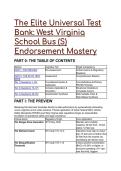
The Elite Universal Test
Bank: West Virginia
School Bus (S)
Endorsement Mastery
PART 0: THE TABLE OF CONTENTS
Section Cognitive Tier Target Competency
PART I: THE PREVIEW Pre-Assessment Critical Axioms & Regulatory
Baselines
PART II: THE ELITE TEST Assessment Comprehensive Mastery
BANK
Tier 1 (Questions 1–18) Foundational Syntax & Core Definitions & Primary
Application FMVSS Theories
Tier 2 (Questions 19–37) Complex Application & Situational Variables &
Simulation Immediate Actions
Tier 3 (Questions 38–55) Grandmaster Synthesis Multi-Variable Crisis &
High-Stakes Synthesis
PART I: THE PREVIEW
Mastering this test bank translates directly to elite performance by systematically eliminating
novice cognitive errors under pressure. Precise application of these Federal Motor Vehicle
Safety Standards (FMVSS) and West Virginia state regulations forges an impenetrable
foundation of operational safety and legal compliance.
Critical Axiom Regulatory Origin Core Application
The Danger Zone Imperative WV Policy 4336 Maintain strict visibility
mapping: 30 feet front, 10 feet
lateral, 12 feet rear.
The Railroad Axiom WV Code 17C-12-3 Operators must stop no closer
than 15 feet and no farther than
50 feet from the nearest rail,
neutralizing all internal noise.
The Disqualification WV Code 17E-1-13 A blood alcohol concentration
Threshold (BAC) of 0.04% or higher, or
excessive speeding (15+ mph
over the limit), triggers
,Critical Axiom Regulatory Origin Core Application
immediate commercial
disqualification.
The FMVSS Framework NHTSA Standards FMVSS 111 (Mirrors), 217
(Exits), 220 (Rollover), and 222
(Compartmentalization) govern
all structural survival metrics.
The K-3 Supervision Mandate WV Policy 4336 Parents or designated
guardians must be physically
present for the pickup and
drop-off of all students in
kindergarten through third
grade.
PART II: THE ELITE TEST BANK
Tier 1: Foundational Syntax & Application
Q1: An operator positions the crossover mirrors during a pre-trip inspection. Based on the
principles of FMVSS 111, which visual confirmation is the PRIMARY objective? A) Observing
the rear tires touching the ground at a distance of 200 feet. B) Viewing the blind spot
immediately behind the rear bumper up to 50 feet. C) Seeing the entire area from the front
bumper at ground level to where direct vision is possible. D) Monitoring traffic clearances on the
left and right sides of the bus.
● Answer: C (Seeing the entire area from the front bumper at ground level to where direct
vision is possible.)
● Distractor Analysis:
○ A is incorrect: This objective dictates the adjustment of outside flat mirrors, not
crossover mirrors.
○ B is incorrect: Crossover mirrors cannot view the rear bumper zone.
○ D is incorrect: Monitoring lateral clearances is the structural function of the side
convex and flat mirrors.
The Mentor's Analysis: Crossover mirrors strictly eliminate the lethal forward blind spot directly
in front of the bus. The operational priority is overlapping mirror vision with direct line-of-sight
vision. By executing proper FMVSS 111 adjustments, an operator bypasses the fatal risk of
striking a pedestrian near the front bumper. Professional Intuition: Crossover mirrors detect
pedestrians in the front danger zone; they are never utilized for monitoring parallel
traffic.
Q2: A commercial driver approaches a railroad grade crossing. Based on the principles of WV
Code 17C-12-3, which action is REQUIRED? A) Stop within 60 feet, but not less than 20 feet
from the nearest rail. B) Shift gears while crossing the tracks to maintain optimal engine RPM.
C) Stop within 50 feet, but not closer than 15 feet from the nearest rail. D) Activate the four-way
hazard lights 500 feet prior to the crossing.
● Answer: C (Stop within 50 feet, but not closer than 15 feet from the nearest rail.)
● Distractor Analysis:
○ A is incorrect: The statutory distance is 15 to 50 feet, rendering a 60/20
measurement invalid.
○ B is incorrect: Shifting gears while traversing a railroad crossing is strictly prohibited
, by state law.
○ D is incorrect: Hazard lights must be activated approximately 200 feet before the
crossing, not 500 feet.
The Mentor's Analysis: Railroad crossings present a catastrophic risk profile requiring precise
spatial management. The immediate priority is establishing a safe stopping distance that
maximizes lateral track visibility without encroaching on the train's dynamic envelope. By
utilizing the 15-50 foot rule, an operator bypasses the hazard of inadequate clearance.
Professional Intuition: Operators must secure the transmission in Neutral or Park and
silence all internal noise to confirm acoustic track clearance.
Q3: An operator is discharging a kindergarten student at a designated stop. Based on the
principles of WV Policy 4336, which condition MUST be verified before the student unloads? A)
The student must have an older sibling present to provide an escort home. B) A parent or
designated guardian must be present to provide supervision. C) The student must cross the
street immediately upon exiting. D) The bus operator must exit the bus to escort the student
across the roadway.
● Answer: B (A parent or designated guardian must be present to provide supervision.)
● Distractor Analysis:
○ A is incorrect: Policy 4336 specifically mandates parent or guardian supervision for
K-3 students, invalidating generic sibling escorts.
○ C is incorrect: Students cross only if their residence requires it, maintaining a
10-foot forward perimeter.
○ D is incorrect: The operator must remain seated to manage vehicle controls and
monitor the external traffic matrix.
The Mentor's Analysis: Unsupervised young children exhibit highly unpredictable behaviors near
active traffic lanes. The immediate priority is verifying authorized adult supervision to assume
custody of the K-3 passenger. By utilizing the mandated supervision rule, operators bypass the
liability of abandoning a vulnerable pedestrian in the danger zone. Professional Intuition: If
authorized supervision is absent for a K-3 student, the operator must retain the student
on board and notify dispatch immediately.
Q4: During a post-trip inspection, an operator finds that a seat bottom cushion is easily
removable without tools. Based on the principles of FMVSS 222, what is the MOST ACCURATE
assessment? A) The seat is compliant, provided the cushion relies on gravity to remain in place.
B) The seat is a violation, as seat bottoms designed to flip up must possess a self-latching
mechanism. C) The seat is a violation, as seat cushions must be permanently welded to the
chassis frame. D) The seat is compliant, as easily removable cushions facilitate rapid
emergency evacuations.
● Answer: B (The seat is a violation, as seat bottoms designed to flip up must possess a
self-latching mechanism.)
● Distractor Analysis:
○ A is incorrect: Gravity and weight alone do not satisfy the positive self-latching
requirement under FMVSS 222.
○ C is incorrect: Cushions are not welded; they must be self-latching to allow for
maintenance access while preventing dislodgment.
○ D is incorrect: Unsecured cushions transform into lethal blunt-force projectiles
during a dynamic rollover or collision.
The Mentor's Analysis: The efficacy of compartmentalization relies entirely on the structural
integrity of the seating unit. The immediate priority is recognizing a failure in the passive
occupant protection system. By utilizing the self-latching mandate, operators bypass the error of
Bank: West Virginia
School Bus (S)
Endorsement Mastery
PART 0: THE TABLE OF CONTENTS
Section Cognitive Tier Target Competency
PART I: THE PREVIEW Pre-Assessment Critical Axioms & Regulatory
Baselines
PART II: THE ELITE TEST Assessment Comprehensive Mastery
BANK
Tier 1 (Questions 1–18) Foundational Syntax & Core Definitions & Primary
Application FMVSS Theories
Tier 2 (Questions 19–37) Complex Application & Situational Variables &
Simulation Immediate Actions
Tier 3 (Questions 38–55) Grandmaster Synthesis Multi-Variable Crisis &
High-Stakes Synthesis
PART I: THE PREVIEW
Mastering this test bank translates directly to elite performance by systematically eliminating
novice cognitive errors under pressure. Precise application of these Federal Motor Vehicle
Safety Standards (FMVSS) and West Virginia state regulations forges an impenetrable
foundation of operational safety and legal compliance.
Critical Axiom Regulatory Origin Core Application
The Danger Zone Imperative WV Policy 4336 Maintain strict visibility
mapping: 30 feet front, 10 feet
lateral, 12 feet rear.
The Railroad Axiom WV Code 17C-12-3 Operators must stop no closer
than 15 feet and no farther than
50 feet from the nearest rail,
neutralizing all internal noise.
The Disqualification WV Code 17E-1-13 A blood alcohol concentration
Threshold (BAC) of 0.04% or higher, or
excessive speeding (15+ mph
over the limit), triggers
,Critical Axiom Regulatory Origin Core Application
immediate commercial
disqualification.
The FMVSS Framework NHTSA Standards FMVSS 111 (Mirrors), 217
(Exits), 220 (Rollover), and 222
(Compartmentalization) govern
all structural survival metrics.
The K-3 Supervision Mandate WV Policy 4336 Parents or designated
guardians must be physically
present for the pickup and
drop-off of all students in
kindergarten through third
grade.
PART II: THE ELITE TEST BANK
Tier 1: Foundational Syntax & Application
Q1: An operator positions the crossover mirrors during a pre-trip inspection. Based on the
principles of FMVSS 111, which visual confirmation is the PRIMARY objective? A) Observing
the rear tires touching the ground at a distance of 200 feet. B) Viewing the blind spot
immediately behind the rear bumper up to 50 feet. C) Seeing the entire area from the front
bumper at ground level to where direct vision is possible. D) Monitoring traffic clearances on the
left and right sides of the bus.
● Answer: C (Seeing the entire area from the front bumper at ground level to where direct
vision is possible.)
● Distractor Analysis:
○ A is incorrect: This objective dictates the adjustment of outside flat mirrors, not
crossover mirrors.
○ B is incorrect: Crossover mirrors cannot view the rear bumper zone.
○ D is incorrect: Monitoring lateral clearances is the structural function of the side
convex and flat mirrors.
The Mentor's Analysis: Crossover mirrors strictly eliminate the lethal forward blind spot directly
in front of the bus. The operational priority is overlapping mirror vision with direct line-of-sight
vision. By executing proper FMVSS 111 adjustments, an operator bypasses the fatal risk of
striking a pedestrian near the front bumper. Professional Intuition: Crossover mirrors detect
pedestrians in the front danger zone; they are never utilized for monitoring parallel
traffic.
Q2: A commercial driver approaches a railroad grade crossing. Based on the principles of WV
Code 17C-12-3, which action is REQUIRED? A) Stop within 60 feet, but not less than 20 feet
from the nearest rail. B) Shift gears while crossing the tracks to maintain optimal engine RPM.
C) Stop within 50 feet, but not closer than 15 feet from the nearest rail. D) Activate the four-way
hazard lights 500 feet prior to the crossing.
● Answer: C (Stop within 50 feet, but not closer than 15 feet from the nearest rail.)
● Distractor Analysis:
○ A is incorrect: The statutory distance is 15 to 50 feet, rendering a 60/20
measurement invalid.
○ B is incorrect: Shifting gears while traversing a railroad crossing is strictly prohibited
, by state law.
○ D is incorrect: Hazard lights must be activated approximately 200 feet before the
crossing, not 500 feet.
The Mentor's Analysis: Railroad crossings present a catastrophic risk profile requiring precise
spatial management. The immediate priority is establishing a safe stopping distance that
maximizes lateral track visibility without encroaching on the train's dynamic envelope. By
utilizing the 15-50 foot rule, an operator bypasses the hazard of inadequate clearance.
Professional Intuition: Operators must secure the transmission in Neutral or Park and
silence all internal noise to confirm acoustic track clearance.
Q3: An operator is discharging a kindergarten student at a designated stop. Based on the
principles of WV Policy 4336, which condition MUST be verified before the student unloads? A)
The student must have an older sibling present to provide an escort home. B) A parent or
designated guardian must be present to provide supervision. C) The student must cross the
street immediately upon exiting. D) The bus operator must exit the bus to escort the student
across the roadway.
● Answer: B (A parent or designated guardian must be present to provide supervision.)
● Distractor Analysis:
○ A is incorrect: Policy 4336 specifically mandates parent or guardian supervision for
K-3 students, invalidating generic sibling escorts.
○ C is incorrect: Students cross only if their residence requires it, maintaining a
10-foot forward perimeter.
○ D is incorrect: The operator must remain seated to manage vehicle controls and
monitor the external traffic matrix.
The Mentor's Analysis: Unsupervised young children exhibit highly unpredictable behaviors near
active traffic lanes. The immediate priority is verifying authorized adult supervision to assume
custody of the K-3 passenger. By utilizing the mandated supervision rule, operators bypass the
liability of abandoning a vulnerable pedestrian in the danger zone. Professional Intuition: If
authorized supervision is absent for a K-3 student, the operator must retain the student
on board and notify dispatch immediately.
Q4: During a post-trip inspection, an operator finds that a seat bottom cushion is easily
removable without tools. Based on the principles of FMVSS 222, what is the MOST ACCURATE
assessment? A) The seat is compliant, provided the cushion relies on gravity to remain in place.
B) The seat is a violation, as seat bottoms designed to flip up must possess a self-latching
mechanism. C) The seat is a violation, as seat cushions must be permanently welded to the
chassis frame. D) The seat is compliant, as easily removable cushions facilitate rapid
emergency evacuations.
● Answer: B (The seat is a violation, as seat bottoms designed to flip up must possess a
self-latching mechanism.)
● Distractor Analysis:
○ A is incorrect: Gravity and weight alone do not satisfy the positive self-latching
requirement under FMVSS 222.
○ C is incorrect: Cushions are not welded; they must be self-latching to allow for
maintenance access while preventing dislodgment.
○ D is incorrect: Unsecured cushions transform into lethal blunt-force projectiles
during a dynamic rollover or collision.
The Mentor's Analysis: The efficacy of compartmentalization relies entirely on the structural
integrity of the seating unit. The immediate priority is recognizing a failure in the passive
occupant protection system. By utilizing the self-latching mandate, operators bypass the error of


