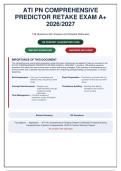
ATI PN COMPREHENSIVE
PREDICTOR RETAKE EXAM A+
2026/2027
139 Questions with Answers and Detailed Rationales
100 PERCENT GUARANTEED PASS
INSTANT DOWNLOAD ANSWERS INCLUDED
IMPORTANCE OF THIS DOCUMENT
This comprehensive examination preparation guide has been meticulously developed to help you succeed in the
ATI PN COMPREHENSIVE PREDICTOR RETAKE EXAM A+ 2026/2027. It contains 139 carefully selected
questions that reflect the most current exam content and testing strategies. Each question is accompanied by a
correct answer and a detailed rationale that explains the underlying pathophysiology, pharmacology, or clinical
reasoning.
Self-Assessment – Test your knowledge and Exam Preparation – Familiarize yourself with the
identify areas requiring further question format and content
study areas
Concept Reinforcement – Deepen your Confidence Building – Develop test-taking
understanding through strategies and reduce
evidence-based exam anxiety
rationales
Time Management – Practice answering
questions under simulated
exam conditions
Review Summary 139 Questions
Foundations - Application - ATI PN Comprehensive Predictor Retake A 2026/2027 Practical Nursing
Comprehensive Predictor Undergraduate YEAR 3 Practical Nursing Program
All answers with rationales
,Table of Contents
Content Area Questions Key Topics
Management OF CARE 1-24 Prescribed, Heart, Disease, Intervention, Medication
Safety AND Infection Control 25-48 Prescribed, Indicates, Finding, Teaching, Blood
Health Promotion AND 49-72 Indicates, Prescribed, Finding, Prevent, Teaching
Maintenance
Psychosocial Integrity 73-96 Indicates, Finding, Intervention, Prescribed, Immediate
Basic CARE AND Comfort 97-120 Finding, Receiving, Indicates, Intervention, Laboratory Value
Pharmacological Therapies 121-139 Finding, Receiving, Intervention, Indicates, Infusion
TOTAL 139 All questions include answers and detailed rationales
,Section A - Management OF CARE
Q1.
A patient with type 2 diabetes and chronic kidney disease (GFR 35 mL/min) is prescribed
metformin. The provider orders metformin 500 mg PO BID. What is the most appropriate
nursing action?
A. Administer the medication as ordered. B. Hold the medication and contact the
provider.
C. Administer with food to reduce GI upset. D. Request a lower dose of 250 mg.
Correct: B - Hold the medication and contact the provider.
Rationale:Metformin is contraindicated in patients with significant renal impairment (GFR <
30 mL/min) and should be used with caution when GFR is 30-45 mL/min; holding and
notifying the provider is safest. Administering as ordered or with food does not address the
renal risk. A lower dose might be appropriate, but the provider must make that decision.
Why the other answers are wrong:
A. Administering metformin with a GFR of 35 mL/min increases risk of lactic acidosis.
C. Food reduces GI upset but does not mitigate renal contraindication.
D. Dose adjustment requires provider order and may still be unsafe at this GFR.
Reference: Lehne, R.A. (2026). Pharmacology for Nursing Care, 12th Ed., Ch. 45
Q2.
A patient in active labor has a contraction frequency of every 2 minutes, duration 90
seconds, and fetal heart rate decelerations to 100 bpm after the peak of each contraction,
returning to baseline by the end of the contraction. What is the priority nursing
intervention?
A. Administer oxygen via face mask at 10 B. Discontinue oxytocin infusion.
L/min.
C. Position the patient on her left side. D. Prepare for immediate cesarean delivery.
Correct: B - Discontinue oxytocin infusion.
Rationale:Late decelerations are caused by uteroplacental insufficiency, often exacerbated
by uterine hyperstimulation. The priority is to improve fetal oxygenation by reducing
contractions; thus, discontinuing oxytocin is the first action. Oxygen and repositioning are
secondary, and cesarean delivery is not immediate unless decelerations persist.
Why the other answers are wrong:
A. Oxygen is given after reducing contractions, not as the first intervention.
C. Left lateral positioning is helpful but does not address the cause of hyperstimulation.
Page 3
, Section A - Management OF CARE
D. Immediate cesarean is not indicated unless decelerations are unresolved after conservative
measures.
Reference: Ricci, S.S. (2026). Essentials of Maternity, Newborn, and Women's Health Nursing, 5th Ed.,
Ch. 16
Q3.
A patient with a history of peptic ulcer disease is prescribed ibuprofen for osteoarthritis.
Which medication, if co-prescribed, would most effectively reduce the risk of
ibuprofen-induced gastric ulceration?
A. Omeprazole B. Famotidine
C. Sucralfate D. Misoprostol
Correct: A - Omeprazole
Rationale:Proton pump inhibitors (PPIs) like omeprazole are the most effective agents for
preventing NSAID-induced ulcers because they provide profound acid suppression, which is
superior to H2 blockers and mucosal protectants. Misoprostol is effective but has more side
effects and is less well tolerated.
Why the other answers are wrong:
B. Famotidine is less effective than PPIs for NSAID ulcer prophylaxis.
C. Sucralfate provides mucosal coating but is not the most effective prophylaxis.
D. Misoprostol is effective but less preferred due to diarrhea and abortion risk.
Reference: Karch, A.M. (2026). Focus on Nursing Pharmacology, 9th Ed., Ch. 53
Q4.
A patient with major depressive disorder is taking phenelzine and presents with a severe
throbbing headache, neck stiffness, and a blood pressure of 200/110 mm Hg. The nurse
suspects hypertensive crisis. Which food item most likely triggered this reaction?
A. Aged cheddar cheese B. Turkey sandwich
C. Baked potato D. Green salad with vinaigrette
Correct: A - Aged cheddar cheese
Rationale:Phenelzine is a nonselective MAOI that inhibits MAO-A, leading to accumulation of
tyramine. Aged cheeses contain high amounts of tyramine, which can precipitate a
hypertensive crisis. Other options are low in tyramine and safe.
Why the other answers are wrong:
B. Turkey is low in tyramine unless it is aged or fermented.
C. Baked potato is low in tyramine.
D. Green salad with vinaigrette is low in tyramine.
Reference: Varcarolis, E.M. (2026). Essentials of Psychiatric Mental Health Nursing, 5th Ed., Ch. 13
Page 4
PREDICTOR RETAKE EXAM A+
2026/2027
139 Questions with Answers and Detailed Rationales
100 PERCENT GUARANTEED PASS
INSTANT DOWNLOAD ANSWERS INCLUDED
IMPORTANCE OF THIS DOCUMENT
This comprehensive examination preparation guide has been meticulously developed to help you succeed in the
ATI PN COMPREHENSIVE PREDICTOR RETAKE EXAM A+ 2026/2027. It contains 139 carefully selected
questions that reflect the most current exam content and testing strategies. Each question is accompanied by a
correct answer and a detailed rationale that explains the underlying pathophysiology, pharmacology, or clinical
reasoning.
Self-Assessment – Test your knowledge and Exam Preparation – Familiarize yourself with the
identify areas requiring further question format and content
study areas
Concept Reinforcement – Deepen your Confidence Building – Develop test-taking
understanding through strategies and reduce
evidence-based exam anxiety
rationales
Time Management – Practice answering
questions under simulated
exam conditions
Review Summary 139 Questions
Foundations - Application - ATI PN Comprehensive Predictor Retake A 2026/2027 Practical Nursing
Comprehensive Predictor Undergraduate YEAR 3 Practical Nursing Program
All answers with rationales
,Table of Contents
Content Area Questions Key Topics
Management OF CARE 1-24 Prescribed, Heart, Disease, Intervention, Medication
Safety AND Infection Control 25-48 Prescribed, Indicates, Finding, Teaching, Blood
Health Promotion AND 49-72 Indicates, Prescribed, Finding, Prevent, Teaching
Maintenance
Psychosocial Integrity 73-96 Indicates, Finding, Intervention, Prescribed, Immediate
Basic CARE AND Comfort 97-120 Finding, Receiving, Indicates, Intervention, Laboratory Value
Pharmacological Therapies 121-139 Finding, Receiving, Intervention, Indicates, Infusion
TOTAL 139 All questions include answers and detailed rationales
,Section A - Management OF CARE
Q1.
A patient with type 2 diabetes and chronic kidney disease (GFR 35 mL/min) is prescribed
metformin. The provider orders metformin 500 mg PO BID. What is the most appropriate
nursing action?
A. Administer the medication as ordered. B. Hold the medication and contact the
provider.
C. Administer with food to reduce GI upset. D. Request a lower dose of 250 mg.
Correct: B - Hold the medication and contact the provider.
Rationale:Metformin is contraindicated in patients with significant renal impairment (GFR <
30 mL/min) and should be used with caution when GFR is 30-45 mL/min; holding and
notifying the provider is safest. Administering as ordered or with food does not address the
renal risk. A lower dose might be appropriate, but the provider must make that decision.
Why the other answers are wrong:
A. Administering metformin with a GFR of 35 mL/min increases risk of lactic acidosis.
C. Food reduces GI upset but does not mitigate renal contraindication.
D. Dose adjustment requires provider order and may still be unsafe at this GFR.
Reference: Lehne, R.A. (2026). Pharmacology for Nursing Care, 12th Ed., Ch. 45
Q2.
A patient in active labor has a contraction frequency of every 2 minutes, duration 90
seconds, and fetal heart rate decelerations to 100 bpm after the peak of each contraction,
returning to baseline by the end of the contraction. What is the priority nursing
intervention?
A. Administer oxygen via face mask at 10 B. Discontinue oxytocin infusion.
L/min.
C. Position the patient on her left side. D. Prepare for immediate cesarean delivery.
Correct: B - Discontinue oxytocin infusion.
Rationale:Late decelerations are caused by uteroplacental insufficiency, often exacerbated
by uterine hyperstimulation. The priority is to improve fetal oxygenation by reducing
contractions; thus, discontinuing oxytocin is the first action. Oxygen and repositioning are
secondary, and cesarean delivery is not immediate unless decelerations persist.
Why the other answers are wrong:
A. Oxygen is given after reducing contractions, not as the first intervention.
C. Left lateral positioning is helpful but does not address the cause of hyperstimulation.
Page 3
, Section A - Management OF CARE
D. Immediate cesarean is not indicated unless decelerations are unresolved after conservative
measures.
Reference: Ricci, S.S. (2026). Essentials of Maternity, Newborn, and Women's Health Nursing, 5th Ed.,
Ch. 16
Q3.
A patient with a history of peptic ulcer disease is prescribed ibuprofen for osteoarthritis.
Which medication, if co-prescribed, would most effectively reduce the risk of
ibuprofen-induced gastric ulceration?
A. Omeprazole B. Famotidine
C. Sucralfate D. Misoprostol
Correct: A - Omeprazole
Rationale:Proton pump inhibitors (PPIs) like omeprazole are the most effective agents for
preventing NSAID-induced ulcers because they provide profound acid suppression, which is
superior to H2 blockers and mucosal protectants. Misoprostol is effective but has more side
effects and is less well tolerated.
Why the other answers are wrong:
B. Famotidine is less effective than PPIs for NSAID ulcer prophylaxis.
C. Sucralfate provides mucosal coating but is not the most effective prophylaxis.
D. Misoprostol is effective but less preferred due to diarrhea and abortion risk.
Reference: Karch, A.M. (2026). Focus on Nursing Pharmacology, 9th Ed., Ch. 53
Q4.
A patient with major depressive disorder is taking phenelzine and presents with a severe
throbbing headache, neck stiffness, and a blood pressure of 200/110 mm Hg. The nurse
suspects hypertensive crisis. Which food item most likely triggered this reaction?
A. Aged cheddar cheese B. Turkey sandwich
C. Baked potato D. Green salad with vinaigrette
Correct: A - Aged cheddar cheese
Rationale:Phenelzine is a nonselective MAOI that inhibits MAO-A, leading to accumulation of
tyramine. Aged cheeses contain high amounts of tyramine, which can precipitate a
hypertensive crisis. Other options are low in tyramine and safe.
Why the other answers are wrong:
B. Turkey is low in tyramine unless it is aged or fermented.
C. Baked potato is low in tyramine.
D. Green salad with vinaigrette is low in tyramine.
Reference: Varcarolis, E.M. (2026). Essentials of Psychiatric Mental Health Nursing, 5th Ed., Ch. 13
Page 4