

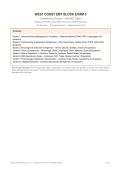
WEST COAST EMT BLOCK EXAM 3
Comprehensive Practice – 2026/2027 Edition
Aligned with the West Coast EMT Curriculum & NREMT Standards
150 Questions | 8 Content Domains | Multiple Choice (A–D)
Contents
Section 1: Advanced Airway Management & Ventilation – Advanced Adjuncts, BVM, CPAP, Capnography (20
questions)
Section 2: Cardiovascular & Respiratory Emergencies – ACS, Heart Failure, Cardiac Arrest, COPD, Asthma (25
questions)
Section 3: Neurological & Endocrine Emergencies – Stroke, Seizures, Diabetic, Thyroid (20 questions)
Section 4: Trauma Emergencies – Hemorrhage, Shock, Head/Spine, Chest, Abdomen, Burns (25 questions)
Section 5: Special Populations – Obstetrics, Pediatrics, Geriatrics, Special Needs (20 questions)
Section 6: EMS Operations & Safety – Ambulance, MCI, Triage, Rescue, Hazmat (15 questions)
Section 7: Pharmacology & Medication Administration – Common Drugs, Routes, Calculations (10 questions)
Section 8: Integrated Scenarios – Complex, Multi-System Emergencies (15 questions)
How to use this exam: Work through each section sequentially. One answer choice per question is correct; the correct answer
and a rationale follow each question. Use the rationales to reinforce clinical judgment and core content. A reference answer key is
provided on the final page.
West Coast EMT Block Exam 3 – Comprehensive Practice (2026/2027 Edition) Page 1
, Section 1: Advanced Airway Management & Ventilation – Advanced Adjuncts,
Section 1
BVM, CPAP, Capnography (20 questions)
Q1: Which airway device is inserted blindly into the esophagus (or pharynx) to ventilate patients when
endotracheal intubation is unavailable?
A. A supraglottic airway (e.g., King LT) [CORRECT]
B. An oropharyngeal airway
C. A nasal cannula
D. A nonrebreather mask
Correct Answer: A
Rationale: Supraglottic airways such as the King LT or Combitube are blind-insertion devices used to provide ventilation
when intubation is not available.
Q2: Which patient is the BEST candidate for a supraglottic airway?
A. An apneic, unresponsive patient without a gag reflex [CORRECT]
B. A responsive patient with an intact gag reflex
C. A patient who is talking
D. A patient with a complete upper airway obstruction from a foreign body
Correct Answer: A
Rationale: Supraglottic airways are used in deeply unresponsive, apneic patients without a gag reflex; they do not
bypass a complete foreign-body obstruction.
Q3: Which step confirms correct placement of a supraglottic airway?
A. Adequate chest rise and improvement in oxygenation [CORRECT]
B. The patient begins to cough
C. Absence of breath sounds
D. Gastric distention
Correct Answer: A
Rationale: Correct placement is confirmed by adequate bilateral chest rise, improved oxygenation, and breath sounds
over the lungs.
Q4: Which advanced airway device is inserted into the esophagus and then ventilates via a separate
lumen, with gastric and pharyngeal balloons?
A. Combitube [CORRECT]
B. OPA
C. NPA
D. Nasal cannula
Correct Answer: A
Rationale: The Combitube is a double-lumen, blind-insertion airway with gastric and pharyngeal balloons that ventilates
regardless of esophageal or tracheal placement.
Q5: Which waveform capnography finding indicates the supraglottic airway is ventilating effectively?
A. A continuous square (rectangular) EtCO2 waveform [CORRECT]
B. A flatline with no waveform
C. A slowly rising then falling spike with no plateau
D. No waveform at all
Correct Answer: A
Rationale: A normal capnogram shows a square waveform with a plateau, indicating exhaled CO2 from the lungs and
effective ventilation.
West Coast EMT Block Exam 3 – Comprehensive Practice (2026/2027 Edition) Page 2
, Q6: Which ventilation rate is recommended when ventilating an adult with a supraglottic airway during
cardiac arrest?
A. One breath every 6 seconds (10 breaths/min) [CORRECT]
B. One breath every 2 seconds
C. One breath every 12 seconds
D. One breath every 15 seconds
Correct Answer: A
Rationale: With an advanced airway in place during cardiac arrest, ventilations are delivered once every 6 seconds
(10/min) without pausing compressions.
Q7: Once an advanced airway is placed during CPR, compressions and ventilations should be:
A. Continuous compressions with asynchronous ventilations [CORRECT]
B. Stopped to allow 30:2 cycles
C. Paused for every ventilation
D. Performed only by one rescuer
Correct Answer: A
Rationale: With a secured advanced airway, compressions are continuous, and ventilations are given asynchronously
every 6 seconds.
Q8: Which is the correct way to confirm continuous capnography indicates return of spontaneous
circulation during CPR?
A. A sudden sustained rise in EtCO2 [CORRECT]
B. A falling EtCO2
C. An EtCO2 that remains at 0
D. A loss of the waveform
Correct Answer: A
Rationale: A sudden rise in EtCO2 during CPR reflects improved pulmonary perfusion and suggests return of
spontaneous circulation.
Q9: Which patient condition is a contraindication to CPAP?
A. The patient cannot maintain their own airway [CORRECT]
B. The patient is awake and alert
C. The patient has pulmonary edema
D. The patient has a respiratory rate of 28/min
Correct Answer: A
Rationale: CPAP requires an awake, cooperative patient who can protect their airway; an inability to maintain the airway
is a contraindication.
Q10: Which sign indicates the patient is tolerating CPAP well?
A. Decreased work of breathing and improving oxygen saturation [CORRECT]
B. Increasing anxiety and tachypnea
C. Worsening cyanosis
D. A falling SpO2
Correct Answer: A
Rationale: Improved oxygenation and reduced work of breathing indicate the patient is responding well to CPAP therapy.
Q11: Which is the correct oxygen flow for a nonrebreather mask to achieve the highest concentration?
A. 12 to 15 L/min [CORRECT]
B. 1 to 2 L/min
C. 4 to 6 L/min
D. 25 L/min
Correct Answer: A
Rationale: The nonrebreather mask requires 12 to 15 L/min to keep the reservoir bag inflated and deliver high oxygen
concentrations.
West Coast EMT Block Exam 3 – Comprehensive Practice (2026/2027 Edition) Page 3
Comprehensive Practice – 2026/2027 Edition
Aligned with the West Coast EMT Curriculum & NREMT Standards
150 Questions | 8 Content Domains | Multiple Choice (A–D)
Contents
Section 1: Advanced Airway Management & Ventilation – Advanced Adjuncts, BVM, CPAP, Capnography (20
questions)
Section 2: Cardiovascular & Respiratory Emergencies – ACS, Heart Failure, Cardiac Arrest, COPD, Asthma (25
questions)
Section 3: Neurological & Endocrine Emergencies – Stroke, Seizures, Diabetic, Thyroid (20 questions)
Section 4: Trauma Emergencies – Hemorrhage, Shock, Head/Spine, Chest, Abdomen, Burns (25 questions)
Section 5: Special Populations – Obstetrics, Pediatrics, Geriatrics, Special Needs (20 questions)
Section 6: EMS Operations & Safety – Ambulance, MCI, Triage, Rescue, Hazmat (15 questions)
Section 7: Pharmacology & Medication Administration – Common Drugs, Routes, Calculations (10 questions)
Section 8: Integrated Scenarios – Complex, Multi-System Emergencies (15 questions)
How to use this exam: Work through each section sequentially. One answer choice per question is correct; the correct answer
and a rationale follow each question. Use the rationales to reinforce clinical judgment and core content. A reference answer key is
provided on the final page.
West Coast EMT Block Exam 3 – Comprehensive Practice (2026/2027 Edition) Page 1
, Section 1: Advanced Airway Management & Ventilation – Advanced Adjuncts,
Section 1
BVM, CPAP, Capnography (20 questions)
Q1: Which airway device is inserted blindly into the esophagus (or pharynx) to ventilate patients when
endotracheal intubation is unavailable?
A. A supraglottic airway (e.g., King LT) [CORRECT]
B. An oropharyngeal airway
C. A nasal cannula
D. A nonrebreather mask
Correct Answer: A
Rationale: Supraglottic airways such as the King LT or Combitube are blind-insertion devices used to provide ventilation
when intubation is not available.
Q2: Which patient is the BEST candidate for a supraglottic airway?
A. An apneic, unresponsive patient without a gag reflex [CORRECT]
B. A responsive patient with an intact gag reflex
C. A patient who is talking
D. A patient with a complete upper airway obstruction from a foreign body
Correct Answer: A
Rationale: Supraglottic airways are used in deeply unresponsive, apneic patients without a gag reflex; they do not
bypass a complete foreign-body obstruction.
Q3: Which step confirms correct placement of a supraglottic airway?
A. Adequate chest rise and improvement in oxygenation [CORRECT]
B. The patient begins to cough
C. Absence of breath sounds
D. Gastric distention
Correct Answer: A
Rationale: Correct placement is confirmed by adequate bilateral chest rise, improved oxygenation, and breath sounds
over the lungs.
Q4: Which advanced airway device is inserted into the esophagus and then ventilates via a separate
lumen, with gastric and pharyngeal balloons?
A. Combitube [CORRECT]
B. OPA
C. NPA
D. Nasal cannula
Correct Answer: A
Rationale: The Combitube is a double-lumen, blind-insertion airway with gastric and pharyngeal balloons that ventilates
regardless of esophageal or tracheal placement.
Q5: Which waveform capnography finding indicates the supraglottic airway is ventilating effectively?
A. A continuous square (rectangular) EtCO2 waveform [CORRECT]
B. A flatline with no waveform
C. A slowly rising then falling spike with no plateau
D. No waveform at all
Correct Answer: A
Rationale: A normal capnogram shows a square waveform with a plateau, indicating exhaled CO2 from the lungs and
effective ventilation.
West Coast EMT Block Exam 3 – Comprehensive Practice (2026/2027 Edition) Page 2
, Q6: Which ventilation rate is recommended when ventilating an adult with a supraglottic airway during
cardiac arrest?
A. One breath every 6 seconds (10 breaths/min) [CORRECT]
B. One breath every 2 seconds
C. One breath every 12 seconds
D. One breath every 15 seconds
Correct Answer: A
Rationale: With an advanced airway in place during cardiac arrest, ventilations are delivered once every 6 seconds
(10/min) without pausing compressions.
Q7: Once an advanced airway is placed during CPR, compressions and ventilations should be:
A. Continuous compressions with asynchronous ventilations [CORRECT]
B. Stopped to allow 30:2 cycles
C. Paused for every ventilation
D. Performed only by one rescuer
Correct Answer: A
Rationale: With a secured advanced airway, compressions are continuous, and ventilations are given asynchronously
every 6 seconds.
Q8: Which is the correct way to confirm continuous capnography indicates return of spontaneous
circulation during CPR?
A. A sudden sustained rise in EtCO2 [CORRECT]
B. A falling EtCO2
C. An EtCO2 that remains at 0
D. A loss of the waveform
Correct Answer: A
Rationale: A sudden rise in EtCO2 during CPR reflects improved pulmonary perfusion and suggests return of
spontaneous circulation.
Q9: Which patient condition is a contraindication to CPAP?
A. The patient cannot maintain their own airway [CORRECT]
B. The patient is awake and alert
C. The patient has pulmonary edema
D. The patient has a respiratory rate of 28/min
Correct Answer: A
Rationale: CPAP requires an awake, cooperative patient who can protect their airway; an inability to maintain the airway
is a contraindication.
Q10: Which sign indicates the patient is tolerating CPAP well?
A. Decreased work of breathing and improving oxygen saturation [CORRECT]
B. Increasing anxiety and tachypnea
C. Worsening cyanosis
D. A falling SpO2
Correct Answer: A
Rationale: Improved oxygenation and reduced work of breathing indicate the patient is responding well to CPAP therapy.
Q11: Which is the correct oxygen flow for a nonrebreather mask to achieve the highest concentration?
A. 12 to 15 L/min [CORRECT]
B. 1 to 2 L/min
C. 4 to 6 L/min
D. 25 L/min
Correct Answer: A
Rationale: The nonrebreather mask requires 12 to 15 L/min to keep the reservoir bag inflated and deliver high oxygen
concentrations.
West Coast EMT Block Exam 3 – Comprehensive Practice (2026/2027 Edition) Page 3


