

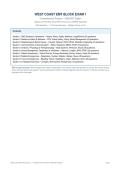
WEST COAST EMT BLOCK EXAM 1
Comprehensive Practice – 2026/2027 Edition
Aligned with the West Coast EMT Curriculum & NREMT Standards
200 Questions | 10 Content Domains | Multiple Choice (A–D)
Contents
Section 1: EMS Systems & Operations – History, Roles, Safety, Wellness, Legal/Ethical (25 questions)
Section 2: Workforce Safety & Wellness – PPE, Scene Safety, Lifting, Stress Management (20 questions)
Section 3: Medical/Legal & Ethical Issues – Consent, Refusal, DNR, HIPAA, Mandatory Reporting (20 questions)
Section 4: Communication & Documentation – Radio, Reporting, SBAR, ePCR (15 questions)
Section 5: Anatomy, Physiology & Pathophysiology – Body Systems, Perfusion, Shock (20 questions)
Section 6: Airway Management, Respiration & Ventilation – Adjuncts, Oxygen, BVM, CPAP (25 questions)
Section 7: Patient Assessment – Scene Size-Up, Primary/Secondary Survey, History, Vitals (25 questions)
Section 8: Medical Emergencies – Respiratory, Cardiac, Diabetic, Allergic, Neuro (20 questions)
Section 9: Trauma Emergencies – Bleeding, Shock, Head/Spine, Chest, Abdomen, Burns (20 questions)
Section 10: Integrated Scenarios – Complex, Multi-System Emergencies (10 questions)
How to use this exam: Work through each section sequentially. One answer choice per question is correct; the correct answer
and a rationale follow each question. Use the rationales to reinforce clinical judgment and core content. A reference answer key is
provided on the final page.
West Coast EMT Block Exam 1 – Comprehensive Practice (2026/2027 Edition) Page 1
, Section 1: EMS Systems & Operations – History, Roles, Safety, Wellness,
Section 1
Legal/Ethical (25 questions)
Q1: Which publication in 1966 identified deficiencies in prehospital emergency care and is credited with
launching modern EMS in the United States?
A. Accidental Death and Disability: The Neglected Disease of Modern Society [CORRECT]
B. The Silent Spring report
C. The Flexner Report
D. Healthy People 2010
Correct Answer: A
Rationale: The 1966 white paper 'Accidental Death and Disability' documented poor prehospital care and drove the
development of modern EMS systems.
Q2: Which federal agency is responsible for establishing national EMS education standards and curricula?
A. National Highway Traffic Safety Administration (NHTSA) [CORRECT]
B. Centers for Disease Control and Prevention (CDC)
C. Food and Drug Administration (FDA)
D. Federal Aviation Administration (FAA)
Correct Answer: A
Rationale: NHTSA leads federal EMS efforts, including the development of the National EMS Education Standards and
curricula.
Q3: The EMT's PRIMARY responsibility on every call is:
A. Personal safety and the safety of the crew and patient [CORRECT]
B. Driving as fast as possible
C. Documentation
D. Billing and reimbursement
Correct Answer: A
Rationale: Safety of self, crew, and patient always comes first; the EMT cannot help the patient if injured.
Q4: Which is an EMT's role under an online (direct) medical direction system?
A. Contacting a physician by radio or phone for orders on a specific patient [CORRECT]
B. Following standing written protocols without contacting a physician
C. Acting independently without oversight
D. Making medical policy for the agency
Correct Answer: A
Rationale: Online (direct) medical direction involves real-time physician orders by radio or phone; offline direction
consists of standing protocols.
Q5: Which of the following is an example of OFFLINE (indirect) medical direction?
A. Standing orders and protocols [CORRECT]
B. A physician giving an order by radio
C. A physician on scene directing care
D. A phone call to the hospital for orders
Correct Answer: A
Rationale: Offline medical direction consists of pre-written protocols and standing orders; online direction is real-time
physician contact.
West Coast EMT Block Exam 1 – Comprehensive Practice (2026/2027 Edition) Page 2
, Q6: Which process is used to continuously evaluate and improve the quality of EMS care?
A. Continuous quality improvement (CQI) [CORRECT]
B. Billing audits only
C. Random equipment checks
D. Annual employee parties
Correct Answer: A
Rationale: CQI reviews care, identifies areas for improvement, and implements changes to enhance patient outcomes.
Q7: Which practice uses current research evidence to guide prehospital patient care?
A. Evidence-based practice (EBP) [CORRECT]
B. Anecdotal practice
C. Tradition-based practice
D. Trial and error only
Correct Answer: A
Rationale: Evidence-based practice integrates the best available research with clinical expertise to guide care decisions.
Q8: Which system provides a nationally standardized approach to command and coordination at an
incident?
A. Incident Command System (ICS) [CORRECT]
B. START triage
C. SBAR reporting
D. AVPU assessment
Correct Answer: A
Rationale: ICS provides a common structure for command, communication, and resource management at all incidents.
Q9: In the Incident Command System, the span of control should be approximately:
A. Three to seven subordinates per supervisor [CORRECT]
B. One subordinate per supervisor
C. Twenty subordinates per supervisor
D. Fifty subordinates per supervisor
Correct Answer: A
Rationale: ICS recommends a span of control of three to seven (ideally five) subordinates per supervisor for effective
management.
Q10: Which section of ICS is responsible for obtaining and managing personnel, equipment, and supplies?
A. Logistics [CORRECT]
B. Operations
C. Planning
D. Finance/Administration
Correct Answer: A
Rationale: Logistics secures resources; Operations directs tactical activities, Planning develops the incident action plan,
and Finance tracks costs.
Q11: A patient who requires minimal assistance but cannot be left alone is classified in EMS patient
transport as:
A. An intermediate priority patient [CORRECT]
B. A high-priority patient
C. A low-priority patient
D. A deceased patient
Correct Answer: A
Rationale: Priority is based on severity: high priority (life-threatening), intermediate (requires care but stable), and low
(minor, ambulatory).
West Coast EMT Block Exam 1 – Comprehensive Practice (2026/2027 Edition) Page 3
, Q12: Which type of EMS system requires the receiving facility to be notified and prepared before the
ambulance arrives?
A. All transport systems, via prearrival notification for serious patients [CORRECT]
B. Only air medical transports
C. Only private services
D. No system requires notification
Correct Answer: A
Rationale: Prearrival notification alerts the emergency department so staff and resources are ready, improving continuity
of care.
Q13: Which statement BEST describes the scope of practice of an EMT?
A. The legal care and procedures an EMT is permitted to perform based on training, certification, and
medical direction [CORRECT]
B. The unlimited practice of medicine
C. The same scope as a physician
D. Whatever the patient requests
Correct Answer: A
Rationale: Scope of practice defines what an EMT may legally do, determined by law, education standards, and medical
direction.
Q14: What is the primary purpose of an EMS system's medical director?
A. To oversee and provide medical accountability for prehospital care [CORRECT]
B. To drive the ambulance
C. To handle billing
D. To manage the station's maintenance
Correct Answer: A
Rationale: The medical director provides medical oversight, protocols, and accountability for the EMS system's clinical
care.
Q15: Which level of EMS provider typically performs advanced procedures such as IV therapy and
advanced airway management?
A. Advanced EMT (AEMT) or Paramedic [CORRECT]
B. EMR
C. EMT
D. Dispatcher
Correct Answer: A
Rationale: Advanced EMTs and paramedics perform advanced interventions; EMTs provide basic life support, and
EMRs provide immediate first response.
Q16: Which term describes the grouping of patients by severity to allocate care during a mass casualty
incident?
A. Triage [CORRECT]
B. Screening
C. Disposition
D. Discharge
Correct Answer: A
Rationale: Triage sorts patients by priority when resources are limited, ensuring the greatest benefit for the greatest
number.
West Coast EMT Block Exam 1 – Comprehensive Practice (2026/2027 Edition) Page 4
Comprehensive Practice – 2026/2027 Edition
Aligned with the West Coast EMT Curriculum & NREMT Standards
200 Questions | 10 Content Domains | Multiple Choice (A–D)
Contents
Section 1: EMS Systems & Operations – History, Roles, Safety, Wellness, Legal/Ethical (25 questions)
Section 2: Workforce Safety & Wellness – PPE, Scene Safety, Lifting, Stress Management (20 questions)
Section 3: Medical/Legal & Ethical Issues – Consent, Refusal, DNR, HIPAA, Mandatory Reporting (20 questions)
Section 4: Communication & Documentation – Radio, Reporting, SBAR, ePCR (15 questions)
Section 5: Anatomy, Physiology & Pathophysiology – Body Systems, Perfusion, Shock (20 questions)
Section 6: Airway Management, Respiration & Ventilation – Adjuncts, Oxygen, BVM, CPAP (25 questions)
Section 7: Patient Assessment – Scene Size-Up, Primary/Secondary Survey, History, Vitals (25 questions)
Section 8: Medical Emergencies – Respiratory, Cardiac, Diabetic, Allergic, Neuro (20 questions)
Section 9: Trauma Emergencies – Bleeding, Shock, Head/Spine, Chest, Abdomen, Burns (20 questions)
Section 10: Integrated Scenarios – Complex, Multi-System Emergencies (10 questions)
How to use this exam: Work through each section sequentially. One answer choice per question is correct; the correct answer
and a rationale follow each question. Use the rationales to reinforce clinical judgment and core content. A reference answer key is
provided on the final page.
West Coast EMT Block Exam 1 – Comprehensive Practice (2026/2027 Edition) Page 1
, Section 1: EMS Systems & Operations – History, Roles, Safety, Wellness,
Section 1
Legal/Ethical (25 questions)
Q1: Which publication in 1966 identified deficiencies in prehospital emergency care and is credited with
launching modern EMS in the United States?
A. Accidental Death and Disability: The Neglected Disease of Modern Society [CORRECT]
B. The Silent Spring report
C. The Flexner Report
D. Healthy People 2010
Correct Answer: A
Rationale: The 1966 white paper 'Accidental Death and Disability' documented poor prehospital care and drove the
development of modern EMS systems.
Q2: Which federal agency is responsible for establishing national EMS education standards and curricula?
A. National Highway Traffic Safety Administration (NHTSA) [CORRECT]
B. Centers for Disease Control and Prevention (CDC)
C. Food and Drug Administration (FDA)
D. Federal Aviation Administration (FAA)
Correct Answer: A
Rationale: NHTSA leads federal EMS efforts, including the development of the National EMS Education Standards and
curricula.
Q3: The EMT's PRIMARY responsibility on every call is:
A. Personal safety and the safety of the crew and patient [CORRECT]
B. Driving as fast as possible
C. Documentation
D. Billing and reimbursement
Correct Answer: A
Rationale: Safety of self, crew, and patient always comes first; the EMT cannot help the patient if injured.
Q4: Which is an EMT's role under an online (direct) medical direction system?
A. Contacting a physician by radio or phone for orders on a specific patient [CORRECT]
B. Following standing written protocols without contacting a physician
C. Acting independently without oversight
D. Making medical policy for the agency
Correct Answer: A
Rationale: Online (direct) medical direction involves real-time physician orders by radio or phone; offline direction
consists of standing protocols.
Q5: Which of the following is an example of OFFLINE (indirect) medical direction?
A. Standing orders and protocols [CORRECT]
B. A physician giving an order by radio
C. A physician on scene directing care
D. A phone call to the hospital for orders
Correct Answer: A
Rationale: Offline medical direction consists of pre-written protocols and standing orders; online direction is real-time
physician contact.
West Coast EMT Block Exam 1 – Comprehensive Practice (2026/2027 Edition) Page 2
, Q6: Which process is used to continuously evaluate and improve the quality of EMS care?
A. Continuous quality improvement (CQI) [CORRECT]
B. Billing audits only
C. Random equipment checks
D. Annual employee parties
Correct Answer: A
Rationale: CQI reviews care, identifies areas for improvement, and implements changes to enhance patient outcomes.
Q7: Which practice uses current research evidence to guide prehospital patient care?
A. Evidence-based practice (EBP) [CORRECT]
B. Anecdotal practice
C. Tradition-based practice
D. Trial and error only
Correct Answer: A
Rationale: Evidence-based practice integrates the best available research with clinical expertise to guide care decisions.
Q8: Which system provides a nationally standardized approach to command and coordination at an
incident?
A. Incident Command System (ICS) [CORRECT]
B. START triage
C. SBAR reporting
D. AVPU assessment
Correct Answer: A
Rationale: ICS provides a common structure for command, communication, and resource management at all incidents.
Q9: In the Incident Command System, the span of control should be approximately:
A. Three to seven subordinates per supervisor [CORRECT]
B. One subordinate per supervisor
C. Twenty subordinates per supervisor
D. Fifty subordinates per supervisor
Correct Answer: A
Rationale: ICS recommends a span of control of three to seven (ideally five) subordinates per supervisor for effective
management.
Q10: Which section of ICS is responsible for obtaining and managing personnel, equipment, and supplies?
A. Logistics [CORRECT]
B. Operations
C. Planning
D. Finance/Administration
Correct Answer: A
Rationale: Logistics secures resources; Operations directs tactical activities, Planning develops the incident action plan,
and Finance tracks costs.
Q11: A patient who requires minimal assistance but cannot be left alone is classified in EMS patient
transport as:
A. An intermediate priority patient [CORRECT]
B. A high-priority patient
C. A low-priority patient
D. A deceased patient
Correct Answer: A
Rationale: Priority is based on severity: high priority (life-threatening), intermediate (requires care but stable), and low
(minor, ambulatory).
West Coast EMT Block Exam 1 – Comprehensive Practice (2026/2027 Edition) Page 3
, Q12: Which type of EMS system requires the receiving facility to be notified and prepared before the
ambulance arrives?
A. All transport systems, via prearrival notification for serious patients [CORRECT]
B. Only air medical transports
C. Only private services
D. No system requires notification
Correct Answer: A
Rationale: Prearrival notification alerts the emergency department so staff and resources are ready, improving continuity
of care.
Q13: Which statement BEST describes the scope of practice of an EMT?
A. The legal care and procedures an EMT is permitted to perform based on training, certification, and
medical direction [CORRECT]
B. The unlimited practice of medicine
C. The same scope as a physician
D. Whatever the patient requests
Correct Answer: A
Rationale: Scope of practice defines what an EMT may legally do, determined by law, education standards, and medical
direction.
Q14: What is the primary purpose of an EMS system's medical director?
A. To oversee and provide medical accountability for prehospital care [CORRECT]
B. To drive the ambulance
C. To handle billing
D. To manage the station's maintenance
Correct Answer: A
Rationale: The medical director provides medical oversight, protocols, and accountability for the EMS system's clinical
care.
Q15: Which level of EMS provider typically performs advanced procedures such as IV therapy and
advanced airway management?
A. Advanced EMT (AEMT) or Paramedic [CORRECT]
B. EMR
C. EMT
D. Dispatcher
Correct Answer: A
Rationale: Advanced EMTs and paramedics perform advanced interventions; EMTs provide basic life support, and
EMRs provide immediate first response.
Q16: Which term describes the grouping of patients by severity to allocate care during a mass casualty
incident?
A. Triage [CORRECT]
B. Screening
C. Disposition
D. Discharge
Correct Answer: A
Rationale: Triage sorts patients by priority when resources are limited, ensuring the greatest benefit for the greatest
number.
West Coast EMT Block Exam 1 – Comprehensive Practice (2026/2027 Edition) Page 4


