

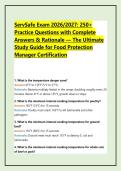
ServSafe Exam 2026/2027: 250+
Practice Questions with Complete
Answers & Rationale — The Ultimate
Study Guide for Food Protection
Manager Certification
1. What is the temperature danger zone?
Answer: 41°F to 135°F (5°C to 57°C)
Rationale: Bacteria multiply fastest in this range, doubling roughly every 20
minutes. Below 41°F or above 135°F, growth slows or stops.
2. What is the minimum internal cooking temperature for poultry?
Answer: 165°F (74°C) for 15 seconds
Rationale: Poultry must reach 165°F to kill Salmonella and other
pathogens.
3. What is the minimum internal cooking temperature for ground
beef?
Answer: 155°F (68°C) for 15 seconds
Rationale: Ground meat must reach 155°F to destroy E. coli and
Salmonella.
4. What is the minimum internal cooking temperature for whole cuts
of beef or pork?
,Answer: 145°F (63°C) for 15 seconds
Rationale: Whole cuts are less risky because pathogens stay on the surface,
which reaches temperature quickly.
5. What is the minimum internal cooking temperature for fish?
Answer: 145°F (63°C) for 15 seconds
Rationale: Fish requires 145°F to ensure safety while maintaining quality.
6. What is the minimum holding temperature for hot TCS food?
Answer: 135°F (57°C)
Rationale: Hot food must stay at or above 135°F to prevent pathogen
growth.
7. What is the maximum holding temperature for cold TCS food?
Answer: 41°F (5°C) or lower
Rationale: Cold TCS food must be held at 41°F or below to inhibit bacterial
growth.
8. What is the minimum internal temperature for reheating leftovers?
Answer: 165°F (74°C) for 15 seconds
Rationale: Previously cooked food must be reheated to 165°F to kill any
bacteria that may have grown.
9. How long can TCS food remain in the danger zone before it must be
discarded?
Answer: 4 hours total
Rationale: After 4 cumulative hours in the danger zone, bacteria may have
multiplied to unsafe levels.
10. What is the correct cooling process for hot food?
Answer: 135°F to 70°F within 2 hours, then 70°F to 41°F within an
additional 4 hours (6 hours total)
,Rationale: Rapid cooling prevents pathogen growth during the danger
zone.
11. What is the minimum internal temperature for cooking stuffed
meat or pasta?
Answer: 165°F (74°C) for 15 seconds
Rationale: Stuffing contains moist, protein-rich ingredients that support
bacterial growth, so a higher temperature is required.
12. What is the minimum internal temperature for cooking a
microwave-reheated dish?
Answer: 165°F (74°C)
Rationale: Microwaved food must reach 165°F, be covered, rotated, and
allowed to stand for 2 minutes.
13. What is the maximum time cold food can be left out at room
temperature during service?
Answer: 4 hours
Rationale: Cold food can be served without temperature control for up to
4 hours, then must be discarded.
14. What is the maximum time hot food can be left out without
temperature control?
Answer: 4 hours
Rationale: Hot food can be held without temperature control for up to 4
hours if it starts at 135°F or above.
15. What temperature should a refrigerator be set to?
Answer: 38°F (3°C) or lower
Rationale: Setting refrigerators at 38°F ensures food stays below 41°F even
with frequent door openings.
, 16. What temperature should a freezer be set to?
Answer: 0°F (-18°C) or lower
Rationale: Freezers at 0°F prevent pathogen growth and preserve food
quality.
17. What is the minimum internal temperature for cooking eggs for
immediate service?
Answer: 145°F (63°C) for 15 seconds
Rationale: Eggs for immediate service require 145°F; eggs held for later
service require 155°F.
18. What is the minimum internal temperature for cooking ratites
(ostrich, emu)?
Answer: 145°F (63°C) for 15 seconds
Rationale: Ratites are classified like whole cuts of meat and require 145°F.
19. What is the minimum internal temperature for cooking ground
poultry?
Answer: 165°F (74°C) for 15 seconds
Rationale: Ground poultry carries the same risk as whole poultry and must
reach 165°F.
20. What is the proper way to check the temperature of thin foods like
hamburger patties?
Answer: Insert the thermometer probe into the side of the patty
Rationale: Thin foods require side insertion to get an accurate internal
reading.
21. What is the correct storage order in a refrigerator from top to
bottom?
Practice Questions with Complete
Answers & Rationale — The Ultimate
Study Guide for Food Protection
Manager Certification
1. What is the temperature danger zone?
Answer: 41°F to 135°F (5°C to 57°C)
Rationale: Bacteria multiply fastest in this range, doubling roughly every 20
minutes. Below 41°F or above 135°F, growth slows or stops.
2. What is the minimum internal cooking temperature for poultry?
Answer: 165°F (74°C) for 15 seconds
Rationale: Poultry must reach 165°F to kill Salmonella and other
pathogens.
3. What is the minimum internal cooking temperature for ground
beef?
Answer: 155°F (68°C) for 15 seconds
Rationale: Ground meat must reach 155°F to destroy E. coli and
Salmonella.
4. What is the minimum internal cooking temperature for whole cuts
of beef or pork?
,Answer: 145°F (63°C) for 15 seconds
Rationale: Whole cuts are less risky because pathogens stay on the surface,
which reaches temperature quickly.
5. What is the minimum internal cooking temperature for fish?
Answer: 145°F (63°C) for 15 seconds
Rationale: Fish requires 145°F to ensure safety while maintaining quality.
6. What is the minimum holding temperature for hot TCS food?
Answer: 135°F (57°C)
Rationale: Hot food must stay at or above 135°F to prevent pathogen
growth.
7. What is the maximum holding temperature for cold TCS food?
Answer: 41°F (5°C) or lower
Rationale: Cold TCS food must be held at 41°F or below to inhibit bacterial
growth.
8. What is the minimum internal temperature for reheating leftovers?
Answer: 165°F (74°C) for 15 seconds
Rationale: Previously cooked food must be reheated to 165°F to kill any
bacteria that may have grown.
9. How long can TCS food remain in the danger zone before it must be
discarded?
Answer: 4 hours total
Rationale: After 4 cumulative hours in the danger zone, bacteria may have
multiplied to unsafe levels.
10. What is the correct cooling process for hot food?
Answer: 135°F to 70°F within 2 hours, then 70°F to 41°F within an
additional 4 hours (6 hours total)
,Rationale: Rapid cooling prevents pathogen growth during the danger
zone.
11. What is the minimum internal temperature for cooking stuffed
meat or pasta?
Answer: 165°F (74°C) for 15 seconds
Rationale: Stuffing contains moist, protein-rich ingredients that support
bacterial growth, so a higher temperature is required.
12. What is the minimum internal temperature for cooking a
microwave-reheated dish?
Answer: 165°F (74°C)
Rationale: Microwaved food must reach 165°F, be covered, rotated, and
allowed to stand for 2 minutes.
13. What is the maximum time cold food can be left out at room
temperature during service?
Answer: 4 hours
Rationale: Cold food can be served without temperature control for up to
4 hours, then must be discarded.
14. What is the maximum time hot food can be left out without
temperature control?
Answer: 4 hours
Rationale: Hot food can be held without temperature control for up to 4
hours if it starts at 135°F or above.
15. What temperature should a refrigerator be set to?
Answer: 38°F (3°C) or lower
Rationale: Setting refrigerators at 38°F ensures food stays below 41°F even
with frequent door openings.
, 16. What temperature should a freezer be set to?
Answer: 0°F (-18°C) or lower
Rationale: Freezers at 0°F prevent pathogen growth and preserve food
quality.
17. What is the minimum internal temperature for cooking eggs for
immediate service?
Answer: 145°F (63°C) for 15 seconds
Rationale: Eggs for immediate service require 145°F; eggs held for later
service require 155°F.
18. What is the minimum internal temperature for cooking ratites
(ostrich, emu)?
Answer: 145°F (63°C) for 15 seconds
Rationale: Ratites are classified like whole cuts of meat and require 145°F.
19. What is the minimum internal temperature for cooking ground
poultry?
Answer: 165°F (74°C) for 15 seconds
Rationale: Ground poultry carries the same risk as whole poultry and must
reach 165°F.
20. What is the proper way to check the temperature of thin foods like
hamburger patties?
Answer: Insert the thermometer probe into the side of the patty
Rationale: Thin foods require side insertion to get an accurate internal
reading.
21. What is the correct storage order in a refrigerator from top to
bottom?


