
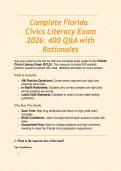
Complete Florida
Civics Literacy Exam
2026: 400 Q&A with
Rationales
Ace your exam on the first try with this complete study guide for the Florida
Civics Literacy Exam (FCLE). This resource includes 400 realistic
practice questions paired with clear, detailed rationales for every answer.
What Is Included
• 400 Practice Questions: Covers every required core topic and
historical document.
• In-Depth Rationales: Explains why correct answers are right and
wrong answers are wrong.
• Latest 2026 Standards: Updated to match current state testing
guidelines.
Why Buy This Guide
• Save Time: Skip long textbooks and focus on high-yield exam
concepts.
• Build Confidence: Learn the logic behind each answer to pass with
ease.
• Guaranteed Prep: Ideal for college students and high schoolers
needing to meet the Florida civics graduation requirement.
1. What is the supreme law of the land?
The Constitution.
•
, • Detailed Rationale: Signed in 1787, the U.S. Constitution serves as the foundational
framework of the federal government. According to the Supremacy Clause in Article VI,
Clause 2, the Constitution, along with federal laws made pursuant to it and treaties made
under its authority, constitutes the highest legal standard in the nation. This means no
state or local laws, nor federal statutes, can conflict with its provisions.
•
2. What does the Constitution do?
•
• Sets up the government
• Defines the government
• Protects basic rights of Americans
• Detailed Rationale: The Constitution acts as a structural blueprint and legal shield.
It organizes the federal government into three distinct branches to prevent tyranny,
defines the precise limits of federal power (leaving other powers to the states or the
people), and explicitly restricts the government from infringing upon fundamental human
liberties.
•
3. The idea of self-government is in the first three words of the
Constitution. What are these words?
We the People.
•
• Detailed Rationale: The Preamble opens with these words to explicitly state that the
power of the government comes from the citizens themselves rather than a monarch or a
ruling elite. This concept is known as popular sovereignty—meaning the government
exists only by the consent of the governed.
•
4. What is an amendment?
•
• A change (to the Constitution)
• An addition (to the Constitution)
• Detailed Rationale: The Framers recognized that the United States would grow and
change over time. Article V outlines the rigorous amendment process, allowing future
, generations to adapt the text without scrapping the entire framework. An amendment can
either alter existing text or append entirely new protections and rules to the document.
•
5. What do we call the first ten amendments to the Constitution?
The Bill of Rights.
•
• Detailed Rationale: Ratified collectively in 1791, the Bill of Rights was demanded
by early Americans who feared the federal government would grow too powerful. It
places explicit boundaries on federal power by guaranteeing specific personal liberties,
such as freedom of speech, the right to a fair trial, and protection against unlawful
searches.
•
6. What is one right or freedom from the First Amendment?
•
• Speech
• Religion
• Assembly
• Press
• Petition the government
• Detailed Rationale: The First Amendment serves as a cornerstone of American
democracy by safeguarding individual expression and belief. It guarantees that citizens
can speak freely, practice any religion (or none), gather peacefully, publish news without
government censorship, and directly request changes from their leaders.
•
7. How many amendments does the Constitution have?
Twenty-seven (27).
•
• Detailed Rationale: Thousands of amendments have been proposed since 1787, but
only 27 have successfully navigated the demanding ratification process, which requires
approval by a two-thirds majority in Congress and three-fourths of the states. The most
, recent modification, the Twenty-Seventh Amendment, was ratified in 1992 and regulates
congressional pay increases.
•
8. What did the Declaration of Independence do?
•
• Announced our independence (from Great Britain)
• Declared our independence (from Great Britain)
• Said that the United States is free (from Great Britain)
• Detailed Rationale: Adopted by the Continental Congress, this document severed all
political ties between the thirteen American colonies and Great Britain. It formally
established a new nation, explained the political philosophies behind the separation, and
listed the colonial grievances against King George III.
•
9. What are two rights in the Declaration of Independence?
•
• Life
• Liberty
• Pursuit of happiness
• Detailed Rationale: The Declaration famously asserts that all people possess certain
unalienable rights—natural rights given by birth that no government can justly take away.
The philosophy behind this draws heavily from Enlightenment thinkers who believed a
government's primary duty is to protect these core components of human dignity.
•
10. What is freedom of religion?
You can practice any religion, or not practice a religion.
•
• Detailed Rationale: This right stems from the Establishment Clause and the Free
Exercise Clause of the First Amendment. It prohibits the federal government from
establishing an official state church and protects citizens from being forced to conform to
a specific faith, ensuring full spiritual autonomy.
•
Civics Literacy Exam
2026: 400 Q&A with
Rationales
Ace your exam on the first try with this complete study guide for the Florida
Civics Literacy Exam (FCLE). This resource includes 400 realistic
practice questions paired with clear, detailed rationales for every answer.
What Is Included
• 400 Practice Questions: Covers every required core topic and
historical document.
• In-Depth Rationales: Explains why correct answers are right and
wrong answers are wrong.
• Latest 2026 Standards: Updated to match current state testing
guidelines.
Why Buy This Guide
• Save Time: Skip long textbooks and focus on high-yield exam
concepts.
• Build Confidence: Learn the logic behind each answer to pass with
ease.
• Guaranteed Prep: Ideal for college students and high schoolers
needing to meet the Florida civics graduation requirement.
1. What is the supreme law of the land?
The Constitution.
•
, • Detailed Rationale: Signed in 1787, the U.S. Constitution serves as the foundational
framework of the federal government. According to the Supremacy Clause in Article VI,
Clause 2, the Constitution, along with federal laws made pursuant to it and treaties made
under its authority, constitutes the highest legal standard in the nation. This means no
state or local laws, nor federal statutes, can conflict with its provisions.
•
2. What does the Constitution do?
•
• Sets up the government
• Defines the government
• Protects basic rights of Americans
• Detailed Rationale: The Constitution acts as a structural blueprint and legal shield.
It organizes the federal government into three distinct branches to prevent tyranny,
defines the precise limits of federal power (leaving other powers to the states or the
people), and explicitly restricts the government from infringing upon fundamental human
liberties.
•
3. The idea of self-government is in the first three words of the
Constitution. What are these words?
We the People.
•
• Detailed Rationale: The Preamble opens with these words to explicitly state that the
power of the government comes from the citizens themselves rather than a monarch or a
ruling elite. This concept is known as popular sovereignty—meaning the government
exists only by the consent of the governed.
•
4. What is an amendment?
•
• A change (to the Constitution)
• An addition (to the Constitution)
• Detailed Rationale: The Framers recognized that the United States would grow and
change over time. Article V outlines the rigorous amendment process, allowing future
, generations to adapt the text without scrapping the entire framework. An amendment can
either alter existing text or append entirely new protections and rules to the document.
•
5. What do we call the first ten amendments to the Constitution?
The Bill of Rights.
•
• Detailed Rationale: Ratified collectively in 1791, the Bill of Rights was demanded
by early Americans who feared the federal government would grow too powerful. It
places explicit boundaries on federal power by guaranteeing specific personal liberties,
such as freedom of speech, the right to a fair trial, and protection against unlawful
searches.
•
6. What is one right or freedom from the First Amendment?
•
• Speech
• Religion
• Assembly
• Press
• Petition the government
• Detailed Rationale: The First Amendment serves as a cornerstone of American
democracy by safeguarding individual expression and belief. It guarantees that citizens
can speak freely, practice any religion (or none), gather peacefully, publish news without
government censorship, and directly request changes from their leaders.
•
7. How many amendments does the Constitution have?
Twenty-seven (27).
•
• Detailed Rationale: Thousands of amendments have been proposed since 1787, but
only 27 have successfully navigated the demanding ratification process, which requires
approval by a two-thirds majority in Congress and three-fourths of the states. The most
, recent modification, the Twenty-Seventh Amendment, was ratified in 1992 and regulates
congressional pay increases.
•
8. What did the Declaration of Independence do?
•
• Announced our independence (from Great Britain)
• Declared our independence (from Great Britain)
• Said that the United States is free (from Great Britain)
• Detailed Rationale: Adopted by the Continental Congress, this document severed all
political ties between the thirteen American colonies and Great Britain. It formally
established a new nation, explained the political philosophies behind the separation, and
listed the colonial grievances against King George III.
•
9. What are two rights in the Declaration of Independence?
•
• Life
• Liberty
• Pursuit of happiness
• Detailed Rationale: The Declaration famously asserts that all people possess certain
unalienable rights—natural rights given by birth that no government can justly take away.
The philosophy behind this draws heavily from Enlightenment thinkers who believed a
government's primary duty is to protect these core components of human dignity.
•
10. What is freedom of religion?
You can practice any religion, or not practice a religion.
•
• Detailed Rationale: This right stems from the Establishment Clause and the Free
Exercise Clause of the First Amendment. It prohibits the federal government from
establishing an official state church and protects citizens from being forced to conform to
a specific faith, ensuring full spiritual autonomy.
•


