

Monomers and polymers
Monomer = A small repeating molecule that can join together to form larger polymers
Polymer = A larger molecule made up of many identical / similar monomers
Polymerisation = The process of joining many monomers together to form polymers
Macromolecule = a large molecule
Hydration = addition of water
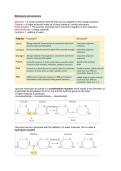
-glucose molecules are joined in a condensation reaction which results in the formation of
a glycosidic bond between the H on one and the hydroxyl group on the other
-a water molecule is produced
-monosaccharide + monosaccharide → disaccharide
-this bond can be hydrolysed with the addition of a water molecule, this is called a
hydrolysis reaction
,Monosaccharides and disaccharides
Monosaccharide = a single carbohydrate monomer from which larger carbohydrates are
made
→ disaccharide is 2 bonded together,polysaccharide is many
General formula for monosaccharides: (CH2O)n (n can be from 2-7)
-in alpha glucose,the OH on C1 and C4 are on the bottom
Reducing sugars
-a chemical gains electrons when reduced
-a reducing sugar donates electrons to something else meaning that thing is reduced and
the reducing sugar itself is oxidised
→ has a free aldehyde or ketone group
-all monosaccharides are reducing sugars (glucose,fructose,galactose)
-some disaccharides are reducing sugars (maltose,lactose, NOT sucrose)
, Polysaccharides
polysaccharide Plants or monomer Function structure How is structure adapted
animals for function
starch Plants a-glucose Storage -Polysaccharide -Insoluble so doesn’t affect
molecule -Glycosidic bonds water potential.
(energy) between monomers -Branched / coiled so
-Contains C, H and O compact
-Composed of amylose -Polymer so source of
(helical) and amylopectin ɑ-glucose for respiration
(branched) -Branched to increase SA
Amylose 1,4 glycosidic for more simultaneous
bonds enzyme action
Amylopectin 1,4 + 1,6 -Large so can’t cross cell
glycosidic bonds surface membrane
glycogen Animals a-glucose Storage -Polysaccharide -Helix / branched so
molecule (polymer) compact
(energy) -Glycosidic bonds -Polymer so source of
between monomers ɑ-glucose for respiration
-Contains C, H and O -Highly branched so more
-1,4 and 1,6 glycosidic ends for faster hydrolysis
bonds -Insoluble so doesn’t affect
the water potential
-Large so not able to cross
the cell surface membrane
Cellulose plants b-glucose Structural Polysaccharide (polymer) Rotation of monomers
molecule 1,4 Glycosidic bonds produces straight chains
between monomers H bonding between chains
𝛃-glucose forms fibrils increasing
Alternate monomers strength
rotated 180° Arrangement into fibers
Contains C, H and O provides strength and
Straight, parallel chains stability to cell wall
Unbranched chains
H bonds between chains
Chains arranged into
Micro/macro fibrils
Monomer = A small repeating molecule that can join together to form larger polymers
Polymer = A larger molecule made up of many identical / similar monomers
Polymerisation = The process of joining many monomers together to form polymers
Macromolecule = a large molecule
Hydration = addition of water
-glucose molecules are joined in a condensation reaction which results in the formation of
a glycosidic bond between the H on one and the hydroxyl group on the other
-a water molecule is produced
-monosaccharide + monosaccharide → disaccharide
-this bond can be hydrolysed with the addition of a water molecule, this is called a
hydrolysis reaction
,Monosaccharides and disaccharides
Monosaccharide = a single carbohydrate monomer from which larger carbohydrates are
made
→ disaccharide is 2 bonded together,polysaccharide is many
General formula for monosaccharides: (CH2O)n (n can be from 2-7)
-in alpha glucose,the OH on C1 and C4 are on the bottom
Reducing sugars
-a chemical gains electrons when reduced
-a reducing sugar donates electrons to something else meaning that thing is reduced and
the reducing sugar itself is oxidised
→ has a free aldehyde or ketone group
-all monosaccharides are reducing sugars (glucose,fructose,galactose)
-some disaccharides are reducing sugars (maltose,lactose, NOT sucrose)
, Polysaccharides
polysaccharide Plants or monomer Function structure How is structure adapted
animals for function
starch Plants a-glucose Storage -Polysaccharide -Insoluble so doesn’t affect
molecule -Glycosidic bonds water potential.
(energy) between monomers -Branched / coiled so
-Contains C, H and O compact
-Composed of amylose -Polymer so source of
(helical) and amylopectin ɑ-glucose for respiration
(branched) -Branched to increase SA
Amylose 1,4 glycosidic for more simultaneous
bonds enzyme action
Amylopectin 1,4 + 1,6 -Large so can’t cross cell
glycosidic bonds surface membrane
glycogen Animals a-glucose Storage -Polysaccharide -Helix / branched so
molecule (polymer) compact
(energy) -Glycosidic bonds -Polymer so source of
between monomers ɑ-glucose for respiration
-Contains C, H and O -Highly branched so more
-1,4 and 1,6 glycosidic ends for faster hydrolysis
bonds -Insoluble so doesn’t affect
the water potential
-Large so not able to cross
the cell surface membrane
Cellulose plants b-glucose Structural Polysaccharide (polymer) Rotation of monomers
molecule 1,4 Glycosidic bonds produces straight chains
between monomers H bonding between chains
𝛃-glucose forms fibrils increasing
Alternate monomers strength
rotated 180° Arrangement into fibers
Contains C, H and O provides strength and
Straight, parallel chains stability to cell wall
Unbranched chains
H bonds between chains
Chains arranged into
Micro/macro fibrils


