

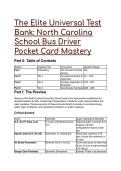
The Elite Universal Test
Bank: North Carolina
School Bus Driver
Pocket Card Mastery
Part 0: Table of Contents
Section Cognitive Tier Focus Area Question Range
Part I Preparatory The Preview & Critical N/A
Axioms
Part II Tier 1 Foundational Syntax & Q1 – Q18
Application
Part II Tier 2 Complex Application & Q19 – Q37
Simulation
Part II Tier 3 Grandmaster Synthesis Q38 – Q55
Part I: The Preview
Mastery of the North Carolina School Bus Driver Pocket Card requirements establishes the
absolute baseline for elite, incident-free transportation of students under rigorous federal and
state mandates. Precise execution of these protocols directly translates to uncompromising
safety, legal compliance, and operational excellence on public roadways.
Critical Axioms
Axiom Parameter Legal / Operational Standard
G.S. 20-217 (Stop Law) 4+ Lanes with Median/Center Opposing traffic is exempt from
Turn stopping. All other
configurations require a total
halt.
Speed Limits (G.S. 20-218) School Bus vs. Activity Bus School Bus maximum is 45
mph; Activity Bus maximum is
55 mph.
Air Brake Parameters Governor Cut-in / Cut-out Cut-in must occur no lower than
85 psi; Cut-out at approximately
120-140 psi.
Danger Zone Perimeter Geometric Dimensions Extends 10 feet in all directions
,Axiom Parameter Legal / Operational Standard
around the bus; students must
wait 6 feet from the curb.
Medical Clearances Visual, Auditory, & Minimum 20/40 visual acuity
Cardiovascular per eye; maximum 40 dB
hearing loss; blood pressure
under 140/90.
Part II: The Elite Test Bank
Tier 1: Foundational Syntax & Application
Q1: An applicant seeks certification to operate a yellow North Carolina school bus. The
individual possesses a valid Class C Commercial Driver's License (CDL) with a Passenger (P)
endorsement but lacks specialized operational training. Based on the principles of North
Carolina commercial licensing, which action is FIRST required to obtain the pocket card?
A) Immediately scheduling a road test with the Division of Motor Vehicles (DMV). B) Submitting
a medical waiver to the North Carolina State Board of Education. C) Enrolling in a 3-day School
Bus Driver Training Class and passing all knowledge tests. D) Driving an activity bus for six
months to gain required commercial experience.
● Answer: C (Enrolling in a 3-day School Bus Driver Training Class and passing all
knowledge tests)
● Distractor Analysis:
○ A is incorrect: A road test cannot be scheduled until the theoretical curriculum is
passed.
○ B is incorrect: Medical waivers do not substitute for the mandatory training
sequence required for licensure.
○ D is incorrect: Driving an activity bus operates under a different primary matrix and
does not fulfill the initial training mandate for a yellow school bus.
The Mentor's Analysis: Foundational certification demands sequential compliance. When facing
initial licensure, the immediate priority is completing the mandatory 3-day theoretical training. By
utilizing structured theoretical validation, you bypass the common trap of premature practical
testing. Professional Intuition: Theoretical mastery must rigidly precede practical operation.
Q2: A fully loaded school bus is traveling on a state-maintained highway where the posted
speed limit is 55 mph. Based on the principles of North Carolina General Statute 20-218, which
conclusion represents the MAXIMUM permissible speed for this vehicle?
A) 35 mph B) 55 mph C) 45 mph D) 50 mph
● Answer: C (45 mph)
● Distractor Analysis:
○ A is incorrect: 35 mph represents the default municipal speed limit, not the statutory
maximum for the vehicle on a highway.
○ B is incorrect: 55 mph is the maximum speed for an activity bus, not a standard
yellow school bus.
○ D is incorrect: 50 mph represents an arbitrary figure not supported by state statutes.
The Mentor's Analysis: Vehicle-specific statutes override general highway postings. When
facing conflicting speed signs, the immediate priority is adhering to the vehicle's statutory
maximum. By utilizing the 45-mph absolute limit, you bypass the common trap of following
generalized traffic flow. Professional Intuition: Statutory vehicle limits permanently supersede
, environmental postings.
Q3: A certified school bus driver is operating on a four-lane divided highway featuring a physical
grass median. The bus activates its flashing red lights and stop arm to discharge students.
Based on the principles of G.S. 20-217, which action is REQUIRED by oncoming traffic traveling
in the opposite direction?
A) Slow down to 25 mph and proceed with caution. B) Come to a complete stop and wait for the
stop arm to retract. C) Proceed without stopping, as the physical median separates the
roadways. D) Stop, sound the horn, and proceed if no children are visible.
● Answer: C (Proceed without stopping, as the physical median separates the roadways)
● Distractor Analysis:
○ A is incorrect: Reducing speed is a general safety practice but not the statutory
requirement for this specific configuration.
○ B is incorrect: Stopping is required on a four-lane road without a median, but the
physical median exempts opposing traffic.
○ D is incorrect: Sounding the horn is irrelevant and stopping is legally unnecessary
for opposing traffic in this scenario.
The Mentor's Analysis: Roadway geometry dictates statutory stopping requirements. When
facing a divided highway, the immediate priority is analyzing the presence of an intervening
space or physical barrier. By utilizing the median exception, you bypass the common trap of
causing unnecessary traffic blockages. Professional Intuition: Physical medians universally
exempt opposing traffic from school bus stop laws.
Q4: A driver candidate undergoes a Department of Transportation (DOT) physical examination.
The examiner records the candidate's blood pressure. Based on the principles of Federal Motor
Carrier Safety Administration (FMCSA) and North Carolina standards, which reading is the
MAXIMUM permissible limit before disqualification or additional medical intervention is
triggered?
A) 120/80 B) 160/100 C) 139/89 D) 150/95
● Answer: C (139/89)
● Distractor Analysis:
○ A is incorrect: 120/80 is an optimal reading, not the maximum operational threshold.
○ B is incorrect: 160/100 significantly exceeds the permissible threshold and warrants
immediate disqualification.
○ D is incorrect: 150/95 exceeds the federal threshold, which requires readings to be
strictly less than 140/90.
The Mentor's Analysis: Physiological stability is non-negotiable for commercial transit. When
facing blood pressure evaluations, the immediate priority is ensuring readings fall strictly below
140 systolic and 90 diastolic. By utilizing this strict physiological metric, you bypass the common
trap of conditional or temporary medical certification errors. Professional Intuition:
Cardiovascular limits are absolute; 140/90 is the operational ceiling.
Q5: A school bus driver must perform a daily pre-trip inspection. During the static air brake
check, the engine is off, the wheels are chocked, and the service brake is fully applied. Based
on the principles of the North Carolina Commercial Driver's Manual, which conclusion is the
MOST APPROPRIATE parameter for pressure loss in this single vehicle?
A) Pressure must not drop more than 4 psi in one minute. B) Pressure must drop exactly 2 psi in
45 seconds. C) Pressure must not drop more than 3 psi in one minute. D) Pressure must remain
completely static with zero loss.
● Answer: C (Pressure must not drop more than 3 psi in one minute)
● Distractor Analysis:
Bank: North Carolina
School Bus Driver
Pocket Card Mastery
Part 0: Table of Contents
Section Cognitive Tier Focus Area Question Range
Part I Preparatory The Preview & Critical N/A
Axioms
Part II Tier 1 Foundational Syntax & Q1 – Q18
Application
Part II Tier 2 Complex Application & Q19 – Q37
Simulation
Part II Tier 3 Grandmaster Synthesis Q38 – Q55
Part I: The Preview
Mastery of the North Carolina School Bus Driver Pocket Card requirements establishes the
absolute baseline for elite, incident-free transportation of students under rigorous federal and
state mandates. Precise execution of these protocols directly translates to uncompromising
safety, legal compliance, and operational excellence on public roadways.
Critical Axioms
Axiom Parameter Legal / Operational Standard
G.S. 20-217 (Stop Law) 4+ Lanes with Median/Center Opposing traffic is exempt from
Turn stopping. All other
configurations require a total
halt.
Speed Limits (G.S. 20-218) School Bus vs. Activity Bus School Bus maximum is 45
mph; Activity Bus maximum is
55 mph.
Air Brake Parameters Governor Cut-in / Cut-out Cut-in must occur no lower than
85 psi; Cut-out at approximately
120-140 psi.
Danger Zone Perimeter Geometric Dimensions Extends 10 feet in all directions
,Axiom Parameter Legal / Operational Standard
around the bus; students must
wait 6 feet from the curb.
Medical Clearances Visual, Auditory, & Minimum 20/40 visual acuity
Cardiovascular per eye; maximum 40 dB
hearing loss; blood pressure
under 140/90.
Part II: The Elite Test Bank
Tier 1: Foundational Syntax & Application
Q1: An applicant seeks certification to operate a yellow North Carolina school bus. The
individual possesses a valid Class C Commercial Driver's License (CDL) with a Passenger (P)
endorsement but lacks specialized operational training. Based on the principles of North
Carolina commercial licensing, which action is FIRST required to obtain the pocket card?
A) Immediately scheduling a road test with the Division of Motor Vehicles (DMV). B) Submitting
a medical waiver to the North Carolina State Board of Education. C) Enrolling in a 3-day School
Bus Driver Training Class and passing all knowledge tests. D) Driving an activity bus for six
months to gain required commercial experience.
● Answer: C (Enrolling in a 3-day School Bus Driver Training Class and passing all
knowledge tests)
● Distractor Analysis:
○ A is incorrect: A road test cannot be scheduled until the theoretical curriculum is
passed.
○ B is incorrect: Medical waivers do not substitute for the mandatory training
sequence required for licensure.
○ D is incorrect: Driving an activity bus operates under a different primary matrix and
does not fulfill the initial training mandate for a yellow school bus.
The Mentor's Analysis: Foundational certification demands sequential compliance. When facing
initial licensure, the immediate priority is completing the mandatory 3-day theoretical training. By
utilizing structured theoretical validation, you bypass the common trap of premature practical
testing. Professional Intuition: Theoretical mastery must rigidly precede practical operation.
Q2: A fully loaded school bus is traveling on a state-maintained highway where the posted
speed limit is 55 mph. Based on the principles of North Carolina General Statute 20-218, which
conclusion represents the MAXIMUM permissible speed for this vehicle?
A) 35 mph B) 55 mph C) 45 mph D) 50 mph
● Answer: C (45 mph)
● Distractor Analysis:
○ A is incorrect: 35 mph represents the default municipal speed limit, not the statutory
maximum for the vehicle on a highway.
○ B is incorrect: 55 mph is the maximum speed for an activity bus, not a standard
yellow school bus.
○ D is incorrect: 50 mph represents an arbitrary figure not supported by state statutes.
The Mentor's Analysis: Vehicle-specific statutes override general highway postings. When
facing conflicting speed signs, the immediate priority is adhering to the vehicle's statutory
maximum. By utilizing the 45-mph absolute limit, you bypass the common trap of following
generalized traffic flow. Professional Intuition: Statutory vehicle limits permanently supersede
, environmental postings.
Q3: A certified school bus driver is operating on a four-lane divided highway featuring a physical
grass median. The bus activates its flashing red lights and stop arm to discharge students.
Based on the principles of G.S. 20-217, which action is REQUIRED by oncoming traffic traveling
in the opposite direction?
A) Slow down to 25 mph and proceed with caution. B) Come to a complete stop and wait for the
stop arm to retract. C) Proceed without stopping, as the physical median separates the
roadways. D) Stop, sound the horn, and proceed if no children are visible.
● Answer: C (Proceed without stopping, as the physical median separates the roadways)
● Distractor Analysis:
○ A is incorrect: Reducing speed is a general safety practice but not the statutory
requirement for this specific configuration.
○ B is incorrect: Stopping is required on a four-lane road without a median, but the
physical median exempts opposing traffic.
○ D is incorrect: Sounding the horn is irrelevant and stopping is legally unnecessary
for opposing traffic in this scenario.
The Mentor's Analysis: Roadway geometry dictates statutory stopping requirements. When
facing a divided highway, the immediate priority is analyzing the presence of an intervening
space or physical barrier. By utilizing the median exception, you bypass the common trap of
causing unnecessary traffic blockages. Professional Intuition: Physical medians universally
exempt opposing traffic from school bus stop laws.
Q4: A driver candidate undergoes a Department of Transportation (DOT) physical examination.
The examiner records the candidate's blood pressure. Based on the principles of Federal Motor
Carrier Safety Administration (FMCSA) and North Carolina standards, which reading is the
MAXIMUM permissible limit before disqualification or additional medical intervention is
triggered?
A) 120/80 B) 160/100 C) 139/89 D) 150/95
● Answer: C (139/89)
● Distractor Analysis:
○ A is incorrect: 120/80 is an optimal reading, not the maximum operational threshold.
○ B is incorrect: 160/100 significantly exceeds the permissible threshold and warrants
immediate disqualification.
○ D is incorrect: 150/95 exceeds the federal threshold, which requires readings to be
strictly less than 140/90.
The Mentor's Analysis: Physiological stability is non-negotiable for commercial transit. When
facing blood pressure evaluations, the immediate priority is ensuring readings fall strictly below
140 systolic and 90 diastolic. By utilizing this strict physiological metric, you bypass the common
trap of conditional or temporary medical certification errors. Professional Intuition:
Cardiovascular limits are absolute; 140/90 is the operational ceiling.
Q5: A school bus driver must perform a daily pre-trip inspection. During the static air brake
check, the engine is off, the wheels are chocked, and the service brake is fully applied. Based
on the principles of the North Carolina Commercial Driver's Manual, which conclusion is the
MOST APPROPRIATE parameter for pressure loss in this single vehicle?
A) Pressure must not drop more than 4 psi in one minute. B) Pressure must drop exactly 2 psi in
45 seconds. C) Pressure must not drop more than 3 psi in one minute. D) Pressure must remain
completely static with zero loss.
● Answer: C (Pressure must not drop more than 3 psi in one minute)
● Distractor Analysis:


