

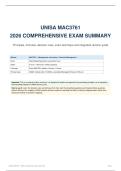
UNISA MAC3761
2026 COMPREHENSIVE EXAM SUMMARY
Principles, formulas, decision rules, exam technique and integrated revision guide
Module MAC3761 – Management Accounting / Financial Management
Exam 2026 October/November examination focus
Paper 3 hours • 100 marks • written questions
Coverage Entire MAC3761 syllabus: Costing + Finance
Primary basis UNISA Tutorial Letter 101/2026 + prescribed Managerial Finance (10th ed.)
Important: This is an original revision summary. It is designed to explain and organise the examinable principles, not to reproduce
the prescribed textbook or UNISA learning units.
How to use it: Learn the decision rules and formulas first; then work the prescribed questions and Question Bank questions
without looking at the mapping. UNISA explicitly advises students to develop the ability to identify integrated topics rather than
relying too heavily on question mappings.
UNISA MAC3761 • 2026 Comprehensive Exam Summary Page 1
, 1. 2026 EXAMINATION ROADMAP
The 2026 tutorial letter states that the final examination covers the entire MAC3761 syllabus. The paper is three hours, out of 100
marks, entirely written, with no multiple-choice questions; all questions must be answered.
Admission and weighting
Item 2026 requirement
Year mark / admission At least 40% average for the required assessments/tests to qualify for the examination.
Year mark contribution 30% of final module mark.
Examination contribution 70% of final module mark.
Examination subminimum If less than 40% is obtained in the examination, the year mark does not count and the examination mark becomes the f
Final paper 3 hours; 100 marks; written questions; no MCQs.
Scope Entire MAC3761 syllabus.
UNISA's official 2026 study programme divides MAC3761 into Costing in the first half and Finance in the second half. Tests 1–2
focus on Costing, Test 3 on Finance, and Test 4 is integrated across both components.
Finance learning-unit map for the 2026 final revision
LU Topic Textbook link Priority
13 Introduction to financial management Ch. 1 High
14 Strategy and business models Ch. 2 High
15 Risk management and governance Ch. 3 High
16 Sources and forms of finance Ch. 7 High
17 Capital structure & cost of capital Ch. 1, 4, 5, 10 Very high
18 Working capital management Ch. 8 liquidity ratios + Ch. 9 Very high
19 Treasury function Ch. 15–16 Very high
20 Dividend decision Ch. 14 High
21 Reporting & performance analysis Ch. 8 Very high
22 Capital budgeting Ch. 6 Very high
23 Business valuations Ch. 11 Very high
24 Mergers & acquisitions Ch. 12 High
The 2026 programme gives the heaviest minimum theory time to capital structure/cost of capital, working capital, treasury,
reporting/performance, capital budgeting and business valuation. Treat these as core calculation + interpretation areas.
UNISA MAC3761 • 2026 Comprehensive Exam Summary Page 2
, 2. MASTER SYLLABUS MAP – COSTING
Weeks LU Topic Core skills
1 01 Cost classification & estimation Fixed/variable/mixed costs; high-low; regression concepts; cost behaviour.
2–3 02 Relevant costing Relevant cash flows; avoidable/unavoidable; opportunity costs; sunk costs; special decis
4 03 CVP relationships Contribution; break-even; target profit; margin of safety; operating leverage.
5 04 Budgets; planning & control Functional budgets; cash budget; flexible budgets; behavioural/strategic issues.
6 05 Variable/direct & absorption costing Product cost; inventory valuation; profit reconciliation; marginal vs absorption.
7 06 Overhead allocation Traditional allocation; ABC; allocation bases; cost drivers.
8–9 07 Standard costing Standards; material/labour/overhead variances; interpretation and management action.
10 08 Process costing Equivalent units; normal/abnormal losses; process accounts.
11 09 Joint & by-product costing Joint costs; split-off; NRV; further processing decisions.
12–13 10 Performance management ROI; RI; KPIs; divisional performance; behavioural effects.
14–15 11 Price setting Target costing; value analysis; pricing strategies; constraints/capacity.
16 12 Ancillary topics Theory of constraints; linear programming principles; integrated decision-making.
2026 Costing outcomes emphasise applying techniques to alternative pricing and capacity decisions, contribution per limiting
factor, forecasting, variance interpretation, costing methods, transfer pricing, sensitivity/scenario analysis, and recommendations
that combine quantitative and qualitative factors.
UNISA MAC3761 • 2026 Comprehensive Exam Summary Page 3
2026 COMPREHENSIVE EXAM SUMMARY
Principles, formulas, decision rules, exam technique and integrated revision guide
Module MAC3761 – Management Accounting / Financial Management
Exam 2026 October/November examination focus
Paper 3 hours • 100 marks • written questions
Coverage Entire MAC3761 syllabus: Costing + Finance
Primary basis UNISA Tutorial Letter 101/2026 + prescribed Managerial Finance (10th ed.)
Important: This is an original revision summary. It is designed to explain and organise the examinable principles, not to reproduce
the prescribed textbook or UNISA learning units.
How to use it: Learn the decision rules and formulas first; then work the prescribed questions and Question Bank questions
without looking at the mapping. UNISA explicitly advises students to develop the ability to identify integrated topics rather than
relying too heavily on question mappings.
UNISA MAC3761 • 2026 Comprehensive Exam Summary Page 1
, 1. 2026 EXAMINATION ROADMAP
The 2026 tutorial letter states that the final examination covers the entire MAC3761 syllabus. The paper is three hours, out of 100
marks, entirely written, with no multiple-choice questions; all questions must be answered.
Admission and weighting
Item 2026 requirement
Year mark / admission At least 40% average for the required assessments/tests to qualify for the examination.
Year mark contribution 30% of final module mark.
Examination contribution 70% of final module mark.
Examination subminimum If less than 40% is obtained in the examination, the year mark does not count and the examination mark becomes the f
Final paper 3 hours; 100 marks; written questions; no MCQs.
Scope Entire MAC3761 syllabus.
UNISA's official 2026 study programme divides MAC3761 into Costing in the first half and Finance in the second half. Tests 1–2
focus on Costing, Test 3 on Finance, and Test 4 is integrated across both components.
Finance learning-unit map for the 2026 final revision
LU Topic Textbook link Priority
13 Introduction to financial management Ch. 1 High
14 Strategy and business models Ch. 2 High
15 Risk management and governance Ch. 3 High
16 Sources and forms of finance Ch. 7 High
17 Capital structure & cost of capital Ch. 1, 4, 5, 10 Very high
18 Working capital management Ch. 8 liquidity ratios + Ch. 9 Very high
19 Treasury function Ch. 15–16 Very high
20 Dividend decision Ch. 14 High
21 Reporting & performance analysis Ch. 8 Very high
22 Capital budgeting Ch. 6 Very high
23 Business valuations Ch. 11 Very high
24 Mergers & acquisitions Ch. 12 High
The 2026 programme gives the heaviest minimum theory time to capital structure/cost of capital, working capital, treasury,
reporting/performance, capital budgeting and business valuation. Treat these as core calculation + interpretation areas.
UNISA MAC3761 • 2026 Comprehensive Exam Summary Page 2
, 2. MASTER SYLLABUS MAP – COSTING
Weeks LU Topic Core skills
1 01 Cost classification & estimation Fixed/variable/mixed costs; high-low; regression concepts; cost behaviour.
2–3 02 Relevant costing Relevant cash flows; avoidable/unavoidable; opportunity costs; sunk costs; special decis
4 03 CVP relationships Contribution; break-even; target profit; margin of safety; operating leverage.
5 04 Budgets; planning & control Functional budgets; cash budget; flexible budgets; behavioural/strategic issues.
6 05 Variable/direct & absorption costing Product cost; inventory valuation; profit reconciliation; marginal vs absorption.
7 06 Overhead allocation Traditional allocation; ABC; allocation bases; cost drivers.
8–9 07 Standard costing Standards; material/labour/overhead variances; interpretation and management action.
10 08 Process costing Equivalent units; normal/abnormal losses; process accounts.
11 09 Joint & by-product costing Joint costs; split-off; NRV; further processing decisions.
12–13 10 Performance management ROI; RI; KPIs; divisional performance; behavioural effects.
14–15 11 Price setting Target costing; value analysis; pricing strategies; constraints/capacity.
16 12 Ancillary topics Theory of constraints; linear programming principles; integrated decision-making.
2026 Costing outcomes emphasise applying techniques to alternative pricing and capacity decisions, contribution per limiting
factor, forecasting, variance interpretation, costing methods, transfer pricing, sensitivity/scenario analysis, and recommendations
that combine quantitative and qualitative factors.
UNISA MAC3761 • 2026 Comprehensive Exam Summary Page 3


