FINANCIAL ACCOUNTING STUDY GUIDE
Comprehensive Step-by-Step Concepts, Key Definitions & Objective Practice
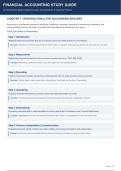
CHAPTER 1: INTRODUCTION & THE ACCOUNTING PROCESS
Accounting is a systematic process of identifying, measuring, recording, classifying, summarising, interpreting, and
communicating financial information to enable informed judgements and decisions by users.
The 6 Core Steps in Accounting
Step 1: Identification
Selecting events and activities that are of financial nature and relate directly to the enterprise.
Example: Deciding to record the purchase of modern office computers while ignoring routine job interviews for new staff.
Step 2: Measurement
Quantifying financial transactions into a common monetary unit (e.g., USD, INR, EUR).
Example: Recording a timber purchase as $1,500 rather than "50 wooden planks".
Step 3: Recording
Entering measured monetary transactions chronologically into the original books of entry (Journal).
Example: Writing down a cash sales entry in the primary Cash Book on the date of transaction.
Step 4: Classifying
Grouping recorded transactions of similar nature into dedicated ledger accounts.
Example: Posting all individual rent payments made throughout the year into a single Rent Account.
Step 5: Summarising
Presenting classified data in understandable summary reports like Trial Balance and Financial Statements.
Example: Aggregating revenue and expense accounts into a Profit & Loss statement to find net yearly profit.
Step 6: Analysis, Interpretation & Communication
Evaluating financial results to draw meaningful insights and sharing final reports with stakeholders.
Example: Presenting annual audited balance sheets to banking institutions to secure a growth loan.
Page 1 of 8
, CHAPTER 2: ESSENTIAL ACCOUNTING TERMS - BUSINESS & ASSETS
1. Entity
A distinctly identified economic unit performing business activities independently.
Example: Sole proprietorships, partnerships, or legal corporations like Infosys Ltd and Apple Inc.
2. Business Transaction
A financial event or exchange between two or more parties recorded in the accounting books.
Example: Paying $500 monthly factory rent, purchasing raw steel, or receiving customer payments.
3. Assets
Valuable tangible or intangible economic resources owned by a business to generate future financial benefits.
Current Assets: Non-Current Assets:
Assets intended to be converted into cash within one year Long-term assets held to facilitate business operations
or one operating cycle. rather than immediate resale.
Examples: Cash in hand, bank balance, short-term Examples: Manufacturing machinery, land, office
investments, accounts receivable, stock. buildings, delivery trucks.
Sub-classification of Non-Current Assets:
• Tangible Assets: Assets with physical existence that can be touched and seen (e.g., Furniture, Machinery).
• Intangible Assets: Assets without physical substance providing long-term value (e.g., Patents, Trademarks, Goodwill).
Objective Check 1
Which of the following is an intangible asset?
A) Cash in Hand B) Machinery C) Goodwill D) Stock
Answer: C) Goodwill
Objective Check 2
Assets held for short-term conversion into cash within a year are called:
A) Fixed Assets B) Current Assets C) Intangible Assets D) Non-Current Assets
Answer: B) Current Assets
Page 2 of 8
Comprehensive Step-by-Step Concepts, Key Definitions & Objective Practice
CHAPTER 1: INTRODUCTION & THE ACCOUNTING PROCESS
Accounting is a systematic process of identifying, measuring, recording, classifying, summarising, interpreting, and
communicating financial information to enable informed judgements and decisions by users.
The 6 Core Steps in Accounting
Step 1: Identification
Selecting events and activities that are of financial nature and relate directly to the enterprise.
Example: Deciding to record the purchase of modern office computers while ignoring routine job interviews for new staff.
Step 2: Measurement
Quantifying financial transactions into a common monetary unit (e.g., USD, INR, EUR).
Example: Recording a timber purchase as $1,500 rather than "50 wooden planks".
Step 3: Recording
Entering measured monetary transactions chronologically into the original books of entry (Journal).
Example: Writing down a cash sales entry in the primary Cash Book on the date of transaction.
Step 4: Classifying
Grouping recorded transactions of similar nature into dedicated ledger accounts.
Example: Posting all individual rent payments made throughout the year into a single Rent Account.
Step 5: Summarising
Presenting classified data in understandable summary reports like Trial Balance and Financial Statements.
Example: Aggregating revenue and expense accounts into a Profit & Loss statement to find net yearly profit.
Step 6: Analysis, Interpretation & Communication
Evaluating financial results to draw meaningful insights and sharing final reports with stakeholders.
Example: Presenting annual audited balance sheets to banking institutions to secure a growth loan.
Page 1 of 8
, CHAPTER 2: ESSENTIAL ACCOUNTING TERMS - BUSINESS & ASSETS
1. Entity
A distinctly identified economic unit performing business activities independently.
Example: Sole proprietorships, partnerships, or legal corporations like Infosys Ltd and Apple Inc.
2. Business Transaction
A financial event or exchange between two or more parties recorded in the accounting books.
Example: Paying $500 monthly factory rent, purchasing raw steel, or receiving customer payments.
3. Assets
Valuable tangible or intangible economic resources owned by a business to generate future financial benefits.
Current Assets: Non-Current Assets:
Assets intended to be converted into cash within one year Long-term assets held to facilitate business operations
or one operating cycle. rather than immediate resale.
Examples: Cash in hand, bank balance, short-term Examples: Manufacturing machinery, land, office
investments, accounts receivable, stock. buildings, delivery trucks.
Sub-classification of Non-Current Assets:
• Tangible Assets: Assets with physical existence that can be touched and seen (e.g., Furniture, Machinery).
• Intangible Assets: Assets without physical substance providing long-term value (e.g., Patents, Trademarks, Goodwill).
Objective Check 1
Which of the following is an intangible asset?
A) Cash in Hand B) Machinery C) Goodwill D) Stock
Answer: C) Goodwill
Objective Check 2
Assets held for short-term conversion into cash within a year are called:
A) Fixed Assets B) Current Assets C) Intangible Assets D) Non-Current Assets
Answer: B) Current Assets
Page 2 of 8