
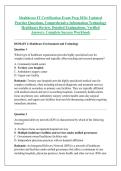
Healthcare IT Certification Exam Prep 2026: Updated
Practice Questions, Comprehensive Information Technology
Healthcare Review, Detailed Explanations, Verified
Answers, Complete Success Workbook
DOMAIN I: Healthcare Environment and Technology
Question 1
Which type of healthcare organization provides highly specialized care for
complex medical conditions and typically offers teaching and research programs?
A. Community health center
B. Tertiary care hospital
C. Ambulatory surgery center
D. Urgent care facility
Rationale: Tertiary care hospitals provide highly specialized medical care for
complex conditions, often including advanced diagnostic and treatment services
not available at secondary or primary care facilities. They are typically affiliated
with medical schools and serve as teaching hospitals. Community health centers
focus on primary care, ambulatory surgery centers handle same-day surgical
procedures, and urgent care facilities treat non-life-threatening conditions requiring
immediate attention.
Question 2
An integrated delivery network (IDN) is characterized by which of the following
features?
A. Exclusive focus on inpatient hospital services
B. Multiple healthcare facilities and services under unified governance
C. Government-owned healthcare facilities only
D. Independent physician practices with no hospital affiliation
Rationale: An Integrated Delivery Network (IDN) is a network of healthcare
providers and facilities under unified governance that offers a continuum of care
including hospitals, physician practices, home health, and other services. IDNs aim
,to coordinate care across settings and improve efficiency. They are not limited to
inpatient services, government ownership, or independent practices.
Question 3
A healthcare organization is implementing a new population health management
program focused on preventive care for diabetic patients. Which type of
organization would most likely lead this initiative?
A. Acute care hospital
B. Accountable Care Organization (ACO)
C. Specialty referral center
D. Long-term acute care hospital
Rationale: Accountable Care Organizations (ACOs) are specifically designed to
improve care coordination and health outcomes for defined populations while
reducing costs. They emphasize preventive care, chronic disease management, and
care coordination across settings. ACOs are held accountable for quality and cost
metrics, making them well-suited for population health initiatives. Acute care
hospitals focus on inpatient treatment, specialty centers handle specific complex
conditions, and LTACs provide extended care for critically ill patients.
Question 4
Which of the following is NOT identified as a current issue facing healthcare
providers?
A. Rising healthcare costs
B. Variations in clinical quality
C. Patient safety concerns
D. Decreasing consumer expectations
Rationale: Healthcare providers face rising costs, variable clinical quality, patient
safety concerns, evidence-based decision-making needs, administrative
complexity, and advances in research and technology. Consumer expectations are
increasing, not decreasing.
,Question 5
Under HIPAA, which of the following represents the minimum necessary
standard?
A. All workforce members may access any patient record
B. Only the information needed to accomplish a specific purpose should be
accessed
C. Patients must authorize every disclosure of their information
D. Healthcare providers may share information freely with business associates
Rationale: The HIPAA Privacy Rule's minimum necessary standard requires that
covered entities take reasonable steps to limit the use or disclosure of protected
health information to the minimum necessary to accomplish the intended purpose.
This means accessing only the information needed for a specific task. The standard
does not permit unrestricted access, does not require authorization for every
disclosure (treatment, payment, and operations exceptions exist), and does not
allow unlimited sharing with business associates.
Question 6
Which federal agency is responsible for enforcing the HIPAA Privacy Rule?
A. Centers for Medicare & Medicaid Services (CMS)
B. Food and Drug Administration (FDA)
C. Office for Civil Rights (OCR)
D. Office of the National Coordinator for Health IT (ONC)
Rationale: The Office for Civil Rights (OCR) within the U.S. Department of
Health and Human Services enforces the HIPAA Privacy and Security Rules,
handling complaints and compliance investigations. CMS administers Medicare
and Medicaid, FDA regulates medical products, and ONC coordinates health IT
initiatives but does not enforce HIPAA.
Question 7
What is the primary purpose of the HIPAA Security Rule?
, A. To protect paper-based patient records
B. To establish national standards for protecting electronic protected health
information (ePHI)
C. To regulate financial transactions between healthcare providers
D. To establish privacy rights for patients
Rationale: The HIPAA Security Rule specifically establishes national standards
for protecting electronic protected health information (ePHI) during transmission
and at rest. The Privacy Rule protects all forms of PHI (paper and electronic),
while the Security Rule focuses specifically on ePHI. Financial transactions are
regulated under HIPAA's Administrative Simplification provisions.
Question 8
Which of the following is considered protected health information (PHI) under
HIPAA?
A. Patient's age and gender
B. Hospital's address and phone number
C. Patient's medical record number and diagnosis
D. Publicly available health statistics
Rationale: PHI includes any information that identifies an individual and relates to
their past, present, or future physical or mental health condition, treatment, or
payment. A medical record number combined with a diagnosis constitutes PHI. A
patient's age and gender alone are not typically considered PHI (unless combined
with other identifiers). Hospital addresses and phone numbers are not PHI.
Publicly available health statistics are not PHI.
Question 9
In the context of healthcare IT, what does HL7 stand for?
A. Health Level Seven
B. Hospital Logistics 7
C. Health Link 7
D. Healthcare Language 7
Practice Questions, Comprehensive Information Technology
Healthcare Review, Detailed Explanations, Verified
Answers, Complete Success Workbook
DOMAIN I: Healthcare Environment and Technology
Question 1
Which type of healthcare organization provides highly specialized care for
complex medical conditions and typically offers teaching and research programs?
A. Community health center
B. Tertiary care hospital
C. Ambulatory surgery center
D. Urgent care facility
Rationale: Tertiary care hospitals provide highly specialized medical care for
complex conditions, often including advanced diagnostic and treatment services
not available at secondary or primary care facilities. They are typically affiliated
with medical schools and serve as teaching hospitals. Community health centers
focus on primary care, ambulatory surgery centers handle same-day surgical
procedures, and urgent care facilities treat non-life-threatening conditions requiring
immediate attention.
Question 2
An integrated delivery network (IDN) is characterized by which of the following
features?
A. Exclusive focus on inpatient hospital services
B. Multiple healthcare facilities and services under unified governance
C. Government-owned healthcare facilities only
D. Independent physician practices with no hospital affiliation
Rationale: An Integrated Delivery Network (IDN) is a network of healthcare
providers and facilities under unified governance that offers a continuum of care
including hospitals, physician practices, home health, and other services. IDNs aim
,to coordinate care across settings and improve efficiency. They are not limited to
inpatient services, government ownership, or independent practices.
Question 3
A healthcare organization is implementing a new population health management
program focused on preventive care for diabetic patients. Which type of
organization would most likely lead this initiative?
A. Acute care hospital
B. Accountable Care Organization (ACO)
C. Specialty referral center
D. Long-term acute care hospital
Rationale: Accountable Care Organizations (ACOs) are specifically designed to
improve care coordination and health outcomes for defined populations while
reducing costs. They emphasize preventive care, chronic disease management, and
care coordination across settings. ACOs are held accountable for quality and cost
metrics, making them well-suited for population health initiatives. Acute care
hospitals focus on inpatient treatment, specialty centers handle specific complex
conditions, and LTACs provide extended care for critically ill patients.
Question 4
Which of the following is NOT identified as a current issue facing healthcare
providers?
A. Rising healthcare costs
B. Variations in clinical quality
C. Patient safety concerns
D. Decreasing consumer expectations
Rationale: Healthcare providers face rising costs, variable clinical quality, patient
safety concerns, evidence-based decision-making needs, administrative
complexity, and advances in research and technology. Consumer expectations are
increasing, not decreasing.
,Question 5
Under HIPAA, which of the following represents the minimum necessary
standard?
A. All workforce members may access any patient record
B. Only the information needed to accomplish a specific purpose should be
accessed
C. Patients must authorize every disclosure of their information
D. Healthcare providers may share information freely with business associates
Rationale: The HIPAA Privacy Rule's minimum necessary standard requires that
covered entities take reasonable steps to limit the use or disclosure of protected
health information to the minimum necessary to accomplish the intended purpose.
This means accessing only the information needed for a specific task. The standard
does not permit unrestricted access, does not require authorization for every
disclosure (treatment, payment, and operations exceptions exist), and does not
allow unlimited sharing with business associates.
Question 6
Which federal agency is responsible for enforcing the HIPAA Privacy Rule?
A. Centers for Medicare & Medicaid Services (CMS)
B. Food and Drug Administration (FDA)
C. Office for Civil Rights (OCR)
D. Office of the National Coordinator for Health IT (ONC)
Rationale: The Office for Civil Rights (OCR) within the U.S. Department of
Health and Human Services enforces the HIPAA Privacy and Security Rules,
handling complaints and compliance investigations. CMS administers Medicare
and Medicaid, FDA regulates medical products, and ONC coordinates health IT
initiatives but does not enforce HIPAA.
Question 7
What is the primary purpose of the HIPAA Security Rule?
, A. To protect paper-based patient records
B. To establish national standards for protecting electronic protected health
information (ePHI)
C. To regulate financial transactions between healthcare providers
D. To establish privacy rights for patients
Rationale: The HIPAA Security Rule specifically establishes national standards
for protecting electronic protected health information (ePHI) during transmission
and at rest. The Privacy Rule protects all forms of PHI (paper and electronic),
while the Security Rule focuses specifically on ePHI. Financial transactions are
regulated under HIPAA's Administrative Simplification provisions.
Question 8
Which of the following is considered protected health information (PHI) under
HIPAA?
A. Patient's age and gender
B. Hospital's address and phone number
C. Patient's medical record number and diagnosis
D. Publicly available health statistics
Rationale: PHI includes any information that identifies an individual and relates to
their past, present, or future physical or mental health condition, treatment, or
payment. A medical record number combined with a diagnosis constitutes PHI. A
patient's age and gender alone are not typically considered PHI (unless combined
with other identifiers). Hospital addresses and phone numbers are not PHI.
Publicly available health statistics are not PHI.
Question 9
In the context of healthcare IT, what does HL7 stand for?
A. Health Level Seven
B. Hospital Logistics 7
C. Health Link 7
D. Healthcare Language 7


