

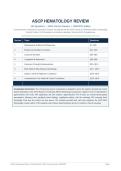
ASCP HEMATOLOGY REVIEW
150 Questions | 100% Correct Answers | 2026/2027 Edition
Comprehensive Certification Examination Practice Set Aligned with the ASCP Board of Certification (BOC) Hematology
Content Outline, CLSI Standards, and Medical Laboratory Science (MLS) Competencies
Section Topic Questions
1 Hematopoiesis & Blood Cell Maturation Q1–Q20
2 Erythrocyte Disorders & Anemias Q21–Q45
3 Leukocyte Disorders Q46–Q65
4 Coagulation & Hemostasis Q66–Q90
5 Laboratory Testing & Instrumentation Q91–Q110
6 Body Fluids & Miscellaneous Hematology Q111–Q125
7 Quality Control & Regulatory Compliance Q126–Q135
8 Comprehensive Case Studies & Clinical Correlations Q136–Q150
Total 150 Questions
Examination Instructions: This 150-question practice examination is designed to mirror the cognitive demand and content
domain distribution of the ASCP Board of Certification (BOC) Hematology examination. Cognitive levels are distributed as
approximately 25% recall, 50% application, and 25% analysis. Approximately 75% of items are scenario-based (patient
presentations, laboratory data, peripheral smear findings, coagulation results), with the remaining 25% assessing direct
knowledge. Each item has exactly one best answer. The rationale provided after each item references the ASCP BOC
Hematology content outline, CLSI standards, and evidence-based laboratory practice to reinforce clinical reasoning.
ASCP Hematology Review | 150 Questions | 100% Correct Answers 2026/2027 Page 1
, Section 1: Hematopoiesis & Blood Cell Maturation
20 Questions | Cognitive mix: 25% recall, 50% application, 25% analysis | ASCP BOC Content Area: Blood Cell Maturation,
Hematopoiesis, Growth Factors, Iron/B12/Folate Metabolism.
Q1: A 38-year-old donor is being evaluated for peripheral blood stem cell collection. Which cell surface
marker, when enriched by immunomagnetic selection, most specifically identifies the hematopoietic stem cell
population to be harvested?
A. CD3
B. CD34 *[CORRECT]*
C. CD14
D. CD41
Correct Answer: B
Rationale: CD34 is the canonical surface marker used to identify and enumerate hematopoietic stem and progenitor cells
(HSPCs) for both engraftment assessment and peripheral blood stem cell harvesting per ASCP BOC Hematology content outline
on hematopoiesis. CD3 marks mature T lymphocytes, CD14 marks monocytes/macrophages, and CD41 marks
megakaryocytes/platelets; none represent pluripotent HSCs.
Q2: A bone marrow core biopsy is performed to assess overall architecture and cellularity. Compared with an
aspirate smear, what is the principal diagnostic advantage of the core biopsy?
A. Superior cytologic detail of individual blast morphology
B. Better visualization of cytochemical staining reactions
C. Evaluation of marrow architecture, cellularity, and fibrosis *[CORRECT]*
D. More accurate identification of ringed sideroblasts
Correct Answer: C
Rationale: The core biopsy preserves marrow architecture, permitting objective assessment of cellularity (age-adjusted),
trabecular pattern, fibrosis (reticulin/collagen), and granuloma or infiltration per CLSI H5-A bone marrow standards. Aspirate
smears excel at cytologic detail and cytochemistry but are vulnerable to hemodilution and cannot quantify fibrosis; sideroblasts
require Perls' Prussian blue stain on aspirate particles.
Q3: During erythroid maturation, at which developmental stage does the cell first lose its nucleus and become
a recognizable reticulocyte in the peripheral blood?
A. Pronormoblast
B. Basophilic normoblast
C. Orthochromatic normoblast *[CORRECT]*
D. Polychromatophilic normoblast
Correct Answer: C
Rationale: The orthochromatic normoblast extrudes its pyknotic nucleus to become a reticulocyte, the last anucleate stage still
containing residual RNA. The pronormoblast is the earliest recognizable erythroid precursor; basophilic and
polychromatophilic normoblasts retain large nuclei with progressive hemoglobinization. ASCP BOC Hematology expects
technologists to know the full erythroid maturation sequence.
ASCP Hematology Review | 150 Questions | 100% Correct Answers 2026/2027 Page 2
, Q4: A 55-year-old man with chronic kidney disease stage 5 has a hemoglobin of 8.2 g/dL and absolute
reticulocyte count of 25 × 10⁹/L (low). Which growth factor, produced primarily by the peritubular interstitial
cells of the kidney, is deficient in this patient?
A. Granulocyte colony-stimulating factor (G-CSF)
B. Thrombopoietin (TPO)
C. Erythropoietin (EPO) *[CORRECT]*
D. Granulocyte-macrophage colony-stimulating factor (GM-CSF)
Correct Answer: C
Rationale: Erythropoietin (EPO) is produced by peritubular interstitial fibroblasts of the renal cortex in response to hypoxia via
HIF-2α. Renal failure causes inappropriately low EPO, producing a normocytic, hypoproliferative anemia correctable with
recombinant EPO. G-CSF and GM-CSF regulate myelopoiesis; TPO regulates megakaryocytes and is hepatic.
Q5: In normal myeloid maturation, which feature best distinguishes a myelocyte from a metamyelocyte on a
Wright-stained peripheral smear?
A. Presence of primary (azurophilic) granules
B. Eccentric kidney-shaped (indented) nucleus *[CORRECT]*
C. Cytoplasmic basophilia exceeding 50%
D. Complete absence of secondary (specific) granules
Correct Answer: B
Rationale: The metamyelocyte is the first stage with a clearly indented (kidney-shaped) nucleus that is no longer round; it is the
last proliferative (non-dividing) stage of myelopoiesis. Myelocytes retain a round/oval nucleus but contain abundant secondary
(specific) granules. Primary granules persist from promyelocyte onward, and cytoplasmic basophilia decreases with maturation.
ASCP BOC expects recognition of myeloid stage transitions.
Q6: Which cytokine, produced constitutively by the liver, is the principal regulator of megakaryocyte
development and platelet production, and serves as the therapeutic target of romiplostim and eltrombopag in
immune thrombocytopenia?
A. Interleukin-3 (IL-3)
B. Stem cell factor (SCF, c-kit ligand)
C. Thrombopoietin (TPO) *[CORRECT]*
D. Interleukin-11 (IL-11)
Correct Answer: C
Rationale: Thrombopoietin (TPO), produced constitutively by hepatocytes and bound to platelets via the c-Mpl receptor, drives
megakaryocyte colony-forming unit (CFU-MK) proliferation, maturation, and proplatelet formation. Romiplostim (peptibody)
and eltrombopag (small molecule) are TPO receptor agonists used in chronic ITP. IL-3 and IL-11 have overlapping but
secondary roles; SCF supports stem cell survival.
ASCP Hematology Review | 150 Questions | 100% Correct Answers 2026/2027 Page 3
, Q7: A patient on long-term chemotherapy receives filgrastim to shorten neutropenic episodes. What is the
principal cellular target and clinical effect of G-CSF?
A. Erythroid progenitors → increased reticulocyte production
B. Committed neutrophil progenitors → proliferation, differentiation, and release of neutrophils
*[CORRECT]*
C. Megakaryocytes → increased platelet production
D. B-lymphocyte precursors → enhanced immunoglobulin production
Correct Answer: B
Rationale: Filgrastim (recombinant human G-CSF) acts on committed neutrophil progenitors (CFU-G) to drive proliferation,
terminal differentiation, and release of neutrophils from the bone marrow storage pool, reducing the duration of
chemotherapy-induced neutropenia per ASCP BOC growth factor content. EPO targets erythroid progenitors; TPO targets
megakaryocytes; IL-7 regulates lymphopoiesis.
Q8: Which metabolic pathway is responsible for generating NADPH required to maintain glutathione in its
reduced state, thereby protecting the erythrocyte from oxidative denaturation of hemoglobin?
A. Embden-Meyerhof (glycolytic) pathway
B. Rapoport-Luebering shunt
C. Hexose monophosphate (HMP) shunt *[CORRECT]*
D. Methemoglobin reductase (NADH-cytochrome b5) pathway
Correct Answer: C
Rationale: The HMP shunt (pentose phosphate pathway) generates NADPH, which reduces glutathione via glutathione
reductase; reduced glutathione detoxifies peroxides and prevents oxidation of hemoglobin to methemoglobin and formation of
Heinz bodies. Deficiency of glucose-6-phosphate dehydrogenase (the rate-limiting enzyme of the HMP shunt) produces oxidative
hemolysis. Glycolysis generates ATP; the Rapoport-Luebering shunt generates 2,3-BPG; methemoglobin reductase reduces
Fe³ hemoglobin.
Q9: Laboratory data on a 45-year-woman show: serum iron 25 µg/dL (low), ferritin 6 ng/mL (low), TIBC 480
µg/dL (high), transferrin saturation 5%. Which statement best describes the physiology of ferritin versus
transferrin in this patient?
A. Ferritin is the iron transport protein; transferrin is the storage form
B. Ferritin is the intracellular iron storage protein; transferrin is the plasma iron transporter whose synthesis
increases in iron deficiency *[CORRECT]*
C. Both ferritin and transferrin are acute-phase reactants that decrease in inflammation
D. Ferritin directly binds iron in plasma; transferrin is only found in hepatocytes
Correct Answer: B
Rationale: Ferritin is the intracellular iron storage protein (a small fraction circulates and reflects total body iron stores, hence
low in iron deficiency). Transferrin, synthesized by the liver, transports iron in plasma; its synthesis is up-regulated in iron
deficiency, raising TIBC. Ferritin is an acute-phase reactant (rises in inflammation, confusing iron assessment). ASCP BOC
requires interpretation of iron studies to differentiate iron-deficiency vs anemia of chronic disease.
ASCP Hematology Review | 150 Questions | 100% Correct Answers 2026/2027 Page 4
150 Questions | 100% Correct Answers | 2026/2027 Edition
Comprehensive Certification Examination Practice Set Aligned with the ASCP Board of Certification (BOC) Hematology
Content Outline, CLSI Standards, and Medical Laboratory Science (MLS) Competencies
Section Topic Questions
1 Hematopoiesis & Blood Cell Maturation Q1–Q20
2 Erythrocyte Disorders & Anemias Q21–Q45
3 Leukocyte Disorders Q46–Q65
4 Coagulation & Hemostasis Q66–Q90
5 Laboratory Testing & Instrumentation Q91–Q110
6 Body Fluids & Miscellaneous Hematology Q111–Q125
7 Quality Control & Regulatory Compliance Q126–Q135
8 Comprehensive Case Studies & Clinical Correlations Q136–Q150
Total 150 Questions
Examination Instructions: This 150-question practice examination is designed to mirror the cognitive demand and content
domain distribution of the ASCP Board of Certification (BOC) Hematology examination. Cognitive levels are distributed as
approximately 25% recall, 50% application, and 25% analysis. Approximately 75% of items are scenario-based (patient
presentations, laboratory data, peripheral smear findings, coagulation results), with the remaining 25% assessing direct
knowledge. Each item has exactly one best answer. The rationale provided after each item references the ASCP BOC
Hematology content outline, CLSI standards, and evidence-based laboratory practice to reinforce clinical reasoning.
ASCP Hematology Review | 150 Questions | 100% Correct Answers 2026/2027 Page 1
, Section 1: Hematopoiesis & Blood Cell Maturation
20 Questions | Cognitive mix: 25% recall, 50% application, 25% analysis | ASCP BOC Content Area: Blood Cell Maturation,
Hematopoiesis, Growth Factors, Iron/B12/Folate Metabolism.
Q1: A 38-year-old donor is being evaluated for peripheral blood stem cell collection. Which cell surface
marker, when enriched by immunomagnetic selection, most specifically identifies the hematopoietic stem cell
population to be harvested?
A. CD3
B. CD34 *[CORRECT]*
C. CD14
D. CD41
Correct Answer: B
Rationale: CD34 is the canonical surface marker used to identify and enumerate hematopoietic stem and progenitor cells
(HSPCs) for both engraftment assessment and peripheral blood stem cell harvesting per ASCP BOC Hematology content outline
on hematopoiesis. CD3 marks mature T lymphocytes, CD14 marks monocytes/macrophages, and CD41 marks
megakaryocytes/platelets; none represent pluripotent HSCs.
Q2: A bone marrow core biopsy is performed to assess overall architecture and cellularity. Compared with an
aspirate smear, what is the principal diagnostic advantage of the core biopsy?
A. Superior cytologic detail of individual blast morphology
B. Better visualization of cytochemical staining reactions
C. Evaluation of marrow architecture, cellularity, and fibrosis *[CORRECT]*
D. More accurate identification of ringed sideroblasts
Correct Answer: C
Rationale: The core biopsy preserves marrow architecture, permitting objective assessment of cellularity (age-adjusted),
trabecular pattern, fibrosis (reticulin/collagen), and granuloma or infiltration per CLSI H5-A bone marrow standards. Aspirate
smears excel at cytologic detail and cytochemistry but are vulnerable to hemodilution and cannot quantify fibrosis; sideroblasts
require Perls' Prussian blue stain on aspirate particles.
Q3: During erythroid maturation, at which developmental stage does the cell first lose its nucleus and become
a recognizable reticulocyte in the peripheral blood?
A. Pronormoblast
B. Basophilic normoblast
C. Orthochromatic normoblast *[CORRECT]*
D. Polychromatophilic normoblast
Correct Answer: C
Rationale: The orthochromatic normoblast extrudes its pyknotic nucleus to become a reticulocyte, the last anucleate stage still
containing residual RNA. The pronormoblast is the earliest recognizable erythroid precursor; basophilic and
polychromatophilic normoblasts retain large nuclei with progressive hemoglobinization. ASCP BOC Hematology expects
technologists to know the full erythroid maturation sequence.
ASCP Hematology Review | 150 Questions | 100% Correct Answers 2026/2027 Page 2
, Q4: A 55-year-old man with chronic kidney disease stage 5 has a hemoglobin of 8.2 g/dL and absolute
reticulocyte count of 25 × 10⁹/L (low). Which growth factor, produced primarily by the peritubular interstitial
cells of the kidney, is deficient in this patient?
A. Granulocyte colony-stimulating factor (G-CSF)
B. Thrombopoietin (TPO)
C. Erythropoietin (EPO) *[CORRECT]*
D. Granulocyte-macrophage colony-stimulating factor (GM-CSF)
Correct Answer: C
Rationale: Erythropoietin (EPO) is produced by peritubular interstitial fibroblasts of the renal cortex in response to hypoxia via
HIF-2α. Renal failure causes inappropriately low EPO, producing a normocytic, hypoproliferative anemia correctable with
recombinant EPO. G-CSF and GM-CSF regulate myelopoiesis; TPO regulates megakaryocytes and is hepatic.
Q5: In normal myeloid maturation, which feature best distinguishes a myelocyte from a metamyelocyte on a
Wright-stained peripheral smear?
A. Presence of primary (azurophilic) granules
B. Eccentric kidney-shaped (indented) nucleus *[CORRECT]*
C. Cytoplasmic basophilia exceeding 50%
D. Complete absence of secondary (specific) granules
Correct Answer: B
Rationale: The metamyelocyte is the first stage with a clearly indented (kidney-shaped) nucleus that is no longer round; it is the
last proliferative (non-dividing) stage of myelopoiesis. Myelocytes retain a round/oval nucleus but contain abundant secondary
(specific) granules. Primary granules persist from promyelocyte onward, and cytoplasmic basophilia decreases with maturation.
ASCP BOC expects recognition of myeloid stage transitions.
Q6: Which cytokine, produced constitutively by the liver, is the principal regulator of megakaryocyte
development and platelet production, and serves as the therapeutic target of romiplostim and eltrombopag in
immune thrombocytopenia?
A. Interleukin-3 (IL-3)
B. Stem cell factor (SCF, c-kit ligand)
C. Thrombopoietin (TPO) *[CORRECT]*
D. Interleukin-11 (IL-11)
Correct Answer: C
Rationale: Thrombopoietin (TPO), produced constitutively by hepatocytes and bound to platelets via the c-Mpl receptor, drives
megakaryocyte colony-forming unit (CFU-MK) proliferation, maturation, and proplatelet formation. Romiplostim (peptibody)
and eltrombopag (small molecule) are TPO receptor agonists used in chronic ITP. IL-3 and IL-11 have overlapping but
secondary roles; SCF supports stem cell survival.
ASCP Hematology Review | 150 Questions | 100% Correct Answers 2026/2027 Page 3
, Q7: A patient on long-term chemotherapy receives filgrastim to shorten neutropenic episodes. What is the
principal cellular target and clinical effect of G-CSF?
A. Erythroid progenitors → increased reticulocyte production
B. Committed neutrophil progenitors → proliferation, differentiation, and release of neutrophils
*[CORRECT]*
C. Megakaryocytes → increased platelet production
D. B-lymphocyte precursors → enhanced immunoglobulin production
Correct Answer: B
Rationale: Filgrastim (recombinant human G-CSF) acts on committed neutrophil progenitors (CFU-G) to drive proliferation,
terminal differentiation, and release of neutrophils from the bone marrow storage pool, reducing the duration of
chemotherapy-induced neutropenia per ASCP BOC growth factor content. EPO targets erythroid progenitors; TPO targets
megakaryocytes; IL-7 regulates lymphopoiesis.
Q8: Which metabolic pathway is responsible for generating NADPH required to maintain glutathione in its
reduced state, thereby protecting the erythrocyte from oxidative denaturation of hemoglobin?
A. Embden-Meyerhof (glycolytic) pathway
B. Rapoport-Luebering shunt
C. Hexose monophosphate (HMP) shunt *[CORRECT]*
D. Methemoglobin reductase (NADH-cytochrome b5) pathway
Correct Answer: C
Rationale: The HMP shunt (pentose phosphate pathway) generates NADPH, which reduces glutathione via glutathione
reductase; reduced glutathione detoxifies peroxides and prevents oxidation of hemoglobin to methemoglobin and formation of
Heinz bodies. Deficiency of glucose-6-phosphate dehydrogenase (the rate-limiting enzyme of the HMP shunt) produces oxidative
hemolysis. Glycolysis generates ATP; the Rapoport-Luebering shunt generates 2,3-BPG; methemoglobin reductase reduces
Fe³ hemoglobin.
Q9: Laboratory data on a 45-year-woman show: serum iron 25 µg/dL (low), ferritin 6 ng/mL (low), TIBC 480
µg/dL (high), transferrin saturation 5%. Which statement best describes the physiology of ferritin versus
transferrin in this patient?
A. Ferritin is the iron transport protein; transferrin is the storage form
B. Ferritin is the intracellular iron storage protein; transferrin is the plasma iron transporter whose synthesis
increases in iron deficiency *[CORRECT]*
C. Both ferritin and transferrin are acute-phase reactants that decrease in inflammation
D. Ferritin directly binds iron in plasma; transferrin is only found in hepatocytes
Correct Answer: B
Rationale: Ferritin is the intracellular iron storage protein (a small fraction circulates and reflects total body iron stores, hence
low in iron deficiency). Transferrin, synthesized by the liver, transports iron in plasma; its synthesis is up-regulated in iron
deficiency, raising TIBC. Ferritin is an acute-phase reactant (rises in inflammation, confusing iron assessment). ASCP BOC
requires interpretation of iron studies to differentiate iron-deficiency vs anemia of chronic disease.
ASCP Hematology Review | 150 Questions | 100% Correct Answers 2026/2027 Page 4


