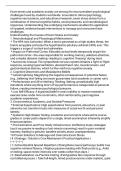
Exam stress and academic anxiety are among the most prevalent psychological
challenges faced by students worldwide. Grounded in clinical psychology,
cognitive neuroscience, and educational research, exam stress stems from a
combination of internal cognitive habits, social pressures, and neurobiological
responses. Understanding the underlying mechanisms enables the application
of targeted, evidence-based interventions to manage and overcome these
challenges.
Understanding the Causes of Exam Stress and Anxiety
1. Neurobiological and Physiological Mechanisms
* The HPA Axis Activation: When a test is perceived as a high-stakes threat, the
brain's amygdala activates the hypothalamic-pituitary-adrenal (HPA) axis. This
triggers a surge of cortisol and adrenaline.
* Impact on Prefrontal Cortex: Elevated cortisol levels temporarily impair the
prefrontal cortex—the area responsible for working memory, selective attention,
and complex decision-making—leading to cognitive "freezing" during tests.
* Autonomic Arousal: The sympathetic nervous system initiates a fight-or-flight
response, causing hyperventilation, elevated heart rate, muscle tension, and
gastrointestinal distress, which further reinforce cognitive anxiety.
2. Cognitive Distortions and Maladaptive Beliefs
* Catastrophizing: Magnifying the negative consequences of potential failure
(e.g., believing that failing one exam guarantees total academic or career ruin).
* Perfectionism and All-or-Nothing Thinking: Setting unrealistically high
standards where anything short of top performance is categorized as personal
failure, creating immense psychological pressure.
* Low Self-Efficacy: A ingrained belief in one's inability to master material or
execute tasks under time constraints, often reinforced by past negative
academic experiences.
3. Environmental, Academic, and Societal Pressures
* External Expectations: High expectations from parents, educators, or peer
networks can transform tests into measures of social worth and personal
identity.
* Systemic High-Stakes Testing: Academic environments where entire course
grades or career paths depend on a single, timed examination inherently amplify
threat perception.
* Procrastination and Poor Study Infrastructure: Ineffective study strategies
(such as passive re-reading or last-minute cramming) result in poor material
mastery, leading to genuine, baseline anxiety about unpreparedness.
10 Proven Solutions to Manage and Overcome Exam Stress
| # | Strategy / Solution | Core Mechanism | Practical Application |
|---|---|---|---|
| 1 | Active Recall & Spaced Repetition | Strengthens neural pathways; builds true
cognitive retrieval fluency. | Replace passive reading with flashcards (e.g., Anki)
or testing; space review intervals over weeks rather than days. |
| 2 | Desensitization via Practice Testing | Extinguishes fear response through
controlled exposure. | Take full-length, timed practice exams under realistic, quiet
challenges faced by students worldwide. Grounded in clinical psychology,
cognitive neuroscience, and educational research, exam stress stems from a
combination of internal cognitive habits, social pressures, and neurobiological
responses. Understanding the underlying mechanisms enables the application
of targeted, evidence-based interventions to manage and overcome these
challenges.
Understanding the Causes of Exam Stress and Anxiety
1. Neurobiological and Physiological Mechanisms
* The HPA Axis Activation: When a test is perceived as a high-stakes threat, the
brain's amygdala activates the hypothalamic-pituitary-adrenal (HPA) axis. This
triggers a surge of cortisol and adrenaline.
* Impact on Prefrontal Cortex: Elevated cortisol levels temporarily impair the
prefrontal cortex—the area responsible for working memory, selective attention,
and complex decision-making—leading to cognitive "freezing" during tests.
* Autonomic Arousal: The sympathetic nervous system initiates a fight-or-flight
response, causing hyperventilation, elevated heart rate, muscle tension, and
gastrointestinal distress, which further reinforce cognitive anxiety.
2. Cognitive Distortions and Maladaptive Beliefs
* Catastrophizing: Magnifying the negative consequences of potential failure
(e.g., believing that failing one exam guarantees total academic or career ruin).
* Perfectionism and All-or-Nothing Thinking: Setting unrealistically high
standards where anything short of top performance is categorized as personal
failure, creating immense psychological pressure.
* Low Self-Efficacy: A ingrained belief in one's inability to master material or
execute tasks under time constraints, often reinforced by past negative
academic experiences.
3. Environmental, Academic, and Societal Pressures
* External Expectations: High expectations from parents, educators, or peer
networks can transform tests into measures of social worth and personal
identity.
* Systemic High-Stakes Testing: Academic environments where entire course
grades or career paths depend on a single, timed examination inherently amplify
threat perception.
* Procrastination and Poor Study Infrastructure: Ineffective study strategies
(such as passive re-reading or last-minute cramming) result in poor material
mastery, leading to genuine, baseline anxiety about unpreparedness.
10 Proven Solutions to Manage and Overcome Exam Stress
| # | Strategy / Solution | Core Mechanism | Practical Application |
|---|---|---|---|
| 1 | Active Recall & Spaced Repetition | Strengthens neural pathways; builds true
cognitive retrieval fluency. | Replace passive reading with flashcards (e.g., Anki)
or testing; space review intervals over weeks rather than days. |
| 2 | Desensitization via Practice Testing | Extinguishes fear response through
controlled exposure. | Take full-length, timed practice exams under realistic, quiet