
SERGEANT EXAM NFLST EXAM WITH CORRECT
ACTUAL QUESTIONS AND CORRECTLY WELL
DEFINED ANSWERS LATEST ALREADY GRADED
A+
Play your way to mastery with fun games
Match Blocks Charms NEW
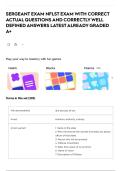
Terms in this set (202)
14th ammendment due process of law
Arrest intention, authority, custody
Arrest warrant 1. Name of the state
2. Who will execute the warrant (normally any peace
officer of that state)
3. Person who will be arrested
4. Offense Committed
5. Date, time, place of occurrence
6. Name of victim
7. Description of Offense
, Mapp v. Ohio Established the exclusionary rule was applicable to
the states (evidence seized illegally cannot be used
in court)
Search Warrant Exceptions Consent, warrant, exigency, vehicle inventory,
incident to arrest, motor vehicle, plain view
Chimel v. California (1969) search is valid of a person and area under him
immediate control form which he could produce a
weapon or destroy evidence
Carroll v. U.S. (1925) movable vehicle rule
Arizona v. Gant (2009) can search a vehicle when reasonable to believe
will find evidence of the offense. Only in passenger
compartment.
inductive reasoning factual and logical explanation of the crime
deductive reasoning hypothesis
neighborhood canvas helpful in about 20% of investigations
vehicle canvas get description, location, plate of vehicles in the
area with description of anything suspicious ie
blood, bullet holes, possible evidence.
ACTUAL QUESTIONS AND CORRECTLY WELL
DEFINED ANSWERS LATEST ALREADY GRADED
A+
Play your way to mastery with fun games
Match Blocks Charms NEW
Terms in this set (202)
14th ammendment due process of law
Arrest intention, authority, custody
Arrest warrant 1. Name of the state
2. Who will execute the warrant (normally any peace
officer of that state)
3. Person who will be arrested
4. Offense Committed
5. Date, time, place of occurrence
6. Name of victim
7. Description of Offense
, Mapp v. Ohio Established the exclusionary rule was applicable to
the states (evidence seized illegally cannot be used
in court)
Search Warrant Exceptions Consent, warrant, exigency, vehicle inventory,
incident to arrest, motor vehicle, plain view
Chimel v. California (1969) search is valid of a person and area under him
immediate control form which he could produce a
weapon or destroy evidence
Carroll v. U.S. (1925) movable vehicle rule
Arizona v. Gant (2009) can search a vehicle when reasonable to believe
will find evidence of the offense. Only in passenger
compartment.
inductive reasoning factual and logical explanation of the crime
deductive reasoning hypothesis
neighborhood canvas helpful in about 20% of investigations
vehicle canvas get description, location, plate of vehicles in the
area with description of anything suspicious ie
blood, bullet holes, possible evidence.


