
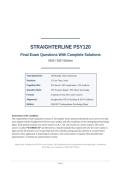
STRAIGHTERLINE PSY120
Final Exam Questions With Complete Solutions
Edition
Total Questions: 120 Multiple Choice Questions
Sections: 12 Core Topic Areas
Cognitive Mix: 25% Recall / 50% Application / 25% Analysis
Question Style: 70% Scenario-Based / 30% Direct Knowledge
Format: 4 Options (A-D), One Correct Answer
Alignment: Straighterline PSY120 Syllabus & APA Guidelines
Edition: 2026/2027 Undergraduate Psychology Major
Instructions to the Candidate:
This comprehensive final examination consists of 120 multiple-choice questions distributed across twelve core topic
areas aligned with the Straighterline PSY120 course syllabus and APA Guidelines for the Undergraduate Psychology
Major. Each question presents four answer choices (A, B, C, D), with exactly one correct response. The correct
answer is marked *[CORRECT]* and followed by a detailed rationale that explains both why the correct option is
right and why the distractors are wrong. Read each stem carefully, paying particular attention to scenario-based
questions where application of psychological concepts to real-world contexts is required. Recommended time:
approximately 1.5 minutes per question (total 3 hours).
Aligned with: Straighterline PSY120 Course Syllabus | APA Guidelines for the Undergraduate Psychology Major | Introductory
Psychology Core Competencies (2026/2027 Edition)
Page 1
, STRAIGHTERLINE PSY120 - FINAL EXAM QUESTIONS WITH COMPLETE SOLUTIONS 2026/2027
Section 1: History, Approaches, & Research Methods
Q1: Wilhelm Wundt is credited with establishing the first psychology laboratory in 1879. Which
perspective is most associated with his student Edward Titchener's method of introspection?
A. Functionalism
B. Structuralism *[CORRECT]*
C. Behaviorism
D. Psychoanalysis
Correct Answer: B
Rationale: Structuralism, developed by Titchener, used introspection to identify the basic elements of consciousness.
Functionalism (James) focused on the purpose of mental processes, behaviorism (Watson) rejected introspection
entirely, and psychoanalysis (Freud) focused on unconscious conflicts.
Q2: A researcher hypothesizes that students who sleep 8 hours before an exam will score higher than
those who sleep 5 hours. In this experiment, the independent variable is:
A. The exam scores
B. The number of students in each group
C. The amount of sleep *[CORRECT]*
D. The difficulty of the exam
Correct Answer: C
Rationale: The independent variable is the variable the researcher manipulates; here, it is the amount of sleep (5 vs 8
hours). Exam scores are the dependent variable (measured outcome). The number of students and exam difficulty are
controlled variables that should remain constant across conditions.
Q3: Dr. Lopez conducts a study finding that children who eat breakfast have higher GPAs (r = +0.45).
She concludes that eating breakfast causes higher academic achievement. This conclusion is flawed
because:
A. Correlation does not imply causation *[CORRECT]*
B. The sample size was too small
C. The correlation is negative
D. GPA cannot be measured reliably
Correct Answer: A
Rationale: A correlation of +0.45 indicates a moderate positive relationship but cannot establish cause and effect;
there may be third variables (socioeconomic status, parental involvement) or reverse causation. The conclusion
reflects the classic correlation vs. causation fallacy emphasized in APA research methodology standards.
Page 2
, STRAIGHTERLINE PSY120 - FINAL EXAM QUESTIONS WITH COMPLETE SOLUTIONS 2026/2027
Q4: Which psychological perspective emphasizes the role of natural selection in shaping human behavior
and mental processes?
A. Humanistic psychology
B. Psychoanalysis
C. Evolutionary psychology *[CORRECT]*
D. Cognitive psychology
Correct Answer: C
Rationale: Evolutionary psychology examines how natural selection has shaped mental processes and behaviors to
solve adaptive problems. Humanistic psychology focuses on personal growth, psychoanalysis on unconscious conflicts,
and cognitive psychology on mental processes like thinking and memory.
Q5: A researcher wants to study the natural behavior of toddlers in a preschool without interfering. The
best research method for this would be:
A. Case study
B. Survey
C. Experiment
D. Naturalistic observation *[CORRECT]*
Correct Answer: D
Rationale: Naturalistic observation involves observing subjects in their natural environment without intervention.
Case study focuses on one individual, survey uses questionnaires, and experiment requires manipulation of variables
— all inappropriate for studying naturalistic behavior.
Q6: In a double-blind drug study, neither the participants nor the researchers know who receives the
actual drug versus the placebo. The primary purpose of this design is to:
A. Reduce sample size requirements
B. Eliminate experimenter and participant bias *[CORRECT]*
C. Increase statistical significance
D. Ensure random assignment
Correct Answer: B
Rationale: Double-blind procedures control for both experimenter expectancy effects and participant placebo effects,
eliminating bias from both sides. This aligns with APA ethics code standards for rigorous experimental design and
protects the validity of the findings.
Page 3
, STRAIGHTERLINE PSY120 - FINAL EXAM QUESTIONS WITH COMPLETE SOLUTIONS 2026/2027
Q7: In statistics, a normal distribution is characterized by all of the following EXCEPT:
A. The mean, median, and mode are equal
B. It forms a symmetrical bell-shaped curve
C. Approximately 68% of scores fall within one standard deviation of the mean
D. It is asymmetric with a long right tail *[CORRECT]*
Correct Answer: D
Rationale: A normal distribution is symmetric, with mean = median = mode, and approximately 68% of scores fall
within ±1 SD. An asymmetric distribution with a long tail is 'skewed,' not normal. This is a foundational concept in
PSY120 statistics modules.
Q8: Dr. Chen collects survey data from 500 college students and computes the mean, median, and mode
of their reported stress levels. The mean is significantly higher than the median. This suggests:
A. The distribution is normally distributed
B. The distribution is positively skewed *[CORRECT]*
C. The distribution is negatively skewed
D. The data are unreliable
Correct Answer: B
Rationale: When mean > median > mode, the distribution is positively skewed (tail to the right), pulled by extreme
high values. In a normal distribution, all three measures are equal. Negatively skewed distributions have mean <
median. This is a core concept in descriptive statistics.
Q9: The American Psychological Association's ethics code requires all of the following for human
research EXCEPT:
A. Informed consent
B. Debriefing after the study
C. Approval from an Institutional Review Board (IRB)
D. Guarantee of anonymity to all participants *[CORRECT]*
Correct Answer: D
Rationale: APA ethics require informed consent, debriefing, and IRB approval, but researchers may use
confidentiality (not anonymity) when needed. Some research — such as naturalistic observation of public behavior —
does not require individual consent, and deception is permitted under strict conditions with justification.
Page 4
Final Exam Questions With Complete Solutions
Edition
Total Questions: 120 Multiple Choice Questions
Sections: 12 Core Topic Areas
Cognitive Mix: 25% Recall / 50% Application / 25% Analysis
Question Style: 70% Scenario-Based / 30% Direct Knowledge
Format: 4 Options (A-D), One Correct Answer
Alignment: Straighterline PSY120 Syllabus & APA Guidelines
Edition: 2026/2027 Undergraduate Psychology Major
Instructions to the Candidate:
This comprehensive final examination consists of 120 multiple-choice questions distributed across twelve core topic
areas aligned with the Straighterline PSY120 course syllabus and APA Guidelines for the Undergraduate Psychology
Major. Each question presents four answer choices (A, B, C, D), with exactly one correct response. The correct
answer is marked *[CORRECT]* and followed by a detailed rationale that explains both why the correct option is
right and why the distractors are wrong. Read each stem carefully, paying particular attention to scenario-based
questions where application of psychological concepts to real-world contexts is required. Recommended time:
approximately 1.5 minutes per question (total 3 hours).
Aligned with: Straighterline PSY120 Course Syllabus | APA Guidelines for the Undergraduate Psychology Major | Introductory
Psychology Core Competencies (2026/2027 Edition)
Page 1
, STRAIGHTERLINE PSY120 - FINAL EXAM QUESTIONS WITH COMPLETE SOLUTIONS 2026/2027
Section 1: History, Approaches, & Research Methods
Q1: Wilhelm Wundt is credited with establishing the first psychology laboratory in 1879. Which
perspective is most associated with his student Edward Titchener's method of introspection?
A. Functionalism
B. Structuralism *[CORRECT]*
C. Behaviorism
D. Psychoanalysis
Correct Answer: B
Rationale: Structuralism, developed by Titchener, used introspection to identify the basic elements of consciousness.
Functionalism (James) focused on the purpose of mental processes, behaviorism (Watson) rejected introspection
entirely, and psychoanalysis (Freud) focused on unconscious conflicts.
Q2: A researcher hypothesizes that students who sleep 8 hours before an exam will score higher than
those who sleep 5 hours. In this experiment, the independent variable is:
A. The exam scores
B. The number of students in each group
C. The amount of sleep *[CORRECT]*
D. The difficulty of the exam
Correct Answer: C
Rationale: The independent variable is the variable the researcher manipulates; here, it is the amount of sleep (5 vs 8
hours). Exam scores are the dependent variable (measured outcome). The number of students and exam difficulty are
controlled variables that should remain constant across conditions.
Q3: Dr. Lopez conducts a study finding that children who eat breakfast have higher GPAs (r = +0.45).
She concludes that eating breakfast causes higher academic achievement. This conclusion is flawed
because:
A. Correlation does not imply causation *[CORRECT]*
B. The sample size was too small
C. The correlation is negative
D. GPA cannot be measured reliably
Correct Answer: A
Rationale: A correlation of +0.45 indicates a moderate positive relationship but cannot establish cause and effect;
there may be third variables (socioeconomic status, parental involvement) or reverse causation. The conclusion
reflects the classic correlation vs. causation fallacy emphasized in APA research methodology standards.
Page 2
, STRAIGHTERLINE PSY120 - FINAL EXAM QUESTIONS WITH COMPLETE SOLUTIONS 2026/2027
Q4: Which psychological perspective emphasizes the role of natural selection in shaping human behavior
and mental processes?
A. Humanistic psychology
B. Psychoanalysis
C. Evolutionary psychology *[CORRECT]*
D. Cognitive psychology
Correct Answer: C
Rationale: Evolutionary psychology examines how natural selection has shaped mental processes and behaviors to
solve adaptive problems. Humanistic psychology focuses on personal growth, psychoanalysis on unconscious conflicts,
and cognitive psychology on mental processes like thinking and memory.
Q5: A researcher wants to study the natural behavior of toddlers in a preschool without interfering. The
best research method for this would be:
A. Case study
B. Survey
C. Experiment
D. Naturalistic observation *[CORRECT]*
Correct Answer: D
Rationale: Naturalistic observation involves observing subjects in their natural environment without intervention.
Case study focuses on one individual, survey uses questionnaires, and experiment requires manipulation of variables
— all inappropriate for studying naturalistic behavior.
Q6: In a double-blind drug study, neither the participants nor the researchers know who receives the
actual drug versus the placebo. The primary purpose of this design is to:
A. Reduce sample size requirements
B. Eliminate experimenter and participant bias *[CORRECT]*
C. Increase statistical significance
D. Ensure random assignment
Correct Answer: B
Rationale: Double-blind procedures control for both experimenter expectancy effects and participant placebo effects,
eliminating bias from both sides. This aligns with APA ethics code standards for rigorous experimental design and
protects the validity of the findings.
Page 3
, STRAIGHTERLINE PSY120 - FINAL EXAM QUESTIONS WITH COMPLETE SOLUTIONS 2026/2027
Q7: In statistics, a normal distribution is characterized by all of the following EXCEPT:
A. The mean, median, and mode are equal
B. It forms a symmetrical bell-shaped curve
C. Approximately 68% of scores fall within one standard deviation of the mean
D. It is asymmetric with a long right tail *[CORRECT]*
Correct Answer: D
Rationale: A normal distribution is symmetric, with mean = median = mode, and approximately 68% of scores fall
within ±1 SD. An asymmetric distribution with a long tail is 'skewed,' not normal. This is a foundational concept in
PSY120 statistics modules.
Q8: Dr. Chen collects survey data from 500 college students and computes the mean, median, and mode
of their reported stress levels. The mean is significantly higher than the median. This suggests:
A. The distribution is normally distributed
B. The distribution is positively skewed *[CORRECT]*
C. The distribution is negatively skewed
D. The data are unreliable
Correct Answer: B
Rationale: When mean > median > mode, the distribution is positively skewed (tail to the right), pulled by extreme
high values. In a normal distribution, all three measures are equal. Negatively skewed distributions have mean <
median. This is a core concept in descriptive statistics.
Q9: The American Psychological Association's ethics code requires all of the following for human
research EXCEPT:
A. Informed consent
B. Debriefing after the study
C. Approval from an Institutional Review Board (IRB)
D. Guarantee of anonymity to all participants *[CORRECT]*
Correct Answer: D
Rationale: APA ethics require informed consent, debriefing, and IRB approval, but researchers may use
confidentiality (not anonymity) when needed. Some research — such as naturalistic observation of public behavior —
does not require individual consent, and deception is permitted under strict conditions with justification.
Page 4


