

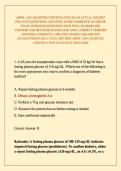
ABFM + KSA DIABETES CERTIFICATION EXAM ACTUAL 2026/2027
PRACTICE QUESTIONS AND STUDY GUIDE COMPLETE ACCURATE
EXAM APPROVED QUESTIONS WITH WELL ELABORATED
ANSWERS AND DETAILED RATIONALES (100% CORRECT VERIFIED
ANSWERS) CURRENTLY UPDATED VERSION 2026 EDITION
|GUARANTEED PASS A+ |FULL REVISED ABFM + KSA DIABETES
CERTIFICATION EXAM |JUST RELEASED
1. A 45-year-old asymptomatic man with a BMI of 32 kg/m² has a
fasting plasma glucose of 118 mg/dL. Which one of the following is
the most appropriate next step to confirm a diagnosis of diabetes
mellitus?
A. Repeat fasting plasma glucose in 6 months
B. Obtain a hemoglobin A1c
C. Perform a 75-g oral glucose tolerance test
D. Reassure the patient that no further testing is needed
E. Start metformin empirically
Correct Answer: B
Rationale: A fasting plasma glucose of 100–125 mg/dL indicates
impaired fasting glucose (prediabetes). To confirm diabetes, either
a repeat fasting plasma glucose ≥126 mg/dL, an A1c ≥6.5%, or a
,2-hour plasma glucose ≥200 mg/dL during a 75-g OGTT is
required. Obtaining an A1c is the most practical single test to
clarify glycemic status in an asymptomatic patient. A single
elevated fasting glucose is not diagnostic without confirmation.
Reassurance alone is inappropriate given the prediabetic range.
Metformin is not indicated without a confirmed diagnosis of
diabetes.
2. Which one of the following A1c thresholds is diagnostic of
diabetes mellitus according to the American Diabetes Association?
A. ≥5.7%
B. ≥6.0%
C. ≥6.5%
D. ≥7.0%
E. ≥7.5%
Correct Answer: C
Rationale: The ADA diagnostic threshold for A1c is ≥6.5% (≥48
mmol/mol). A1c values of 5.7%–6.4% indicate prediabetes. A1c
≥7.0% is a common treatment target for many adults with diabetes
but is not the diagnostic threshold. A1c ≥7.5% is not a diagnostic
cutoff.
,3. A 52-year-old woman with no symptoms has a random plasma
glucose of 215 mg/dL. Which one of the following is required to
diagnose diabetes mellitus in this patient?
A. A repeat random glucose ≥200 mg/dL
B. Classic symptoms of hyperglycemia or hyperglycemic crisis
C. A fasting plasma glucose ≥100 mg/dL
D. An A1c ≥6.0%
E. A 2-hour OGTT glucose ≥140 mg/dL
Correct Answer: B
Rationale: A random plasma glucose ≥200 mg/dL in the presence
of classic symptoms of hyperglycemia (polyuria, polydipsia,
unexplained weight loss) or hyperglycemic crisis is diagnostic of
diabetes without requiring a second confirmatory test. In the
absence of symptoms, a second abnormal test is required. A fasting
glucose ≥100 mg/dL indicates prediabetes, not diabetes. An A1c
≥6.0% is also in the prediabetic range. A 2-hour OGTT glucose
≥140 mg/dL indicates impaired glucose tolerance.
, 4. Which one of the following autoantibodies is most commonly
associated with type 1 diabetes mellitus and should be monitored in
patients with a confirmed single IA-2 autoantibody?
A. Anti-GAD65
B. Anti-insulin
C. Anti-IA-2
D. Anti-ZnT8
E. Anti-islet cell cytoplasmic
Correct Answer: A
Rationale: The 2026 ADA Standards of Care added a
recommendation that patients with a confirmed single IA-2
autoantibody should be monitored similarly to people with stage 2
type 1 diabetes. Anti-GAD65 is the most commonly tested and
sensitive autoantibody for type 1 diabetes and should be included
in the monitoring panel. Anti-insulin and anti-ZnT8 are also
associated with type 1 diabetes but are less commonly used for
monitoring. Anti-islet cell cytoplasmic antibodies are less specific.
5. A 58-year-old man with a 10-year history of type 2 diabetes has an
A1c of 7.8% on metformin monotherapy. He has no cardiovascular
disease, heart failure, or chronic kidney disease. Which one of the
PRACTICE QUESTIONS AND STUDY GUIDE COMPLETE ACCURATE
EXAM APPROVED QUESTIONS WITH WELL ELABORATED
ANSWERS AND DETAILED RATIONALES (100% CORRECT VERIFIED
ANSWERS) CURRENTLY UPDATED VERSION 2026 EDITION
|GUARANTEED PASS A+ |FULL REVISED ABFM + KSA DIABETES
CERTIFICATION EXAM |JUST RELEASED
1. A 45-year-old asymptomatic man with a BMI of 32 kg/m² has a
fasting plasma glucose of 118 mg/dL. Which one of the following is
the most appropriate next step to confirm a diagnosis of diabetes
mellitus?
A. Repeat fasting plasma glucose in 6 months
B. Obtain a hemoglobin A1c
C. Perform a 75-g oral glucose tolerance test
D. Reassure the patient that no further testing is needed
E. Start metformin empirically
Correct Answer: B
Rationale: A fasting plasma glucose of 100–125 mg/dL indicates
impaired fasting glucose (prediabetes). To confirm diabetes, either
a repeat fasting plasma glucose ≥126 mg/dL, an A1c ≥6.5%, or a
,2-hour plasma glucose ≥200 mg/dL during a 75-g OGTT is
required. Obtaining an A1c is the most practical single test to
clarify glycemic status in an asymptomatic patient. A single
elevated fasting glucose is not diagnostic without confirmation.
Reassurance alone is inappropriate given the prediabetic range.
Metformin is not indicated without a confirmed diagnosis of
diabetes.
2. Which one of the following A1c thresholds is diagnostic of
diabetes mellitus according to the American Diabetes Association?
A. ≥5.7%
B. ≥6.0%
C. ≥6.5%
D. ≥7.0%
E. ≥7.5%
Correct Answer: C
Rationale: The ADA diagnostic threshold for A1c is ≥6.5% (≥48
mmol/mol). A1c values of 5.7%–6.4% indicate prediabetes. A1c
≥7.0% is a common treatment target for many adults with diabetes
but is not the diagnostic threshold. A1c ≥7.5% is not a diagnostic
cutoff.
,3. A 52-year-old woman with no symptoms has a random plasma
glucose of 215 mg/dL. Which one of the following is required to
diagnose diabetes mellitus in this patient?
A. A repeat random glucose ≥200 mg/dL
B. Classic symptoms of hyperglycemia or hyperglycemic crisis
C. A fasting plasma glucose ≥100 mg/dL
D. An A1c ≥6.0%
E. A 2-hour OGTT glucose ≥140 mg/dL
Correct Answer: B
Rationale: A random plasma glucose ≥200 mg/dL in the presence
of classic symptoms of hyperglycemia (polyuria, polydipsia,
unexplained weight loss) or hyperglycemic crisis is diagnostic of
diabetes without requiring a second confirmatory test. In the
absence of symptoms, a second abnormal test is required. A fasting
glucose ≥100 mg/dL indicates prediabetes, not diabetes. An A1c
≥6.0% is also in the prediabetic range. A 2-hour OGTT glucose
≥140 mg/dL indicates impaired glucose tolerance.
, 4. Which one of the following autoantibodies is most commonly
associated with type 1 diabetes mellitus and should be monitored in
patients with a confirmed single IA-2 autoantibody?
A. Anti-GAD65
B. Anti-insulin
C. Anti-IA-2
D. Anti-ZnT8
E. Anti-islet cell cytoplasmic
Correct Answer: A
Rationale: The 2026 ADA Standards of Care added a
recommendation that patients with a confirmed single IA-2
autoantibody should be monitored similarly to people with stage 2
type 1 diabetes. Anti-GAD65 is the most commonly tested and
sensitive autoantibody for type 1 diabetes and should be included
in the monitoring panel. Anti-insulin and anti-ZnT8 are also
associated with type 1 diabetes but are less commonly used for
monitoring. Anti-islet cell cytoplasmic antibodies are less specific.
5. A 58-year-old man with a 10-year history of type 2 diabetes has an
A1c of 7.8% on metformin monotherapy. He has no cardiovascular
disease, heart failure, or chronic kidney disease. Which one of the


