, BIOL 251 HUMAN ANATOMY & PHYSIOLOGY I W/LAB |
MODULE 1 & 2 LAB PRACTICAL EXAM QUESTIONS AND
CORRECT ANSWERS WITH RATIONALES GRADED A+
Question 1
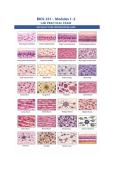
Slide shows a single layer of flat cells lining a blood vessel.
Answer: Simple squamous epithelium
Rationale: Single layer of flattened cells facilitates diffusion.
Question 2
Slide shows cube-shaped cells with large nuclei lining a gland duct.
Answer: Simple cuboidal epithelium
Rationale: Cube-shaped cells function in secretion and absorption.
Question 3
Slide shows column-shaped cells with microvilli lining the small intestine.
Answer: Simple columnar epithelium
Rationale: Microvilli increase surface area for absorption.
Question 4
Slide shows stratified layers of flat cells in areas of high abrasion (e.g., esophagus).
Answer: Stratified squamous epithelium
Rationale: Multiple layers protect against mechanical stress.
, Question 5
Slide shows ciliated cells with goblet cells lining the respiratory tract.
Answer: Pseudostratified ciliated columnar epithelium
Rationale: Cilia move mucus, goblet cells secrete mucus.
Question 6
Slide shows multiple layers of rounded and flattened cells lining the urinary
bladder.
Answer: Transitional epithelium
Rationale: Transitional epithelium stretches to accommodate urine.
Question 7
Slide shows collagen fibers in parallel bundles connecting muscle to bone.
Answer: Dense regular connective tissue
Rationale: Fibers arranged parallel for tensile strength (tendons, ligaments).
Question 8
Slide shows dense connective tissue with fibers arranged irregularly in multiple
directions.
Answer: Dense irregular connective tissue
Rationale: Resists stress from multiple directions (dermis).
MODULE 1 & 2 LAB PRACTICAL EXAM QUESTIONS AND
CORRECT ANSWERS WITH RATIONALES GRADED A+
Question 1
Slide shows a single layer of flat cells lining a blood vessel.
Answer: Simple squamous epithelium
Rationale: Single layer of flattened cells facilitates diffusion.
Question 2
Slide shows cube-shaped cells with large nuclei lining a gland duct.
Answer: Simple cuboidal epithelium
Rationale: Cube-shaped cells function in secretion and absorption.
Question 3
Slide shows column-shaped cells with microvilli lining the small intestine.
Answer: Simple columnar epithelium
Rationale: Microvilli increase surface area for absorption.
Question 4
Slide shows stratified layers of flat cells in areas of high abrasion (e.g., esophagus).
Answer: Stratified squamous epithelium
Rationale: Multiple layers protect against mechanical stress.
, Question 5
Slide shows ciliated cells with goblet cells lining the respiratory tract.
Answer: Pseudostratified ciliated columnar epithelium
Rationale: Cilia move mucus, goblet cells secrete mucus.
Question 6
Slide shows multiple layers of rounded and flattened cells lining the urinary
bladder.
Answer: Transitional epithelium
Rationale: Transitional epithelium stretches to accommodate urine.
Question 7
Slide shows collagen fibers in parallel bundles connecting muscle to bone.
Answer: Dense regular connective tissue
Rationale: Fibers arranged parallel for tensile strength (tendons, ligaments).
Question 8
Slide shows dense connective tissue with fibers arranged irregularly in multiple
directions.
Answer: Dense irregular connective tissue
Rationale: Resists stress from multiple directions (dermis).