

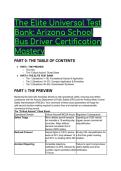
The Elite Universal Test
Bank: Arizona School
Bus Driver Certification
Mastery
PART 0: THE TABLE OF CONTENTS
● PART I: THE PREVIEW
○ The Intro
○ The "Critical Axioms" Cheat Sheet
● PART II: THE ELITE TEST BANK
○ Tier 1 (Questions 1–18): Foundational Syntax & Application
○ Tier 2 (Questions 19–37): Complex Application & Simulation
○ Tier 3 (Questions 38–55): Grandmaster Synthesis
PART I: THE PREVIEW
Mastering this test bank translates directly to elite operational safety, ensuring zero-defect
compliance with the Arizona Department of Public Safety (DPS) and the Federal Motor Carrier
Safety Administration (FMCSA). Your command of these exact parameters will forge the
split-second decision-making required to protect lives and maintain an unimpeachable
commercial driving record.
The "Critical Axioms" Cheat Sheet:
Operational Domain Critical Arizona/FMCSA Axiom Regulatory Consequence
Defect Triage Minor defects permit transport Operating an OOS vehicle
but mandate a 15-working-day triggers severe commercial
correction. Major defects disqualification.
demand immediate Out of
Service (OOS) status.
Railroad Protocol Hazard lights at 100 ft; silence 60-day CDL disqualification for
audio at 50 ft; stop between 15 a first-time grade crossing
and 50 ft; no loading within 200 violation.
ft.
Accident Reporting Immediate telephone Failure to report compromises
notification to DPS, followed by district liability and driver
a written report submitted within certification.
72 hours.
,Operational Domain Critical Arizona/FMCSA Axiom Regulatory Consequence
Training Hard-Deck 14 hours of classroom Skills test eligibility is federally
instruction, 20 hours and state-blocked without
behind-the-wheel (BTW), and verified completion.
FMCSA ELDT compliance.
Major CDL Offenses Leaving the scene, DUI, or Immediate loss of livelihood;
using any vehicle in a felony second major offense results in
triggers a baseline 1-year CDL lifetime CDL revocation.
disqualification.
PART II: THE ELITE TEST BANK
Tier 1 - Foundational Syntax Application
Q1: An applicant seeks initial certification as an Arizona school bus driver. Based on the
principles of A.A.C. R13-13-102, which action is the FIRST mandatory training requirement
before state certification can be issued? A) Completion of an FMCSA-approved ELDT theory
course exclusively. B) Completion of 10 hours of classroom training and 15 hours of
behind-the-wheel training. C) Completion of a minimum of 14 hours of classroom training and
20 hours of behind-the-wheel training in Arizona. D) Passing the physical performance test
within 30 days of submitting a standard fingerprint card.
● Answer: C (Completion of a minimum of 14 hours of classroom training and 20 hours of
behind-the-wheel training in Arizona.)
● Distractor Analysis:
○ A is incorrect: While ELDT is a federal prerequisite, Arizona state law specifically
dictates mandatory minimum hours that must be met regardless of federal theory
completion.
○ B is incorrect: These hours represent an outdated baseline, falling short of Arizona
DPS's strict minimums.
○ D is incorrect: A standard fingerprint card is insufficient; an Identity Verified Print
(IVP) clearance card is strictly required for certification.
The Mentor's Analysis: Foundational compliance begins with state-mandated training
minimums. When facing initial certification, the immediate priority is fulfilling the strict 14-hour
classroom and 20-hour behind-the-wheel baseline. By utilizing the exact figures outlined in
R13-13-102, you bypass the common trap of assuming federal ELDT supersedes state-specific
hourly requirements. Professional Intuition: Always verify that state-mandated training
hours (14/20) are met in conjunction with federal ELDT requirements.
Q2: A driver applicant must submit to a medical examination to obtain a school bus driver
certificate. Based on the principles of A.A.C. R13-13-102, which conclusion regarding the
physical examination is UNEQUIVOCALLY correct? A) The examination must be renewed
every 24 months, and the form submitted before the end of the expiration month. B) The
examination is valid for a maximum of 12 months for all commercial drivers. C) Only a physician
employed directly by the Department of Public Safety may conduct the examination. D) A driver
with insulin-dependent diabetes is permanently disqualified from obtaining certification.
● Answer: A (The examination must be renewed every 24 months, and the form submitted
before the end of the expiration month.)
● Distractor Analysis:
○ B is incorrect: Standard FMCSA medical cards may vary based on conditions, but
, the Arizona baseline for school bus driver physicals is 24 months unless shortened
by the examiner.
○ C is incorrect: Any qualified health care professional (MD, DO, DC, PA, NP) defined
in the statute may perform the exam.
○ D is incorrect: An insulin-dependent driver may operate a school bus if they
successfully obtain a specific medical waiver under A.A.C. R17-5-208.
The Mentor's Analysis: Medical fitness is a continuous, closely monitored requirement that
dictates legal operational capability. When facing medical recertification, the immediate priority
is tracking the exact 24-month expiration window. By utilizing proactive submission protocols,
you bypass the common trap of allowing the certification to lapse, which instantly invalidates
operational privileges. Professional Intuition: Medical examinations expire 24 months from
the date of issue and must be submitted to DPS before the expiration month concludes.
Q3: During an annual DPS inspection, a school bus is found to have a missing body fluid
cleanup kit. Based on the principles of A.A.C. R13-13-108, which conclusion is the MOST
APPROPRIATE regarding the vehicle's status? A) The bus is placed Out of Service (OOS)
immediately until the kit is replaced. B) The bus has a minor defect and may transport
passengers, but the defect must be corrected and reported within 15 working days. C) The bus
has a minor defect and the employer has 30 calendar days to return the inspection order. D)
The bus is exempt from repair because the first-aid kit serves as a legal substitute.
● Answer: B (The bus has a minor defect and may transport passengers, but the defect
must be corrected and reported within 15 working days.)
● Distractor Analysis:
○ A is incorrect: A missing body fluid cleanup kit is classified as a minor defect, not a
major defect requiring immediate OOS status.
○ C is incorrect: The repair and reporting timeline is strictly 15 working days, not 30
calendar days.
○ D is incorrect: The body fluid kit is a distinct, legally required item; first-aid kits
cannot act as substitutes.
The Mentor's Analysis: Understanding the division between major and minor defects ensures
operational continuity without compromising compliance. When facing a minor defect, the
immediate priority is continuing safe transport while scheduling prompt maintenance. By utilizing
the 15-working-day correction rule, you bypass the common trap of grounding a compliant
vehicle or missing the strict reporting deadline. Professional Intuition: Minor defects allow
passenger transport but mandate a strict 15-working-day correction and reporting
window.
Q4: A driver holds a CDL and an S-endorsement but also works a second job as a rideshare
driver on weekends. Based on A.A.C. R13-13-104, what is the MANDATORY action required to
maintain compliance? A) The driver must quit the second job, as dual employment is prohibited
by the DPS. B) The driver must only drive the school bus on days they do not drive for the
rideshare company. C) The driver must provide the employer, in writing, the name and
telephone number of the other entity and the hours worked each day. D) The driver is exempt
from reporting hours if the second job does not require a commercial driver's license.
● Answer: C (The driver must provide the employer, in writing, the name and telephone
number of the other entity and the hours worked each day.)
● Distractor Analysis:
○ A is incorrect: Dual employment is not prohibited, but it is strictly monitored for
Hours of Service (HOS) fatigue limits.
○ B is incorrect: They can work both on the same day, provided they do not exceed
Bank: Arizona School
Bus Driver Certification
Mastery
PART 0: THE TABLE OF CONTENTS
● PART I: THE PREVIEW
○ The Intro
○ The "Critical Axioms" Cheat Sheet
● PART II: THE ELITE TEST BANK
○ Tier 1 (Questions 1–18): Foundational Syntax & Application
○ Tier 2 (Questions 19–37): Complex Application & Simulation
○ Tier 3 (Questions 38–55): Grandmaster Synthesis
PART I: THE PREVIEW
Mastering this test bank translates directly to elite operational safety, ensuring zero-defect
compliance with the Arizona Department of Public Safety (DPS) and the Federal Motor Carrier
Safety Administration (FMCSA). Your command of these exact parameters will forge the
split-second decision-making required to protect lives and maintain an unimpeachable
commercial driving record.
The "Critical Axioms" Cheat Sheet:
Operational Domain Critical Arizona/FMCSA Axiom Regulatory Consequence
Defect Triage Minor defects permit transport Operating an OOS vehicle
but mandate a 15-working-day triggers severe commercial
correction. Major defects disqualification.
demand immediate Out of
Service (OOS) status.
Railroad Protocol Hazard lights at 100 ft; silence 60-day CDL disqualification for
audio at 50 ft; stop between 15 a first-time grade crossing
and 50 ft; no loading within 200 violation.
ft.
Accident Reporting Immediate telephone Failure to report compromises
notification to DPS, followed by district liability and driver
a written report submitted within certification.
72 hours.
,Operational Domain Critical Arizona/FMCSA Axiom Regulatory Consequence
Training Hard-Deck 14 hours of classroom Skills test eligibility is federally
instruction, 20 hours and state-blocked without
behind-the-wheel (BTW), and verified completion.
FMCSA ELDT compliance.
Major CDL Offenses Leaving the scene, DUI, or Immediate loss of livelihood;
using any vehicle in a felony second major offense results in
triggers a baseline 1-year CDL lifetime CDL revocation.
disqualification.
PART II: THE ELITE TEST BANK
Tier 1 - Foundational Syntax Application
Q1: An applicant seeks initial certification as an Arizona school bus driver. Based on the
principles of A.A.C. R13-13-102, which action is the FIRST mandatory training requirement
before state certification can be issued? A) Completion of an FMCSA-approved ELDT theory
course exclusively. B) Completion of 10 hours of classroom training and 15 hours of
behind-the-wheel training. C) Completion of a minimum of 14 hours of classroom training and
20 hours of behind-the-wheel training in Arizona. D) Passing the physical performance test
within 30 days of submitting a standard fingerprint card.
● Answer: C (Completion of a minimum of 14 hours of classroom training and 20 hours of
behind-the-wheel training in Arizona.)
● Distractor Analysis:
○ A is incorrect: While ELDT is a federal prerequisite, Arizona state law specifically
dictates mandatory minimum hours that must be met regardless of federal theory
completion.
○ B is incorrect: These hours represent an outdated baseline, falling short of Arizona
DPS's strict minimums.
○ D is incorrect: A standard fingerprint card is insufficient; an Identity Verified Print
(IVP) clearance card is strictly required for certification.
The Mentor's Analysis: Foundational compliance begins with state-mandated training
minimums. When facing initial certification, the immediate priority is fulfilling the strict 14-hour
classroom and 20-hour behind-the-wheel baseline. By utilizing the exact figures outlined in
R13-13-102, you bypass the common trap of assuming federal ELDT supersedes state-specific
hourly requirements. Professional Intuition: Always verify that state-mandated training
hours (14/20) are met in conjunction with federal ELDT requirements.
Q2: A driver applicant must submit to a medical examination to obtain a school bus driver
certificate. Based on the principles of A.A.C. R13-13-102, which conclusion regarding the
physical examination is UNEQUIVOCALLY correct? A) The examination must be renewed
every 24 months, and the form submitted before the end of the expiration month. B) The
examination is valid for a maximum of 12 months for all commercial drivers. C) Only a physician
employed directly by the Department of Public Safety may conduct the examination. D) A driver
with insulin-dependent diabetes is permanently disqualified from obtaining certification.
● Answer: A (The examination must be renewed every 24 months, and the form submitted
before the end of the expiration month.)
● Distractor Analysis:
○ B is incorrect: Standard FMCSA medical cards may vary based on conditions, but
, the Arizona baseline for school bus driver physicals is 24 months unless shortened
by the examiner.
○ C is incorrect: Any qualified health care professional (MD, DO, DC, PA, NP) defined
in the statute may perform the exam.
○ D is incorrect: An insulin-dependent driver may operate a school bus if they
successfully obtain a specific medical waiver under A.A.C. R17-5-208.
The Mentor's Analysis: Medical fitness is a continuous, closely monitored requirement that
dictates legal operational capability. When facing medical recertification, the immediate priority
is tracking the exact 24-month expiration window. By utilizing proactive submission protocols,
you bypass the common trap of allowing the certification to lapse, which instantly invalidates
operational privileges. Professional Intuition: Medical examinations expire 24 months from
the date of issue and must be submitted to DPS before the expiration month concludes.
Q3: During an annual DPS inspection, a school bus is found to have a missing body fluid
cleanup kit. Based on the principles of A.A.C. R13-13-108, which conclusion is the MOST
APPROPRIATE regarding the vehicle's status? A) The bus is placed Out of Service (OOS)
immediately until the kit is replaced. B) The bus has a minor defect and may transport
passengers, but the defect must be corrected and reported within 15 working days. C) The bus
has a minor defect and the employer has 30 calendar days to return the inspection order. D)
The bus is exempt from repair because the first-aid kit serves as a legal substitute.
● Answer: B (The bus has a minor defect and may transport passengers, but the defect
must be corrected and reported within 15 working days.)
● Distractor Analysis:
○ A is incorrect: A missing body fluid cleanup kit is classified as a minor defect, not a
major defect requiring immediate OOS status.
○ C is incorrect: The repair and reporting timeline is strictly 15 working days, not 30
calendar days.
○ D is incorrect: The body fluid kit is a distinct, legally required item; first-aid kits
cannot act as substitutes.
The Mentor's Analysis: Understanding the division between major and minor defects ensures
operational continuity without compromising compliance. When facing a minor defect, the
immediate priority is continuing safe transport while scheduling prompt maintenance. By utilizing
the 15-working-day correction rule, you bypass the common trap of grounding a compliant
vehicle or missing the strict reporting deadline. Professional Intuition: Minor defects allow
passenger transport but mandate a strict 15-working-day correction and reporting
window.
Q4: A driver holds a CDL and an S-endorsement but also works a second job as a rideshare
driver on weekends. Based on A.A.C. R13-13-104, what is the MANDATORY action required to
maintain compliance? A) The driver must quit the second job, as dual employment is prohibited
by the DPS. B) The driver must only drive the school bus on days they do not drive for the
rideshare company. C) The driver must provide the employer, in writing, the name and
telephone number of the other entity and the hours worked each day. D) The driver is exempt
from reporting hours if the second job does not require a commercial driver's license.
● Answer: C (The driver must provide the employer, in writing, the name and telephone
number of the other entity and the hours worked each day.)
● Distractor Analysis:
○ A is incorrect: Dual employment is not prohibited, but it is strictly monitored for
Hours of Service (HOS) fatigue limits.
○ B is incorrect: They can work both on the same day, provided they do not exceed


