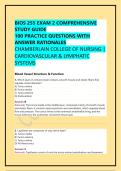
BIOS 255 EXAM 2 COMPREHENSIVE
STUDY GUIDE
100 PRACTICE QUESTIONS WITH
ANSWER RATIONALES
CHAMBERLAIN COLLEGE OF NURSING |
CARDIOVASCULAR & LYMPHATIC
SYSTEMS
Blood Vessel Structure & Function
1. Which layer of a blood vessel contains smooth muscle and elastic fibers that
regulate vessel diameter?
A) Tunica intima
B) Tunica media
C) Tunica externa
D) Endocardium
Answer: B
Rationale: The tunica media is the middle layer, composed mainly of smooth muscle
and elastic fibers. It controls vasoconstriction and vasodilation, which regulate blood
flow and pressure. The tunica intima is the innermost endothelial lining, and the
tunica externa is the outermost connective tissue layer.
2. Capillaries are composed of only which layer?
A) Tunica media
B) Tunica externa
C) Tunica intima
D) All three tunics
Answer: C
Rationale: Capillaries consist of only the tunica intima (endothelium and basement
,membrane) to allow for efficient exchange of gases, nutrients, and wastes. Their thin
walls minimize diffusion distance.
3. Which type of capillary is found in the kidneys and intestinal mucosa and contains
pores for filtration?
A) Continuous
B) Fenestrated
C) Sinusoidal
D) Metarteriole
Answer: B
Rationale: Fenestrated capillaries have pores (fenestrations) that increase
permeability, making them ideal for filtration and absorption in the kidneys,
intestines, and endocrine glands.
4. Which vessels are known as "capacitance vessels" because they hold the largest
volume of blood at rest?
A) Arteries
B) Arterioles
C) Capillaries
D) Veins
Answer: D
Rationale: Veins and venules hold about 60–65% of the body's blood volume at rest,
acting as blood reservoirs. Their high compliance allows them to stretch and store
blood.
5. Which vessels are the primary resistance vessels that regulate blood flow into
capillary beds?
A) Elastic arteries
B) Muscular arteries
C) Arterioles
D) Venules
,Answer: C
Rationale: Arterioles have the greatest resistance to blood flow because of their small
diameter and abundant smooth muscle. They are the main site of vascular resistance
and regulate blood distribution to tissues.
Hemodynamics & Blood Pressure
6. Blood flow is directly proportional to which factor?
A) Viscosity
B) Vessel length
C) Pressure gradient
D) Resistance
Answer: C
Rationale: Flow (F) = ΔP/R. Blood flow is directly proportional to the pressure
gradient (ΔP) and inversely proportional to resistance (R). Increased pressure
gradient increases flow.
7. Which factor increases peripheral resistance?
A) Vasodilation
B) Decreased blood viscosity
C) Increased vessel length
D) Increased vessel diameter
Answer: C
Rationale: Resistance is directly proportional to vessel length and blood viscosity, and
inversely proportional to the fourth power of vessel radius. Longer vessels and higher
viscosity increase resistance; vasodilation decreases it.
8. According to Poiseuille's law, if vessel radius doubles, resistance:
A) Doubles
B) Quadruples
C) Decreases by half
D) Decreases to 1/16
, Answer: D
Rationale: Resistance is inversely proportional to the fourth power of radius (R ∝
1/r⁴). If radius doubles (2⁴ = 16), resistance decreases to 1/16 of its original value.
9. Which of the following represents the correct formula for mean arterial pressure
(MAP)?
A) MAP = SBP − DBP
B) MAP = DBP + 1/3 (SBP − DBP)
C) MAP = SBP + DBP
D) MAP = HR × SV
Answer: B
Rationale: MAP ≈ DBP + 1/3(pulse pressure). Because the heart spends about twice
as long in diastole as systole, diastolic pressure is weighted more heavily.
10. If a patient has a blood pressure of 130/85 mm Hg, what is the approximate
MAP?
A) 100 mm Hg
B) 105 mm Hg
C) 90 mm Hg
D) 110 mm Hg
Answer: A
Rationale: MAP = 85 + 1/3(130 − 85) = 85 + 1/3(45) = 85 + 15 = 100 mm Hg.
11. Which of the following would increase blood pressure?
A) Increased parasympathetic activity to the heart
B) Vasodilation of arterioles
C) Increased stroke volume
D) Decreased blood volume
Answer: C
Rationale: BP = CO × TPR, and CO = HR × SV. Increased stroke volume increases
cardiac output, which raises blood pressure. Parasympathetic activity slows the heart,
vasodilation lowers TPR, and decreased blood volume lowers BP.
STUDY GUIDE
100 PRACTICE QUESTIONS WITH
ANSWER RATIONALES
CHAMBERLAIN COLLEGE OF NURSING |
CARDIOVASCULAR & LYMPHATIC
SYSTEMS
Blood Vessel Structure & Function
1. Which layer of a blood vessel contains smooth muscle and elastic fibers that
regulate vessel diameter?
A) Tunica intima
B) Tunica media
C) Tunica externa
D) Endocardium
Answer: B
Rationale: The tunica media is the middle layer, composed mainly of smooth muscle
and elastic fibers. It controls vasoconstriction and vasodilation, which regulate blood
flow and pressure. The tunica intima is the innermost endothelial lining, and the
tunica externa is the outermost connective tissue layer.
2. Capillaries are composed of only which layer?
A) Tunica media
B) Tunica externa
C) Tunica intima
D) All three tunics
Answer: C
Rationale: Capillaries consist of only the tunica intima (endothelium and basement
,membrane) to allow for efficient exchange of gases, nutrients, and wastes. Their thin
walls minimize diffusion distance.
3. Which type of capillary is found in the kidneys and intestinal mucosa and contains
pores for filtration?
A) Continuous
B) Fenestrated
C) Sinusoidal
D) Metarteriole
Answer: B
Rationale: Fenestrated capillaries have pores (fenestrations) that increase
permeability, making them ideal for filtration and absorption in the kidneys,
intestines, and endocrine glands.
4. Which vessels are known as "capacitance vessels" because they hold the largest
volume of blood at rest?
A) Arteries
B) Arterioles
C) Capillaries
D) Veins
Answer: D
Rationale: Veins and venules hold about 60–65% of the body's blood volume at rest,
acting as blood reservoirs. Their high compliance allows them to stretch and store
blood.
5. Which vessels are the primary resistance vessels that regulate blood flow into
capillary beds?
A) Elastic arteries
B) Muscular arteries
C) Arterioles
D) Venules
,Answer: C
Rationale: Arterioles have the greatest resistance to blood flow because of their small
diameter and abundant smooth muscle. They are the main site of vascular resistance
and regulate blood distribution to tissues.
Hemodynamics & Blood Pressure
6. Blood flow is directly proportional to which factor?
A) Viscosity
B) Vessel length
C) Pressure gradient
D) Resistance
Answer: C
Rationale: Flow (F) = ΔP/R. Blood flow is directly proportional to the pressure
gradient (ΔP) and inversely proportional to resistance (R). Increased pressure
gradient increases flow.
7. Which factor increases peripheral resistance?
A) Vasodilation
B) Decreased blood viscosity
C) Increased vessel length
D) Increased vessel diameter
Answer: C
Rationale: Resistance is directly proportional to vessel length and blood viscosity, and
inversely proportional to the fourth power of vessel radius. Longer vessels and higher
viscosity increase resistance; vasodilation decreases it.
8. According to Poiseuille's law, if vessel radius doubles, resistance:
A) Doubles
B) Quadruples
C) Decreases by half
D) Decreases to 1/16
, Answer: D
Rationale: Resistance is inversely proportional to the fourth power of radius (R ∝
1/r⁴). If radius doubles (2⁴ = 16), resistance decreases to 1/16 of its original value.
9. Which of the following represents the correct formula for mean arterial pressure
(MAP)?
A) MAP = SBP − DBP
B) MAP = DBP + 1/3 (SBP − DBP)
C) MAP = SBP + DBP
D) MAP = HR × SV
Answer: B
Rationale: MAP ≈ DBP + 1/3(pulse pressure). Because the heart spends about twice
as long in diastole as systole, diastolic pressure is weighted more heavily.
10. If a patient has a blood pressure of 130/85 mm Hg, what is the approximate
MAP?
A) 100 mm Hg
B) 105 mm Hg
C) 90 mm Hg
D) 110 mm Hg
Answer: A
Rationale: MAP = 85 + 1/3(130 − 85) = 85 + 1/3(45) = 85 + 15 = 100 mm Hg.
11. Which of the following would increase blood pressure?
A) Increased parasympathetic activity to the heart
B) Vasodilation of arterioles
C) Increased stroke volume
D) Decreased blood volume
Answer: C
Rationale: BP = CO × TPR, and CO = HR × SV. Increased stroke volume increases
cardiac output, which raises blood pressure. Parasympathetic activity slows the heart,
vasodilation lowers TPR, and decreased blood volume lowers BP.