
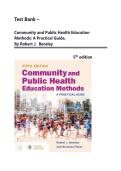
Test Bank –
Community and Public Health Education
Methods: A Practical Guide,
By Robert J. Bensley
5th edition
,Table of contents
Chapter 1 Laying the Foundation for Selecting Community and Public Health Education
Methods and Strategies
Chapter 2 Becoming a Health Education Professional
Chapter 3 Promoting Health Education in a Multicultural Society
Chapter 4 Applying a Health Literacy Framework
Chapter 5 Developing and Selecting Resource Materials
Chapter 6 Developing Effective Presentation and Training Skills
Chapter 7 Applying Motivational Interviewing Techniques
Chapter 8 Exploring Social Marketing Concepts
Chapter 9 Building a Health Communication Framework
Chapter 10 Using Social Media
Chapter 11 Exploring Digital Media Strategies
Chapter 12 Working with Media Outlets
Chapter 13 Facilitating Groups
Chapter 14 Building and Sustaining Coalitions
Chapter 15 Advocating for Health Policy
,CHAPTER 1: Laying the Foundation for Selecting Community and
Public Health Education Methods and Strategies
1. Which of the following is the FIRST step in selecting appropriate health education methods and
strategies for a community?
A) Developing a budget for the program
B) Conducting a needs assessment
C) Selecting a theoretical framework
D) Recruiting community volunteers
Answer: B
Rationale: A needs assessment is the foundational first step because it identifies the health problems,
resources, and priorities of the target population. Without understanding the community's needs, any
subsequent selection of methods or strategies would be uninformed and potentially ineffective.
2. The PRECEDE-PROCEED model is best described as a:
A) Communication theory
B) Community organizing technique
C) Comprehensive planning and evaluation framework
D) Social marketing strategy
Answer: C
Rationale: PRECEDE-PROCEED is one of the most widely used comprehensive planning and evaluation
models in health promotion. PRECEDE focuses on assessment and planning phases, while PROCEED
focuses on implementation and evaluation phases.
3. In the ecological model of health behavior, which level addresses interpersonal relationships and
social networks?
A) Intrapersonal level
B) Interpersonal level
C) Organizational level
D) Policy level
Answer: B
Rationale: The interpersonal level of the ecological model focuses on formal and informal social
networks and social support systems, including family, friends, and peers, that influence an individual's
health behavior.
4. Which planning model uses the phases of assessment, planning, implementation, and evaluation in
a cyclical process?
A) MATCH model
B) MAP-IT framework
, C) Generalized Model for Program Planning
D) Intervention Mapping
Answer: C
Rationale: The Generalized Model for Program Planning provides a simplified, cyclical framework
encompassing assessing needs, setting goals and objectives, developing interventions, implementing the
program, and evaluating results. It serves as a foundational model from which more specific models are
derived.
5. When selecting a health education method, a health educator should PRIMARILY consider:
A) The most technologically advanced option available
B) The method that is least expensive
C) The match between the method, the audience, and the learning objectives
D) The method that has been used most frequently in the literature
Answer: C
Rationale: The most critical factor in method selection is ensuring alignment among the chosen method,
the characteristics and needs of the target audience, and the specific learning objectives. A method that
works well for one audience may be entirely inappropriate for another.
6. Which of the following best describes a "strategy" in the context of health education?
A) A specific activity or tool used to deliver content
B) An overall plan of action designed to achieve a goal
C) A statistical measure of program success
D) A funding mechanism for health programs
Answer: B
Rationale: A strategy is a broader plan of action or approach designed to achieve specific goals and
objectives. Methods are the specific tools or activities used within that strategy. For example, a strategy
may be "increase community awareness," and methods may include workshops, brochures, and social
media campaigns.
7. The MAP-IT framework stands for:
A) Mobilize, Assess, Plan, Implement, Track
B) Monitor, Analyze, Prioritize, Integrate, Train
C) Manage, Allocate, Prepare, Initiate, Test
D) Measure, Adapt, Promote, Inform, Transform
Answer: A
Rationale: MAP-IT is a planning framework used in Healthy People initiatives that stands for Mobilize
key stakeholders, Assess community needs, Plan strategies, Implement interventions, and Track
progress over time.
Community and Public Health Education
Methods: A Practical Guide,
By Robert J. Bensley
5th edition
,Table of contents
Chapter 1 Laying the Foundation for Selecting Community and Public Health Education
Methods and Strategies
Chapter 2 Becoming a Health Education Professional
Chapter 3 Promoting Health Education in a Multicultural Society
Chapter 4 Applying a Health Literacy Framework
Chapter 5 Developing and Selecting Resource Materials
Chapter 6 Developing Effective Presentation and Training Skills
Chapter 7 Applying Motivational Interviewing Techniques
Chapter 8 Exploring Social Marketing Concepts
Chapter 9 Building a Health Communication Framework
Chapter 10 Using Social Media
Chapter 11 Exploring Digital Media Strategies
Chapter 12 Working with Media Outlets
Chapter 13 Facilitating Groups
Chapter 14 Building and Sustaining Coalitions
Chapter 15 Advocating for Health Policy
,CHAPTER 1: Laying the Foundation for Selecting Community and
Public Health Education Methods and Strategies
1. Which of the following is the FIRST step in selecting appropriate health education methods and
strategies for a community?
A) Developing a budget for the program
B) Conducting a needs assessment
C) Selecting a theoretical framework
D) Recruiting community volunteers
Answer: B
Rationale: A needs assessment is the foundational first step because it identifies the health problems,
resources, and priorities of the target population. Without understanding the community's needs, any
subsequent selection of methods or strategies would be uninformed and potentially ineffective.
2. The PRECEDE-PROCEED model is best described as a:
A) Communication theory
B) Community organizing technique
C) Comprehensive planning and evaluation framework
D) Social marketing strategy
Answer: C
Rationale: PRECEDE-PROCEED is one of the most widely used comprehensive planning and evaluation
models in health promotion. PRECEDE focuses on assessment and planning phases, while PROCEED
focuses on implementation and evaluation phases.
3. In the ecological model of health behavior, which level addresses interpersonal relationships and
social networks?
A) Intrapersonal level
B) Interpersonal level
C) Organizational level
D) Policy level
Answer: B
Rationale: The interpersonal level of the ecological model focuses on formal and informal social
networks and social support systems, including family, friends, and peers, that influence an individual's
health behavior.
4. Which planning model uses the phases of assessment, planning, implementation, and evaluation in
a cyclical process?
A) MATCH model
B) MAP-IT framework
, C) Generalized Model for Program Planning
D) Intervention Mapping
Answer: C
Rationale: The Generalized Model for Program Planning provides a simplified, cyclical framework
encompassing assessing needs, setting goals and objectives, developing interventions, implementing the
program, and evaluating results. It serves as a foundational model from which more specific models are
derived.
5. When selecting a health education method, a health educator should PRIMARILY consider:
A) The most technologically advanced option available
B) The method that is least expensive
C) The match between the method, the audience, and the learning objectives
D) The method that has been used most frequently in the literature
Answer: C
Rationale: The most critical factor in method selection is ensuring alignment among the chosen method,
the characteristics and needs of the target audience, and the specific learning objectives. A method that
works well for one audience may be entirely inappropriate for another.
6. Which of the following best describes a "strategy" in the context of health education?
A) A specific activity or tool used to deliver content
B) An overall plan of action designed to achieve a goal
C) A statistical measure of program success
D) A funding mechanism for health programs
Answer: B
Rationale: A strategy is a broader plan of action or approach designed to achieve specific goals and
objectives. Methods are the specific tools or activities used within that strategy. For example, a strategy
may be "increase community awareness," and methods may include workshops, brochures, and social
media campaigns.
7. The MAP-IT framework stands for:
A) Mobilize, Assess, Plan, Implement, Track
B) Monitor, Analyze, Prioritize, Integrate, Train
C) Manage, Allocate, Prepare, Initiate, Test
D) Measure, Adapt, Promote, Inform, Transform
Answer: A
Rationale: MAP-IT is a planning framework used in Healthy People initiatives that stands for Mobilize
key stakeholders, Assess community needs, Plan strategies, Implement interventions, and Track
progress over time.


