

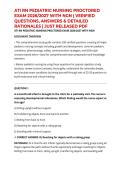
ATI RN PEDIATRIC NURSING PROCTORED
EXAM 2026/2027 WITH NGN | VERIFIED
QUESTIONS, ANSWERS & DETAILED
RATIONALES | JUST RELEASED PDF
ATI RN PEDIATRIC NURSING PROCTORED EXAM 2026/2027 WITH NGN
DOCUMENT OVERVIEW
• This comprehensive study guide contains 200 verified questions covering all major
pediatric nursing concepts including growth and development, common pediatric
conditions, pharmacology, safety, communication strategies, and NGN-style
scenario-based items—ideal for comprehensive exam preparation and knowledge
retention.
• Master pediatric nursing by using these questions for spaced repetition study
sessions; review incorrect answers thoroughly, understand the rationales deeply,
and simulate exam conditions by timing yourself through sets of 25-50 questions to
build endurance and critical thinking.
QUESTION 1
A 4-month-old infant is brought to the clinic for a well-baby visit. The nurse is
assessing developmental milestones. Which finding would the nurse expect at
this age?
A) Sitting upright without support
B) Transferring objects from one hand to another
C) Rolling from back to front
D) Reaching for objects with a raking grasp
E) Standing with minimal support
✓ CORRECT ANSWER: D) Reaching for objects with a raking grasp
RATIONALE: At 4 months old, infants typically demonstrate a raking grasp (using all
fingers against the palm without thumb opposition) and begin reaching for objects.
Rolling from back to front, sitting upright, transferring objects, and standing with
,support are developmental milestones that occur at later ages (6+ months). The
raking grasp is a normal gross motor response at this age and indicates
appropriate neurological development.
QUESTION 2
A 2-year-old toddler is admitted with suspected acute epiglottitis. Which
nursing action is the PRIORITY?
A) Obtain a throat culture immediately
B) Keep the child calm and in an upright position
C) Administer antipyretics for fever management
D) Perform a thorough throat examination
E) Insert an IV line for fluid administration
✓ CORRECT ANSWER: B) Keep the child calm and in an upright position
RATIONALE: Acute epiglottitis is a medical emergency. The priority is to maintain
airway patency by keeping the child calm (agitation increases respiratory distress)
and in an upright position (tripod position helps open airway). Throat cultures,
examinations, or aggressive interventions can trigger complete airway obstruction.
The child should be kept NPO and prepared for airway management. Other
interventions are secondary to airway maintenance.
QUESTION 3
A nurse is calculating a medication dose for a 6-year-old child weighing 20 kg.
The prescribed dose is 10 mg/kg/day to be given in two divided doses. How
many mg should the nurse administer per dose?
A) 50 mg
B) 100 mg
C) 150 mg
,D) 200 mg
E) 250 mg
✓ CORRECT ANSWER: B) 100 mg
RATIONALE: Using the formula: Dose = Weight (kg) × Prescribed dose (mg/kg) = 20
kg × 10 mg/kg = 200 mg/day. Since this is divided into two doses: 200 mg ÷ 2 = 100
mg per dose. Accurate medication calculation is critical in pediatric nursing to
prevent medication errors and ensure therapeutic dosing.
QUESTION 4
A 3-month-old infant presents with symptoms of gastroesophageal reflux
(GER). Which feeding strategy would the nurse recommend to the parents?
A) Feed the infant in a flat, horizontal position
B) Use thickened formula and position infant upright at 30 degrees for 30 minutes
after feeding
C) Increase feeding frequency and volume
D) Switch to cold formula to reduce irritation
E) Place the infant on their stomach for sleeping
✓ CORRECT ANSWER: B) Use thickened formula and position infant upright at
30 degrees for 30 minutes after feeding
RATIONALE: Management of GER in infants includes thickening feedings with rice
cereal and maintaining an upright position (30-degree head elevation) for at least
30 minutes after feeding to reduce reflux episodes. Flat positioning, increased
volume, cold formula, and prone sleeping increase reflux risk and are
contraindicated. Back sleeping position (supine) is recommended per SIDS
prevention guidelines.
QUESTION 5
, A 5-year-old child is being prepared for surgery. The child is experiencing
anxiety about the procedure. Which therapeutic communication technique is
MOST appropriate?
A) Tell the child that everything will be fine and there is nothing to worry about
B) Use simple, concrete language and allow the child to handle safe equipment
C) Provide detailed medical explanations of the surgical procedure
D) Distract the child by talking about unrelated topics
E) Ask the child to describe their fears in complex medical terminology
✓ CORRECT ANSWER: B) Use simple, concrete language and allow the child to
handle safe equipment
RATIONALE: Preschoolers (4-5 years) respond best to concrete explanations using
simple language and concrete experiences. Allowing them to touch and handle safe
equipment (play therapy) reduces anxiety and promotes coping. Dismissing fears,
over-explaining with medical jargon, and distraction may increase anxiety. Honest,
age-appropriate preparation is therapeutic and supports the child's sense of
control.
QUESTION 6
An 8-year-old child with asthma is prescribed an albuterol inhaler. When
teaching the child how to use the inhaler, which instruction is CORRECT?
A) Exhale completely, then place the mouthpiece in the mouth and inhale while
pressing the canister
B) Inhale while standing upright, hold breath for 1 minute, then exhale
C) Use the inhaler while lying flat to maximize medication delivery
D) Rinse the mouth with water before using the inhaler
E) Take two puffs immediately without waiting between doses
EXAM 2026/2027 WITH NGN | VERIFIED
QUESTIONS, ANSWERS & DETAILED
RATIONALES | JUST RELEASED PDF
ATI RN PEDIATRIC NURSING PROCTORED EXAM 2026/2027 WITH NGN
DOCUMENT OVERVIEW
• This comprehensive study guide contains 200 verified questions covering all major
pediatric nursing concepts including growth and development, common pediatric
conditions, pharmacology, safety, communication strategies, and NGN-style
scenario-based items—ideal for comprehensive exam preparation and knowledge
retention.
• Master pediatric nursing by using these questions for spaced repetition study
sessions; review incorrect answers thoroughly, understand the rationales deeply,
and simulate exam conditions by timing yourself through sets of 25-50 questions to
build endurance and critical thinking.
QUESTION 1
A 4-month-old infant is brought to the clinic for a well-baby visit. The nurse is
assessing developmental milestones. Which finding would the nurse expect at
this age?
A) Sitting upright without support
B) Transferring objects from one hand to another
C) Rolling from back to front
D) Reaching for objects with a raking grasp
E) Standing with minimal support
✓ CORRECT ANSWER: D) Reaching for objects with a raking grasp
RATIONALE: At 4 months old, infants typically demonstrate a raking grasp (using all
fingers against the palm without thumb opposition) and begin reaching for objects.
Rolling from back to front, sitting upright, transferring objects, and standing with
,support are developmental milestones that occur at later ages (6+ months). The
raking grasp is a normal gross motor response at this age and indicates
appropriate neurological development.
QUESTION 2
A 2-year-old toddler is admitted with suspected acute epiglottitis. Which
nursing action is the PRIORITY?
A) Obtain a throat culture immediately
B) Keep the child calm and in an upright position
C) Administer antipyretics for fever management
D) Perform a thorough throat examination
E) Insert an IV line for fluid administration
✓ CORRECT ANSWER: B) Keep the child calm and in an upright position
RATIONALE: Acute epiglottitis is a medical emergency. The priority is to maintain
airway patency by keeping the child calm (agitation increases respiratory distress)
and in an upright position (tripod position helps open airway). Throat cultures,
examinations, or aggressive interventions can trigger complete airway obstruction.
The child should be kept NPO and prepared for airway management. Other
interventions are secondary to airway maintenance.
QUESTION 3
A nurse is calculating a medication dose for a 6-year-old child weighing 20 kg.
The prescribed dose is 10 mg/kg/day to be given in two divided doses. How
many mg should the nurse administer per dose?
A) 50 mg
B) 100 mg
C) 150 mg
,D) 200 mg
E) 250 mg
✓ CORRECT ANSWER: B) 100 mg
RATIONALE: Using the formula: Dose = Weight (kg) × Prescribed dose (mg/kg) = 20
kg × 10 mg/kg = 200 mg/day. Since this is divided into two doses: 200 mg ÷ 2 = 100
mg per dose. Accurate medication calculation is critical in pediatric nursing to
prevent medication errors and ensure therapeutic dosing.
QUESTION 4
A 3-month-old infant presents with symptoms of gastroesophageal reflux
(GER). Which feeding strategy would the nurse recommend to the parents?
A) Feed the infant in a flat, horizontal position
B) Use thickened formula and position infant upright at 30 degrees for 30 minutes
after feeding
C) Increase feeding frequency and volume
D) Switch to cold formula to reduce irritation
E) Place the infant on their stomach for sleeping
✓ CORRECT ANSWER: B) Use thickened formula and position infant upright at
30 degrees for 30 minutes after feeding
RATIONALE: Management of GER in infants includes thickening feedings with rice
cereal and maintaining an upright position (30-degree head elevation) for at least
30 minutes after feeding to reduce reflux episodes. Flat positioning, increased
volume, cold formula, and prone sleeping increase reflux risk and are
contraindicated. Back sleeping position (supine) is recommended per SIDS
prevention guidelines.
QUESTION 5
, A 5-year-old child is being prepared for surgery. The child is experiencing
anxiety about the procedure. Which therapeutic communication technique is
MOST appropriate?
A) Tell the child that everything will be fine and there is nothing to worry about
B) Use simple, concrete language and allow the child to handle safe equipment
C) Provide detailed medical explanations of the surgical procedure
D) Distract the child by talking about unrelated topics
E) Ask the child to describe their fears in complex medical terminology
✓ CORRECT ANSWER: B) Use simple, concrete language and allow the child to
handle safe equipment
RATIONALE: Preschoolers (4-5 years) respond best to concrete explanations using
simple language and concrete experiences. Allowing them to touch and handle safe
equipment (play therapy) reduces anxiety and promotes coping. Dismissing fears,
over-explaining with medical jargon, and distraction may increase anxiety. Honest,
age-appropriate preparation is therapeutic and supports the child's sense of
control.
QUESTION 6
An 8-year-old child with asthma is prescribed an albuterol inhaler. When
teaching the child how to use the inhaler, which instruction is CORRECT?
A) Exhale completely, then place the mouthpiece in the mouth and inhale while
pressing the canister
B) Inhale while standing upright, hold breath for 1 minute, then exhale
C) Use the inhaler while lying flat to maximize medication delivery
D) Rinse the mouth with water before using the inhaler
E) Take two puffs immediately without waiting between doses


