
NUR417 Nursing Care of the Adult 2
EKG Rhythm Interpretation Packet
EKG Rhythm Interpretation Packet
Instructions
Complete a review the basics of the conduction system and electrocardiogram (EKG) readings, then work
through the steps of systematically interpreting EKG rhythms that follow. After completing these, you will
be presented with several opportunities to practice your interpretation skills. Analyze the strips in the
Rhythm Practice section and enter the related data below each.
Review of the Basics
Conduction system
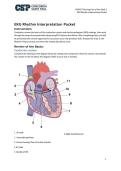
Complete the labeling for the diagram below by naming each component. Place the correct name beside
the number in the list below the diagram. Refer to your text as needed.
1. SA node
6. Right bundle branch
2. Internodal pathway
3. Arrow showing: flow of cardiac impulse
4. AV node
5. Bundle of HIS
1
, NUR417 Nursing Care of the Adult 2
EKG Rhythm Interpretation Packet
7. Purkinje Fibers
8. anterior fascicle of bundle branch
9. posterior fascicle of left bundle branch
10. left bundle branch
11. Arrows showing: flow of cardiac
impulse
2
, NUR417 Nursing Care of the Adult 2
EKG Rhythm Interpretation Packet
Electrocardiogram
The diagram that follows shows a normal sinus rhythm. Different aspects of the rhythm are labeled
(progressing from left to right):
• The rhythm begins as straight, on the baseline.
• Next, the PR Interval is identified with the upward bend of the P wave and a return to the
baseline – which is identified as the PR Segment.
• The QRS Complex follows with the dip of the Q wave, followed by the spike of the R wave, and
completed with another dip – the S wave.
• Another return to baseline, following the S wave and extending to the upward bend of the T
wave, is identified as the ST Segment.
• The QT Interval begins with QRS Complex and extends to the end of the T wave.
• After the T wave, there is a return to baseline.
Image Attribution: Created by Agateller (Anthony Atkielski), converted to svg by atom., Public domain, via
Wikimedia Commons
Lead Placement
The proceeding diagram illustrates EKG lead
placement (starting at the top, by the shoulders,
and moving down the abdomen):
• RA – On the right, by the clavicle
• LA – On the left, by the clavicle
• V – In the center, to the right of the
sternum
• RL – On the right, below the rib cage
• LL – On the left, below the rib cage
3
EKG Rhythm Interpretation Packet
EKG Rhythm Interpretation Packet
Instructions
Complete a review the basics of the conduction system and electrocardiogram (EKG) readings, then work
through the steps of systematically interpreting EKG rhythms that follow. After completing these, you will
be presented with several opportunities to practice your interpretation skills. Analyze the strips in the
Rhythm Practice section and enter the related data below each.
Review of the Basics
Conduction system
Complete the labeling for the diagram below by naming each component. Place the correct name beside
the number in the list below the diagram. Refer to your text as needed.
1. SA node
6. Right bundle branch
2. Internodal pathway
3. Arrow showing: flow of cardiac impulse
4. AV node
5. Bundle of HIS
1
, NUR417 Nursing Care of the Adult 2
EKG Rhythm Interpretation Packet
7. Purkinje Fibers
8. anterior fascicle of bundle branch
9. posterior fascicle of left bundle branch
10. left bundle branch
11. Arrows showing: flow of cardiac
impulse
2
, NUR417 Nursing Care of the Adult 2
EKG Rhythm Interpretation Packet
Electrocardiogram
The diagram that follows shows a normal sinus rhythm. Different aspects of the rhythm are labeled
(progressing from left to right):
• The rhythm begins as straight, on the baseline.
• Next, the PR Interval is identified with the upward bend of the P wave and a return to the
baseline – which is identified as the PR Segment.
• The QRS Complex follows with the dip of the Q wave, followed by the spike of the R wave, and
completed with another dip – the S wave.
• Another return to baseline, following the S wave and extending to the upward bend of the T
wave, is identified as the ST Segment.
• The QT Interval begins with QRS Complex and extends to the end of the T wave.
• After the T wave, there is a return to baseline.
Image Attribution: Created by Agateller (Anthony Atkielski), converted to svg by atom., Public domain, via
Wikimedia Commons
Lead Placement
The proceeding diagram illustrates EKG lead
placement (starting at the top, by the shoulders,
and moving down the abdomen):
• RA – On the right, by the clavicle
• LA – On the left, by the clavicle
• V – In the center, to the right of the
sternum
• RL – On the right, below the rib cage
• LL – On the left, below the rib cage
3


