
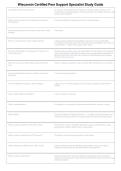
Wisconsin Certified Peer Support Specialist Study Guide
er Specialist (CPS) training course? To introduce the profession of peer support, including scope of practice, core
competencies, ethics/boundaries, and the processes, key concepts, skills, and tools
of peer support practice.
What are the four (later five) fundamental processes of Connecting, Exploring, Supporting, Planning, and Advocating.
CPS practice?
Which fundamental process is "task number one" in every Connecting.
meeting?
What is a "brave space" in peer support training? A space where participants and facilitators actively lean into uncomfortable
conversations, take risks, and share with honesty and vulnerability, even when it is
uncomfortable — distinct from a purely "safe" space.
Why does the training shift emphasis from "self-care" to Because self-care alone places sole responsibility for well-being on the individual
"community care"? and can feel isolating, especially for people who are systemically marginalized or
lack time/resources; community care recognizes interdependence and unequal
access to time and money.
Name the five ways to shift thinking toward community Check in regularly, empathize, make a specific offer, prioritize rest, and socialize.
care.
According to Maslow's Hierarchy of Needs, what is the A sense of belonging and love.
third level?
How does Webster's Dictionary define privilege? A right, favor, or immunity granted to one individual or group and withheld from
another.
What is stigma (Merriam-Webster)? A mark of shame or discredit.
What is marginalization? To relegate to an unimportant or powerless position within a society or group.
What is WISE? Wisconsin Initiative for Stigma Elimination — a coalition promoting inclusion and
evidence-based stigma reduction through people sharing their recovery stories.
What is culture (as defined in the CPS course)? The behaviors, values, and beliefs shared by a group of people (ethnic, racial,
geographical, religious, gender, class, or age group).
What is power (as defined in the CPS course)? The ability to affect change and control or direct others.
What is privilege (as defined in the CPS course)? A type of inherent power that affords people benefits, access, and support,
frequently without realizing it and often without having earned it.
What is systemic oppression? Systems in place that create and maintain inequality (also known as systemic
racism when race-based); it exists at the level of institutions and structures, not just
individual prejudice.
, Wisconsin Certified Peer Support Specialist Study Guide
What percentage of Indigenous communities in Wisconsin 77%.
(2011-2016) experienced an adverse childhood experience
(ACE)?
What was a key limitation of the original ACE study noted It relied predominantly on data from white, middle/upper-middle-class people and
in the CPS course? focused on experiences within the home, missing systemic marginalization impacts.
What are the six key principles of a trauma-informed Safety; Trustworthiness and transparency; Peer support; Collaboration and
approach (SAMHSA)? mutuality; Empowerment, voice, and choice; Cultural, historical, and gender issues.
Define trauma (as used in this CPS course). Extreme stress like a threat to life or bodily harm that overwhelms a person's ability
to cope; trauma is subjective — what is traumatic to one person may not be to
another.
What is the difference between acute and complex Acute trauma involves re-experiencing (memories, flashbacks) and
trauma? hyperarousal/avoidance after a single event; complex trauma happens early in life
during brain development from prolonged adversity without adequate adult support.
What is psychological trauma? Trauma from observing/experiencing a life-threatening event or being violated by
someone you depend on for well-being (e.g., abuse, bullying, food insecurity,
disasters, violence, war).
What is sanctuary trauma? Trauma occurring in settings socially sanctioned as safe (medical, mental health,
justice, foster care, schools, faith communities), often involving provider bias.
What is provider bias? Attitudes and behaviors by service providers that unnecessarily restrict client
access and choice, which can be explicit (conscious) or implicit (unconscious).
What is historical/generational/intergenerational trauma? Cumulative or collective emotional harm experienced by an individual or group
across generations, still affecting the group today (e.g., racial/ethnic discrimination
and violence).
What is racial trauma (race-based traumatic stress)? Trauma resulting from race-related experiences involving discrimination, prejudice,
and racism.
What is posttraumatic slave syndrome? A consequence of the multigenerational oppression of Africans and their
descendants resulting from centuries of slavery.
What is vicarious trauma? Trauma-related symptoms experienced by someone (such as a CPS) in response
to helping others who experienced traumatic events.
What is collective trauma? A traumatic event shared by a group of people (family or whole society), such as
famines, mass shootings, disasters, pandemics, or war.
What are the three parts of the brain discussed in relation Reptilian brain (basal ganglia/brainstem/cerebellum), limbic system (midbrain,
to trauma, from bottom to top? emotion), and neocortex (thinking brain, prefrontal lobes).
What is the fight, flight, or freeze response? An automatic survival response activated when a person's life is perceived to be in
danger, causing over 1,400 physiological changes in the body.
er Specialist (CPS) training course? To introduce the profession of peer support, including scope of practice, core
competencies, ethics/boundaries, and the processes, key concepts, skills, and tools
of peer support practice.
What are the four (later five) fundamental processes of Connecting, Exploring, Supporting, Planning, and Advocating.
CPS practice?
Which fundamental process is "task number one" in every Connecting.
meeting?
What is a "brave space" in peer support training? A space where participants and facilitators actively lean into uncomfortable
conversations, take risks, and share with honesty and vulnerability, even when it is
uncomfortable — distinct from a purely "safe" space.
Why does the training shift emphasis from "self-care" to Because self-care alone places sole responsibility for well-being on the individual
"community care"? and can feel isolating, especially for people who are systemically marginalized or
lack time/resources; community care recognizes interdependence and unequal
access to time and money.
Name the five ways to shift thinking toward community Check in regularly, empathize, make a specific offer, prioritize rest, and socialize.
care.
According to Maslow's Hierarchy of Needs, what is the A sense of belonging and love.
third level?
How does Webster's Dictionary define privilege? A right, favor, or immunity granted to one individual or group and withheld from
another.
What is stigma (Merriam-Webster)? A mark of shame or discredit.
What is marginalization? To relegate to an unimportant or powerless position within a society or group.
What is WISE? Wisconsin Initiative for Stigma Elimination — a coalition promoting inclusion and
evidence-based stigma reduction through people sharing their recovery stories.
What is culture (as defined in the CPS course)? The behaviors, values, and beliefs shared by a group of people (ethnic, racial,
geographical, religious, gender, class, or age group).
What is power (as defined in the CPS course)? The ability to affect change and control or direct others.
What is privilege (as defined in the CPS course)? A type of inherent power that affords people benefits, access, and support,
frequently without realizing it and often without having earned it.
What is systemic oppression? Systems in place that create and maintain inequality (also known as systemic
racism when race-based); it exists at the level of institutions and structures, not just
individual prejudice.
, Wisconsin Certified Peer Support Specialist Study Guide
What percentage of Indigenous communities in Wisconsin 77%.
(2011-2016) experienced an adverse childhood experience
(ACE)?
What was a key limitation of the original ACE study noted It relied predominantly on data from white, middle/upper-middle-class people and
in the CPS course? focused on experiences within the home, missing systemic marginalization impacts.
What are the six key principles of a trauma-informed Safety; Trustworthiness and transparency; Peer support; Collaboration and
approach (SAMHSA)? mutuality; Empowerment, voice, and choice; Cultural, historical, and gender issues.
Define trauma (as used in this CPS course). Extreme stress like a threat to life or bodily harm that overwhelms a person's ability
to cope; trauma is subjective — what is traumatic to one person may not be to
another.
What is the difference between acute and complex Acute trauma involves re-experiencing (memories, flashbacks) and
trauma? hyperarousal/avoidance after a single event; complex trauma happens early in life
during brain development from prolonged adversity without adequate adult support.
What is psychological trauma? Trauma from observing/experiencing a life-threatening event or being violated by
someone you depend on for well-being (e.g., abuse, bullying, food insecurity,
disasters, violence, war).
What is sanctuary trauma? Trauma occurring in settings socially sanctioned as safe (medical, mental health,
justice, foster care, schools, faith communities), often involving provider bias.
What is provider bias? Attitudes and behaviors by service providers that unnecessarily restrict client
access and choice, which can be explicit (conscious) or implicit (unconscious).
What is historical/generational/intergenerational trauma? Cumulative or collective emotional harm experienced by an individual or group
across generations, still affecting the group today (e.g., racial/ethnic discrimination
and violence).
What is racial trauma (race-based traumatic stress)? Trauma resulting from race-related experiences involving discrimination, prejudice,
and racism.
What is posttraumatic slave syndrome? A consequence of the multigenerational oppression of Africans and their
descendants resulting from centuries of slavery.
What is vicarious trauma? Trauma-related symptoms experienced by someone (such as a CPS) in response
to helping others who experienced traumatic events.
What is collective trauma? A traumatic event shared by a group of people (family or whole society), such as
famines, mass shootings, disasters, pandemics, or war.
What are the three parts of the brain discussed in relation Reptilian brain (basal ganglia/brainstem/cerebellum), limbic system (midbrain,
to trauma, from bottom to top? emotion), and neocortex (thinking brain, prefrontal lobes).
What is the fight, flight, or freeze response? An automatic survival response activated when a person's life is perceived to be in
danger, causing over 1,400 physiological changes in the body.


