

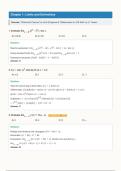
Chapter 1: Limits and Derivatives
Sources: "Differential Calculus" by Amit M Agarwal & "Mathematics for JEE Main" by G. Tewani
1. Evaluate lim
x x
x→0 (5 - 3 ) / tan x.
A) ln(5/3) B) ln(15) C) 5/3 D) 0
Solution:
Rewrite expression: lim
x x
x→0 [ (5 - 1)/x - (3 - 1)/x ] × [x / tan x].
Using standard limits lim
x
x→0 (a -1)/x = ln a and limx→0 (tan x)/x = 1.
Expression becomes: [ln(5) - ln(3)] × 1 = ln(5/3).
Answer: A
x
2. If y = (sin x) , find dy/dx at x = π/2.
A) π/2 B) 1 C) 0 D) -1
Solution:
Take the natural log of both sides: ln y = x ln(sin x).
Differentiate: (1/y)(dy/dx) = ln(sin x) + x(1/sin x)(cos x) = ln(sin x) + x cot x.
dy/dx = (sin x)x [ln(sin x) + x cot x].
Substitute x = π/2: (sin(π/2))
π/2 [ln(sin(π/2)) + (π/2)cot(π/2)].
= 1π/2 [ln(1) + (π/2)(0)] = 1 [0 + 0] = 0.
Answer: C
3. Evaluate lim
x→∞ (√(x² + 8x) - x). CONCEPTUAL / FAST
A) 0 B) 4 C) 8 D) ∞
Solution:
Multiply and divide by the conjugate (√(x² + 8x) + x).
Numerator: (x² + 8x) - x² = 8x.
Expression: lim
x→∞ 8x / (√(x² + 8x) + x). Divide num and den by x.
limx→∞ 8 / (√(1 + 8/x) + 1) = 8 / (1 + 1) = 4.
Answer: B
, -1
4. Find the derivative of tan [ (cos x - sin x) / (cos x + sin x) ] with respect to x.
A) 1 B) -1 C) sec²x D) 0
Solution:
Divide numerator and denominator inside the bracket by cos x.
-1
The expression becomes tan [ (1 - tan x) / (1 + tan x) ].
Using the formula tan(π/4 - x) = (1 - tan x)/(1 + tan x).
-1
The function is y = tan [ tan(π/4 - x) ] = π/4 - x.
Differentiate w.r.t x: dy/dx = -1.
Answer: B
5. Evaluate lim
x→0 (tan x - sin x) / x³. CORE ADVANCED
A) 1/2 B) 1 C) 1/3 D) 0
Solution:
Rewrite tan x as sin x / cos x.
Numerator: (sin x/cos x) - sin x = sin x (1/cos x - 1) = sin x (1 - cos x)/cos x.
Expression: lim
x→0 [sin x · (1 - cos x)] / [x³ cos x].
Separate standard limits: [lim (sin x)/x] × [lim (1 - cos x)/x²] × [lim 1/cos x].
= (1) × (1/2) × (1) = 1/2.
Answer: A
Chapter 2: Functions
Sources: "Algebra" by S.K. Goyal & "Coordinate Geometry" by Cengage Learning
6. Find the domain of f(x) = 1 / √(|x| - x). CONCEPTUAL / FAST
A) (0, ∞) B) (-∞, 0) C) [0, ∞) D) (-∞, ∞)
Solution:
For the function to be defined, the term inside the square root in the denominator must be strictly positive:
|x| - x > 0 ⇒ |x| > x.
If x ≥ 0, |x| = x, so x > x (False).
If x < 0, |x| = -x, so -x > x ⇒ -2x > 0 ⇒ x < 0 (True).
Therefore, the domain is all negative real numbers, (-∞, 0).
Answer: B
Sources: "Differential Calculus" by Amit M Agarwal & "Mathematics for JEE Main" by G. Tewani
1. Evaluate lim
x x
x→0 (5 - 3 ) / tan x.
A) ln(5/3) B) ln(15) C) 5/3 D) 0
Solution:
Rewrite expression: lim
x x
x→0 [ (5 - 1)/x - (3 - 1)/x ] × [x / tan x].
Using standard limits lim
x
x→0 (a -1)/x = ln a and limx→0 (tan x)/x = 1.
Expression becomes: [ln(5) - ln(3)] × 1 = ln(5/3).
Answer: A
x
2. If y = (sin x) , find dy/dx at x = π/2.
A) π/2 B) 1 C) 0 D) -1
Solution:
Take the natural log of both sides: ln y = x ln(sin x).
Differentiate: (1/y)(dy/dx) = ln(sin x) + x(1/sin x)(cos x) = ln(sin x) + x cot x.
dy/dx = (sin x)x [ln(sin x) + x cot x].
Substitute x = π/2: (sin(π/2))
π/2 [ln(sin(π/2)) + (π/2)cot(π/2)].
= 1π/2 [ln(1) + (π/2)(0)] = 1 [0 + 0] = 0.
Answer: C
3. Evaluate lim
x→∞ (√(x² + 8x) - x). CONCEPTUAL / FAST
A) 0 B) 4 C) 8 D) ∞
Solution:
Multiply and divide by the conjugate (√(x² + 8x) + x).
Numerator: (x² + 8x) - x² = 8x.
Expression: lim
x→∞ 8x / (√(x² + 8x) + x). Divide num and den by x.
limx→∞ 8 / (√(1 + 8/x) + 1) = 8 / (1 + 1) = 4.
Answer: B
, -1
4. Find the derivative of tan [ (cos x - sin x) / (cos x + sin x) ] with respect to x.
A) 1 B) -1 C) sec²x D) 0
Solution:
Divide numerator and denominator inside the bracket by cos x.
-1
The expression becomes tan [ (1 - tan x) / (1 + tan x) ].
Using the formula tan(π/4 - x) = (1 - tan x)/(1 + tan x).
-1
The function is y = tan [ tan(π/4 - x) ] = π/4 - x.
Differentiate w.r.t x: dy/dx = -1.
Answer: B
5. Evaluate lim
x→0 (tan x - sin x) / x³. CORE ADVANCED
A) 1/2 B) 1 C) 1/3 D) 0
Solution:
Rewrite tan x as sin x / cos x.
Numerator: (sin x/cos x) - sin x = sin x (1/cos x - 1) = sin x (1 - cos x)/cos x.
Expression: lim
x→0 [sin x · (1 - cos x)] / [x³ cos x].
Separate standard limits: [lim (sin x)/x] × [lim (1 - cos x)/x²] × [lim 1/cos x].
= (1) × (1/2) × (1) = 1/2.
Answer: A
Chapter 2: Functions
Sources: "Algebra" by S.K. Goyal & "Coordinate Geometry" by Cengage Learning
6. Find the domain of f(x) = 1 / √(|x| - x). CONCEPTUAL / FAST
A) (0, ∞) B) (-∞, 0) C) [0, ∞) D) (-∞, ∞)
Solution:
For the function to be defined, the term inside the square root in the denominator must be strictly positive:
|x| - x > 0 ⇒ |x| > x.
If x ≥ 0, |x| = x, so x > x (False).
If x < 0, |x| = -x, so -x > x ⇒ -2x > 0 ⇒ x < 0 (True).
Therefore, the domain is all negative real numbers, (-∞, 0).
Answer: B


