

GED MATH / WORDS TO EQUATIONS START HERE
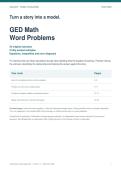
Turn a story into a model.
GED Math
Word Problems
24 original exercises
6 fully worked examples
Equations, inequalities and error diagnosis
For learners who can follow calculations but get stuck deciding what the equation should say. Practice naming
the unknown, describing the relationship and checking the answer against the story.
Your route Pages
Learn the modeling routine and six examples 2-5
Practice six sets of four original tasks 6-11
Compare complete models and worked answers 12-17
Repair recurring errors; sources and scope 18-19
Focused scope: contextual linear equations, unknown fraction/percentage bases, linked quantities and one-variable inequalities.
This is a supplement, not complete GED math coverage, an official practice test or a score prediction.
Created with AI assistance. Calculations checked programmatically; no independent expert review claimed. No actual exam
questions. Not affiliated with or endorsed by GED Testing Service or the American Council on Education.
Independent study supplement | Version 1.0 - September 2026 1
,GED MATH / WORDS TO EQUATIONS MODELING ROUTINE
Write the relationship first
Use a variable with a meaning and a unit. A keyword is a clue, not a complete mathematical rule.
Step What to write
1. Target Name exactly what you must find. Define one variable and its unit.
2. Relationship Describe the total, part, comparison or boundary in plain language.
3. Model Use = for an exact match; use an inequality for a range of allowed values.
4. Check Substitute into the original story. Include units and whole-count restrictions.
E1 Name the quantity before the operation
A craft order costs $7 for packing plus $2.75 per item. The total is $29. Find the number of items.
Define: n = number of items
Model: 7 + 2.75n = 29
The fixed charge is $7. Each additional item adds $2.75.
2.75n = 22, so n = 22/2.75 = 8.
Check: 7 + 2.75(8) = 29. The answer is 8 items.
Why keywords alone can mislead
“More” can describe adding an amount, a comparison between two amounts, or a strict lower bound. Identify
the complete relationship before choosing +, = or >. A correct calculation of the wrong model still answers the
wrong question.
Independent study supplement | Version 1.0 - September 2026 2
, GED MATH / WORDS TO EQUATIONS WORKED MODELS
Find the hidden whole
Write the known part as a multiple of the unknown whole. Decide what counts as 100%.
E2 A fraction of an unknown whole
A container is 3/5 full and holds 42 L. Find its full capacity.
Define: c = capacity in liters
Model: (3/5)c = 42
42 L is the part. The capacity is the whole.
c = 42(5/3) = 70 L.
Check: (3/5)(70) = 42 L.
E3 Reverse a percentage multiplier
A desk costs $102 after a 15% discount, before tax. Find its original price.
Define: p = original price in dollars
Model: 0.85p = 102
The buyer pays 85% of the original amount.
p = 102/0.85 = 120.
Check: the $18 discount leaves $102.
For a remaining amount, first find the remaining fraction. For a percentage increase, the final multiplier is greater than 1. Always
check by applying the original change to your proposed starting amount.
Independent study supplement | Version 1.0 - September 2026 3
Turn a story into a model.
GED Math
Word Problems
24 original exercises
6 fully worked examples
Equations, inequalities and error diagnosis
For learners who can follow calculations but get stuck deciding what the equation should say. Practice naming
the unknown, describing the relationship and checking the answer against the story.
Your route Pages
Learn the modeling routine and six examples 2-5
Practice six sets of four original tasks 6-11
Compare complete models and worked answers 12-17
Repair recurring errors; sources and scope 18-19
Focused scope: contextual linear equations, unknown fraction/percentage bases, linked quantities and one-variable inequalities.
This is a supplement, not complete GED math coverage, an official practice test or a score prediction.
Created with AI assistance. Calculations checked programmatically; no independent expert review claimed. No actual exam
questions. Not affiliated with or endorsed by GED Testing Service or the American Council on Education.
Independent study supplement | Version 1.0 - September 2026 1
,GED MATH / WORDS TO EQUATIONS MODELING ROUTINE
Write the relationship first
Use a variable with a meaning and a unit. A keyword is a clue, not a complete mathematical rule.
Step What to write
1. Target Name exactly what you must find. Define one variable and its unit.
2. Relationship Describe the total, part, comparison or boundary in plain language.
3. Model Use = for an exact match; use an inequality for a range of allowed values.
4. Check Substitute into the original story. Include units and whole-count restrictions.
E1 Name the quantity before the operation
A craft order costs $7 for packing plus $2.75 per item. The total is $29. Find the number of items.
Define: n = number of items
Model: 7 + 2.75n = 29
The fixed charge is $7. Each additional item adds $2.75.
2.75n = 22, so n = 22/2.75 = 8.
Check: 7 + 2.75(8) = 29. The answer is 8 items.
Why keywords alone can mislead
“More” can describe adding an amount, a comparison between two amounts, or a strict lower bound. Identify
the complete relationship before choosing +, = or >. A correct calculation of the wrong model still answers the
wrong question.
Independent study supplement | Version 1.0 - September 2026 2
, GED MATH / WORDS TO EQUATIONS WORKED MODELS
Find the hidden whole
Write the known part as a multiple of the unknown whole. Decide what counts as 100%.
E2 A fraction of an unknown whole
A container is 3/5 full and holds 42 L. Find its full capacity.
Define: c = capacity in liters
Model: (3/5)c = 42
42 L is the part. The capacity is the whole.
c = 42(5/3) = 70 L.
Check: (3/5)(70) = 42 L.
E3 Reverse a percentage multiplier
A desk costs $102 after a 15% discount, before tax. Find its original price.
Define: p = original price in dollars
Model: 0.85p = 102
The buyer pays 85% of the original amount.
p = 102/0.85 = 120.
Check: the $18 discount leaves $102.
For a remaining amount, first find the remaining fraction. For a percentage increase, the final multiplier is greater than 1. Always
check by applying the original change to your proposed starting amount.
Independent study supplement | Version 1.0 - September 2026 3


