
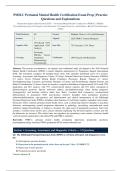
PMH-C Perinatal Mental Health Certification Exam Prep | Practice
Questions and Explanations
Postpartum Support International (PSI) — Perinatal Mental Health Certification (PMH-C): PMADs,
Psychopharmacology in Pregnancy and Lactation, Screening Protocols, and Evidence-Based Psychotherapies
(2026)
Total Questions: 60 Format: Multiple Choice (A-D) with Rationales
Sections: 5 Aligned: 2026 PMH-C Content Blueprint
30% Recall / 50%
Cognitive Mix: Application / 20% Item Mix: 75% Scenario / 25% Direct
Analysis
Screening,
PMADs, Severe
Coverage: Conditions, Verification: 100% Keyed with Rationales
Pharmacology,
Psychotherapy
Abstract. This practice examination is an original, non-confidential study aid aligned to the 2026 Perinatal
Mental Health Certification (PMH-C) content blueprint administered by Postpartum Support International
(PSI). The instrument comprises 60 multiple-choice items with rationales distributed across five sections:
Screening, Assessment, and Diagnostic Criteria (12 items); Perinatal Mood and Anxiety Disorders (PMADs)
(15 items); Severe Perinatal Mental Health Conditions (Psychosis, Bipolar, Trauma) (11 items);
Psychopharmacology, Lactation, and Somatic Therapies (12 items); and Psychotherapy, Support Systems, and
Ethical Considerations (10 items). Items are keyed to a cognitive distribution of approximately 30% recall, 50%
application, and 20% analysis, with 75% scenario-based clinical vignettes and 25% direct conceptual or
pharmacological questions. Special inclusions address psychopharmacology safety during pregnancy
(teratogenicity) and lactation (relative infant dose, Hale’s Lactation Risk Categories); scenario-based
differentiation of postpartum OCD (ego-dystonic intrusive thoughts) from postpartum psychosis
(delusions/hallucinations, ego-syntonic); and administration and clinical interpretation of the Edinburgh
Postnatal Depression Scale (EPDS), including when Question 10 (self-harm) requires immediate intervention.
Distractors reflect common perinatal mental health errors, such as dismissing intrusive thoughts as psychotic
delusions, misinterpreting normal postpartum adjustment as pathology, prescribing contraindicated mood
stabilizers during breastfeeding, or failing to recognize the rapid onset of postpartum psychosis. Each item
includes a verified correct answer and a concise rationale explaining why the keyed option is correct and why
the distractors are incorrect. This artifact does not reproduce any proprietary exam content; clinicians should
verify all current requirements with official PSI and PMH-C materials.
Keywords: PMH-C; perinatal mental health; postpartum depression; postpartum psychosis;
psychopharmacology; lactation; EPDS; postpartum OCD; trauma-informed care
Section 1: Screening, Assessment, and Diagnostic Criteria — 12 Questions
Q1: The Edinburgh Postnatal Depression Scale (EPDS) is a 10-item self-report tool designed to screen
for:
A. Schizophrenia spectrum disorders
B. Depression in the postnatal period, with a focus on the past 7 days *[CORRECT]*
C. Bipolar type I manic episodes
D. Postpartum psychosis specifically
Correct Answer: B
, Rationale: The EPDS screens for postnatal depression in the prior 7 days; it does not specifically detect
schizophrenia, mania, or psychosis, which require different assessment.
Q2: A commonly used EPDS cutoff score suggestive of probable major depression in the postpartum
period is:
A. 5 or higher
B. 3 or higher
C. 13 or higher *[CORRECT]*
D. 20 exactly
Correct Answer: C
Rationale: An EPDS score of 13 or higher suggests probable major depression in the postpartum period; 5 and 3 are
too low to indicate probable depression, and a fixed score of 20 is not the cutoff.
Q3: EPDS Question 10 asks about self-harm thoughts in the past 7 days. If a mother endorses any
response other than 'never,' the clinician should:
A. Wait for the next scheduled visit to discuss it
B. Only act if the total EPDS score exceeds 13
C. Ignore it because intrusive thoughts are common
D. Conduct an immediate, structured assessment of suicidality, including ideation, plan, intent, means, and
protective factors, regardless of total score *[CORRECT]*
Correct Answer: D
Rationale: Any Q10 endorsement beyond 'never' warrants immediate structured suicide risk assessment regardless of
total score; waiting, requiring a high total score, or ignoring it are unsafe and may delay intervention.
Q4: When administering the EPDS, the clinician should ensure that:
A. The mother completes it privately but the clinician reviews item-level responses (especially Q10), not
only the total score *[CORRECT]*
B. Only the total score is reviewed and items are ignored
C. The partner completes it on the mother's behalf
D. The EPDS replaces the need for clinical interview
Correct Answer: A
Rationale: Item-level review (especially Q10) is essential; reviewing only the total, partner completion, and using
the EPDS as a diagnostic replacement are incorrect practices.
Q5: A limitation of the EPDS is that it:
A. It is a definitive diagnostic tool
B. Does not diagnose depression and may not detect anxiety, bipolar disorder, or psychosis, requiring
clinical confirmation *[CORRECT]*
C. It detects all perinatal mental health conditions
D. It screens only for postpartum psychosis
Correct Answer: B
Rationale: The EPDS is a screening tool that does not diagnose and may miss anxiety, bipolar, and psychosis;
definitive-diagnosis, all-conditions, and psychosis-only claims are incorrect.
Q6: A mother scores 12 on the EPDS and reports 'sometimes' having thoughts of self-harm on Q10. The
most appropriate next step is to:
A. Tell her intrusive thoughts are normal and no follow-up is needed
B. Schedule a routine appointment in 4 weeks
C. Conduct an immediate clinical assessment of suicide risk and arrange appropriate follow-up or
emergency care *[CORRECT]*
Questions and Explanations
Postpartum Support International (PSI) — Perinatal Mental Health Certification (PMH-C): PMADs,
Psychopharmacology in Pregnancy and Lactation, Screening Protocols, and Evidence-Based Psychotherapies
(2026)
Total Questions: 60 Format: Multiple Choice (A-D) with Rationales
Sections: 5 Aligned: 2026 PMH-C Content Blueprint
30% Recall / 50%
Cognitive Mix: Application / 20% Item Mix: 75% Scenario / 25% Direct
Analysis
Screening,
PMADs, Severe
Coverage: Conditions, Verification: 100% Keyed with Rationales
Pharmacology,
Psychotherapy
Abstract. This practice examination is an original, non-confidential study aid aligned to the 2026 Perinatal
Mental Health Certification (PMH-C) content blueprint administered by Postpartum Support International
(PSI). The instrument comprises 60 multiple-choice items with rationales distributed across five sections:
Screening, Assessment, and Diagnostic Criteria (12 items); Perinatal Mood and Anxiety Disorders (PMADs)
(15 items); Severe Perinatal Mental Health Conditions (Psychosis, Bipolar, Trauma) (11 items);
Psychopharmacology, Lactation, and Somatic Therapies (12 items); and Psychotherapy, Support Systems, and
Ethical Considerations (10 items). Items are keyed to a cognitive distribution of approximately 30% recall, 50%
application, and 20% analysis, with 75% scenario-based clinical vignettes and 25% direct conceptual or
pharmacological questions. Special inclusions address psychopharmacology safety during pregnancy
(teratogenicity) and lactation (relative infant dose, Hale’s Lactation Risk Categories); scenario-based
differentiation of postpartum OCD (ego-dystonic intrusive thoughts) from postpartum psychosis
(delusions/hallucinations, ego-syntonic); and administration and clinical interpretation of the Edinburgh
Postnatal Depression Scale (EPDS), including when Question 10 (self-harm) requires immediate intervention.
Distractors reflect common perinatal mental health errors, such as dismissing intrusive thoughts as psychotic
delusions, misinterpreting normal postpartum adjustment as pathology, prescribing contraindicated mood
stabilizers during breastfeeding, or failing to recognize the rapid onset of postpartum psychosis. Each item
includes a verified correct answer and a concise rationale explaining why the keyed option is correct and why
the distractors are incorrect. This artifact does not reproduce any proprietary exam content; clinicians should
verify all current requirements with official PSI and PMH-C materials.
Keywords: PMH-C; perinatal mental health; postpartum depression; postpartum psychosis;
psychopharmacology; lactation; EPDS; postpartum OCD; trauma-informed care
Section 1: Screening, Assessment, and Diagnostic Criteria — 12 Questions
Q1: The Edinburgh Postnatal Depression Scale (EPDS) is a 10-item self-report tool designed to screen
for:
A. Schizophrenia spectrum disorders
B. Depression in the postnatal period, with a focus on the past 7 days *[CORRECT]*
C. Bipolar type I manic episodes
D. Postpartum psychosis specifically
Correct Answer: B
, Rationale: The EPDS screens for postnatal depression in the prior 7 days; it does not specifically detect
schizophrenia, mania, or psychosis, which require different assessment.
Q2: A commonly used EPDS cutoff score suggestive of probable major depression in the postpartum
period is:
A. 5 or higher
B. 3 or higher
C. 13 or higher *[CORRECT]*
D. 20 exactly
Correct Answer: C
Rationale: An EPDS score of 13 or higher suggests probable major depression in the postpartum period; 5 and 3 are
too low to indicate probable depression, and a fixed score of 20 is not the cutoff.
Q3: EPDS Question 10 asks about self-harm thoughts in the past 7 days. If a mother endorses any
response other than 'never,' the clinician should:
A. Wait for the next scheduled visit to discuss it
B. Only act if the total EPDS score exceeds 13
C. Ignore it because intrusive thoughts are common
D. Conduct an immediate, structured assessment of suicidality, including ideation, plan, intent, means, and
protective factors, regardless of total score *[CORRECT]*
Correct Answer: D
Rationale: Any Q10 endorsement beyond 'never' warrants immediate structured suicide risk assessment regardless of
total score; waiting, requiring a high total score, or ignoring it are unsafe and may delay intervention.
Q4: When administering the EPDS, the clinician should ensure that:
A. The mother completes it privately but the clinician reviews item-level responses (especially Q10), not
only the total score *[CORRECT]*
B. Only the total score is reviewed and items are ignored
C. The partner completes it on the mother's behalf
D. The EPDS replaces the need for clinical interview
Correct Answer: A
Rationale: Item-level review (especially Q10) is essential; reviewing only the total, partner completion, and using
the EPDS as a diagnostic replacement are incorrect practices.
Q5: A limitation of the EPDS is that it:
A. It is a definitive diagnostic tool
B. Does not diagnose depression and may not detect anxiety, bipolar disorder, or psychosis, requiring
clinical confirmation *[CORRECT]*
C. It detects all perinatal mental health conditions
D. It screens only for postpartum psychosis
Correct Answer: B
Rationale: The EPDS is a screening tool that does not diagnose and may miss anxiety, bipolar, and psychosis;
definitive-diagnosis, all-conditions, and psychosis-only claims are incorrect.
Q6: A mother scores 12 on the EPDS and reports 'sometimes' having thoughts of self-harm on Q10. The
most appropriate next step is to:
A. Tell her intrusive thoughts are normal and no follow-up is needed
B. Schedule a routine appointment in 4 weeks
C. Conduct an immediate clinical assessment of suicide risk and arrange appropriate follow-up or
emergency care *[CORRECT]*


