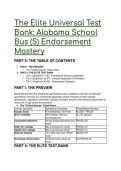
The Elite Universal Test
Bank: Alabama School
Bus (S) Endorsement
Mastery
PART 0: THE TABLE OF CONTENTS
● PART I: THE PREVIEW
○ The "Critical Axioms" Cheat Sheet
● PART II: THE ELITE TEST BANK
○ Tier 1 (Questions 1–18) - Foundational Syntax & Application
○ Tier 2 (Questions 19–37) - Complex Application & Simulation
○ Tier 3 (Questions 38–55) - Grandmaster Synthesis
PART I: THE PREVIEW
Mastering this test bank bridges the gap between basic compliance and elite, incident-free
operational command of a commercial passenger vehicle. Precision in these specific
aerodynamic, regulatory, and kinetic variables translates directly to the absolute preservation of
human life in high-stakes environments.
● The "Critical Axioms" Cheat Sheet:
Critical Framework Operational Parameter Federal/State Standard
Danger Zones 10 ft lateral/rear, 30 ft front AL SDE / FMCSA
Mirror Visibility 200 ft behind, rear tires AL CDL Manual
touching ground
Compartmentalization 24-inch energy-absorbing seat FMVSS 222
backs
Static Air Leakage Max 2 psi loss per minute FMVSS 121
Applied Air Leakage Max 3 psi loss per minute FMVSS 121
Rollover Integrity 1.5x UVW load; max 130mm FMVSS 220
crush
Toxicology (Post-Crash) Alcohol: 8 hours; Drug: 32 49 CFR Part 40
hours
PART II: THE ELITE TEST BANK
,Tier 1 - Foundational Syntax & Application
Q1: An Alabama school bus driver is conducting a pre-trip mirror calibration. The driver must
verify the exterior flat mirrors provide visibility of the ground touching the rear tires. Based on the
principles of Alabama CDL Mirror Adjustment standards, what is the REQUIRED rearward
visibility distance? A) 100 feet or 2 bus lengths. B) 200 feet or 4 bus lengths. C) 300 feet or 6
bus lengths. D) 400 feet or 8 bus lengths.
● Answer: B (200 feet or 4 bus lengths.)
● Distractor Analysis:
○ A is incorrect: This distance is insufficient for highway-speed traffic monitoring and
violates the mandated minimum.
○ C is incorrect: While greater visibility is advantageous, 300 feet exceeds the
baseline regulatory standard for flat mirror calibration.
○ D is incorrect: 400 feet represents the maximum potential blind spot distance, not
the required flat mirror visibility.
The Mentor's Analysis: Spatial awareness is the foundation of vehicular command. When facing
rearward blind spots, the immediate priority is establishing a 200-foot visual baseline. By
utilizing properly adjusted flat mirrors, you bypass the common trap of assuming interior mirrors
cover exterior rear approaching traffic. Professional Intuition: Flat mirrors monitor the sides
and rear; they must definitively capture the rear tires touching the tarmac and 200 feet of trailing
asphalt.
Q2: During the mandatory AL SDE pre-trip air brake inspection, a driver fully charges the
system, turns off the engine, chocks the wheels, and releases the parking brake. Without
pressing the service brake, the driver times the pressure drop. Based on the principles of
FMVSS 121 static leakage limits, which pressure drop is the MAXIMUM allowable over one
minute for a single vehicle? A) 1 psi B) 2 psi C) 3 psi D) 4 psi
● Answer: B (2 psi)
● Distractor Analysis:
○ A is incorrect: 1 psi is an excellent holding rate but is not the regulatory maximum
threshold for failure.
○ C is incorrect: 3 psi per minute is the maximum allowable rate for an applied
leakage test, not a static test.
○ D is incorrect: 4 psi per minute applies to the applied leakage test for combination
vehicles.
The Mentor's Analysis: Pneumatic integrity determines your ability to arrest kinetic energy.
When facing a static brake system, the immediate priority is confirming baseline seal integrity.
By utilizing the static leakage protocol, you bypass the common trap of confusing applied versus
unapplied pressure tolerances. Professional Intuition: Engine off, brakes released: maximum
2 psi loss. Engine off, brakes applied: maximum 3 psi loss.
Q3: A 24-year-old applicant holds a Commercial Learner Permit (CLP). To receive Alabama
SDE certification, they must pass a three-part performance test. Based on the principles of AL
SDE certification requirements, what is the FIRST mandatory component of this skills test? A)
The Basic Control Skills Test (Alley Docking). B) The On-the-Road Driving Skills Test. C) The
Pre-trip inspection of the school bus. D) The DOT Medical Examination.
● Answer: C (The Pre-trip inspection of the school bus.)
● Distractor Analysis:
○ A is incorrect: Basic Control Skills are tested only after the applicant successfully
, proves the vehicle is safe to operate.
○ B is incorrect: The on-road portion is the final phase, testing the synthesis of prior
operational knowledge.
○ D is incorrect: The physical examination must be completed prior to obtaining the
CLP, not as a component of the SDE performance test itself.
The Mentor's Analysis: Certification processes follow strict chronological safety logic. When
facing the performance test, the immediate priority is proving mechanical familiarity. By utilizing
a flawless pre-trip inspection, you bypass the common trap of failing out before ever putting the
vehicle in motion. Professional Intuition: You cannot operate what you cannot validate; the
Pre-Trip Inspection is always the gatekeeper to the skills test.
Q4: A driver is approaching an unprotected highway-rail grade crossing in an empty school bus.
Based on the principles of Alabama Code 32-5A-151, what is the CLOSEST proximity to the
nearest rail the driver may legally stop the bus? A) 10 feet B) 15 feet C) 20 feet D) 50 feet
● Answer: B (15 feet)
● Distractor Analysis:
○ A is incorrect: Stopping at 10 feet encroaches on the locomotive's dynamic
clearance envelope.
○ C is incorrect: 20 feet is the required stopping distance for other vehicles
approaching a stopped school bus, not the bus approaching a rail.
○ D is incorrect: 50 feet is the maximum legal stopping distance from the rail, not the
closest allowed.
The Mentor's Analysis: Railroad crossings present a catastrophic kinetic threat. When facing a
grade crossing, the immediate priority is establishing a safe visual and physical buffer. By
utilizing the 15-to-50-foot rule, you bypass the common trap of stopping too close to the track's
overhang radius. Professional Intuition: Stop within the 15-50 foot bracket; the exact point
should maximize down-track visibility without breaching the train's lateral strike zone.
Q5: An applicant for an Alabama School Bus Certificate undergoes a DOT physical
examination. Based on the principles of Alabama School Bus Driver Physical Qualifications,
what is the MINIMUM acceptable distance visual acuity in each eye? A) 20/20 (Snellen) B)
20/30 (Snellen) C) 20/40 (Snellen) D) 20/50 (Snellen)
● Answer: C (20/40 (Snellen))
● Distractor Analysis:
○ A is incorrect: 20/20 represents perfect vision, which exceeds the minimum
standard required by the state.
○ B is incorrect: While preferable, 20/30 is not the legal cutoff point for commercial
medical qualification.
○ D is incorrect: 20/50 visual acuity fails the commercial standard and requires
specific waiver/restriction actions.
The Mentor's Analysis: Biological capability dictates operational safety. When facing the medical
screening, the immediate priority is verifying standard sensory thresholds. By utilizing the 20/40
acuity baseline, you bypass the common trap of assuming passenger vehicle standards apply to
commercial endorsements. Professional Intuition: 20/40 vision and a 70-degree horizontal
field of vision are the non-negotiable optical baselines for commercial bus operation.
Q6: A school bus designed to seat 72 passengers is inspected for emergency exits. Based on
the principles of FMVSS 217, which configuration is MANDATORY for a bus of this capacity? A)
One left side exit door and zero roof hatches. B) One right side exit door or two exit windows,
plus one roof exit. C) Two roof exits and no side windows. D) One right side exit door only.
● Answer: B (One right side exit door or two exit windows, plus one roof exit.)
Bank: Alabama School
Bus (S) Endorsement
Mastery
PART 0: THE TABLE OF CONTENTS
● PART I: THE PREVIEW
○ The "Critical Axioms" Cheat Sheet
● PART II: THE ELITE TEST BANK
○ Tier 1 (Questions 1–18) - Foundational Syntax & Application
○ Tier 2 (Questions 19–37) - Complex Application & Simulation
○ Tier 3 (Questions 38–55) - Grandmaster Synthesis
PART I: THE PREVIEW
Mastering this test bank bridges the gap between basic compliance and elite, incident-free
operational command of a commercial passenger vehicle. Precision in these specific
aerodynamic, regulatory, and kinetic variables translates directly to the absolute preservation of
human life in high-stakes environments.
● The "Critical Axioms" Cheat Sheet:
Critical Framework Operational Parameter Federal/State Standard
Danger Zones 10 ft lateral/rear, 30 ft front AL SDE / FMCSA
Mirror Visibility 200 ft behind, rear tires AL CDL Manual
touching ground
Compartmentalization 24-inch energy-absorbing seat FMVSS 222
backs
Static Air Leakage Max 2 psi loss per minute FMVSS 121
Applied Air Leakage Max 3 psi loss per minute FMVSS 121
Rollover Integrity 1.5x UVW load; max 130mm FMVSS 220
crush
Toxicology (Post-Crash) Alcohol: 8 hours; Drug: 32 49 CFR Part 40
hours
PART II: THE ELITE TEST BANK
,Tier 1 - Foundational Syntax & Application
Q1: An Alabama school bus driver is conducting a pre-trip mirror calibration. The driver must
verify the exterior flat mirrors provide visibility of the ground touching the rear tires. Based on the
principles of Alabama CDL Mirror Adjustment standards, what is the REQUIRED rearward
visibility distance? A) 100 feet or 2 bus lengths. B) 200 feet or 4 bus lengths. C) 300 feet or 6
bus lengths. D) 400 feet or 8 bus lengths.
● Answer: B (200 feet or 4 bus lengths.)
● Distractor Analysis:
○ A is incorrect: This distance is insufficient for highway-speed traffic monitoring and
violates the mandated minimum.
○ C is incorrect: While greater visibility is advantageous, 300 feet exceeds the
baseline regulatory standard for flat mirror calibration.
○ D is incorrect: 400 feet represents the maximum potential blind spot distance, not
the required flat mirror visibility.
The Mentor's Analysis: Spatial awareness is the foundation of vehicular command. When facing
rearward blind spots, the immediate priority is establishing a 200-foot visual baseline. By
utilizing properly adjusted flat mirrors, you bypass the common trap of assuming interior mirrors
cover exterior rear approaching traffic. Professional Intuition: Flat mirrors monitor the sides
and rear; they must definitively capture the rear tires touching the tarmac and 200 feet of trailing
asphalt.
Q2: During the mandatory AL SDE pre-trip air brake inspection, a driver fully charges the
system, turns off the engine, chocks the wheels, and releases the parking brake. Without
pressing the service brake, the driver times the pressure drop. Based on the principles of
FMVSS 121 static leakage limits, which pressure drop is the MAXIMUM allowable over one
minute for a single vehicle? A) 1 psi B) 2 psi C) 3 psi D) 4 psi
● Answer: B (2 psi)
● Distractor Analysis:
○ A is incorrect: 1 psi is an excellent holding rate but is not the regulatory maximum
threshold for failure.
○ C is incorrect: 3 psi per minute is the maximum allowable rate for an applied
leakage test, not a static test.
○ D is incorrect: 4 psi per minute applies to the applied leakage test for combination
vehicles.
The Mentor's Analysis: Pneumatic integrity determines your ability to arrest kinetic energy.
When facing a static brake system, the immediate priority is confirming baseline seal integrity.
By utilizing the static leakage protocol, you bypass the common trap of confusing applied versus
unapplied pressure tolerances. Professional Intuition: Engine off, brakes released: maximum
2 psi loss. Engine off, brakes applied: maximum 3 psi loss.
Q3: A 24-year-old applicant holds a Commercial Learner Permit (CLP). To receive Alabama
SDE certification, they must pass a three-part performance test. Based on the principles of AL
SDE certification requirements, what is the FIRST mandatory component of this skills test? A)
The Basic Control Skills Test (Alley Docking). B) The On-the-Road Driving Skills Test. C) The
Pre-trip inspection of the school bus. D) The DOT Medical Examination.
● Answer: C (The Pre-trip inspection of the school bus.)
● Distractor Analysis:
○ A is incorrect: Basic Control Skills are tested only after the applicant successfully
, proves the vehicle is safe to operate.
○ B is incorrect: The on-road portion is the final phase, testing the synthesis of prior
operational knowledge.
○ D is incorrect: The physical examination must be completed prior to obtaining the
CLP, not as a component of the SDE performance test itself.
The Mentor's Analysis: Certification processes follow strict chronological safety logic. When
facing the performance test, the immediate priority is proving mechanical familiarity. By utilizing
a flawless pre-trip inspection, you bypass the common trap of failing out before ever putting the
vehicle in motion. Professional Intuition: You cannot operate what you cannot validate; the
Pre-Trip Inspection is always the gatekeeper to the skills test.
Q4: A driver is approaching an unprotected highway-rail grade crossing in an empty school bus.
Based on the principles of Alabama Code 32-5A-151, what is the CLOSEST proximity to the
nearest rail the driver may legally stop the bus? A) 10 feet B) 15 feet C) 20 feet D) 50 feet
● Answer: B (15 feet)
● Distractor Analysis:
○ A is incorrect: Stopping at 10 feet encroaches on the locomotive's dynamic
clearance envelope.
○ C is incorrect: 20 feet is the required stopping distance for other vehicles
approaching a stopped school bus, not the bus approaching a rail.
○ D is incorrect: 50 feet is the maximum legal stopping distance from the rail, not the
closest allowed.
The Mentor's Analysis: Railroad crossings present a catastrophic kinetic threat. When facing a
grade crossing, the immediate priority is establishing a safe visual and physical buffer. By
utilizing the 15-to-50-foot rule, you bypass the common trap of stopping too close to the track's
overhang radius. Professional Intuition: Stop within the 15-50 foot bracket; the exact point
should maximize down-track visibility without breaching the train's lateral strike zone.
Q5: An applicant for an Alabama School Bus Certificate undergoes a DOT physical
examination. Based on the principles of Alabama School Bus Driver Physical Qualifications,
what is the MINIMUM acceptable distance visual acuity in each eye? A) 20/20 (Snellen) B)
20/30 (Snellen) C) 20/40 (Snellen) D) 20/50 (Snellen)
● Answer: C (20/40 (Snellen))
● Distractor Analysis:
○ A is incorrect: 20/20 represents perfect vision, which exceeds the minimum
standard required by the state.
○ B is incorrect: While preferable, 20/30 is not the legal cutoff point for commercial
medical qualification.
○ D is incorrect: 20/50 visual acuity fails the commercial standard and requires
specific waiver/restriction actions.
The Mentor's Analysis: Biological capability dictates operational safety. When facing the medical
screening, the immediate priority is verifying standard sensory thresholds. By utilizing the 20/40
acuity baseline, you bypass the common trap of assuming passenger vehicle standards apply to
commercial endorsements. Professional Intuition: 20/40 vision and a 70-degree horizontal
field of vision are the non-negotiable optical baselines for commercial bus operation.
Q6: A school bus designed to seat 72 passengers is inspected for emergency exits. Based on
the principles of FMVSS 217, which configuration is MANDATORY for a bus of this capacity? A)
One left side exit door and zero roof hatches. B) One right side exit door or two exit windows,
plus one roof exit. C) Two roof exits and no side windows. D) One right side exit door only.
● Answer: B (One right side exit door or two exit windows, plus one roof exit.)