
BTCS Exam Prep | SCTE Broadband TelecomCenter Specialist | 2026/2027 Page 1
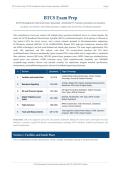
BTCS Exam Prep
SCTE Broadband TelecomCenter Specialist | 2026/2027 | Practice Questions & Answers
Complete Test Review | 100 Verified Questions | Aligned with SCTE BTCS Certification Blueprint
This comprehensive exam prep contains 100 multiple-choice questions distributed across six content domains that
mirror the SCTE Broadband TelecomCenter Specialist (BTCS) certification blueprint. Each question is followed by
four options (A-D), the correct answer, and a concise rationale grounded in telecommunications engineering,
SCTE/industry standards (DOCSIS 3.1/4.0, OFDM/OFDMA, Remote PHY, high-split architectures, advanced fiber
and WDM technologies), and real-world headend and outside plant practices. The exam targets approximately 30%
recall, 50% application, and 20% analysis, with about 75% scenario-based questions and 25% direct
recall/identification. Distractors intentionally capture common BTCS exam pitfalls such as single-mode vs. multimode
fiber confusion, incorrect IRE levels, DOCSIS physical-layer parameter errors, MPEG frame-type misidentification,
optical power unit confusion, OTDR event-type errors, QAM modulation-order thresholds, and CNR/MER
acceptable-range mistakes. Review each rationale carefully; the explanations integrate technical specifications,
measurements, and troubleshooting practice relevant to broadband engineering technicians.
# Section Questions Topic Coverage
Headend/Hub Facility Infrastructure, Power, Cooling,
1 Facilities and Inside Plant Q1-Q15
Grounding, Security & Disaster Recovery
Analog & Digital Video Signals, Baseband Measurements,
2 Baseband Signaling Q16-Q30
Waveforms, IRE Levels & Signal Quality
RF Signal Processing, Modulation, Optical Transport,
3 RF and Photonic Signals Q31-Q50
Fiber Types, WDM & Photonics
Digital Telephony over DOCSIS, PacketCable, VoIP, QoS, CMTS & Cable
4 Q51-Q65
Cable Modem Operations
MPEG Compression, VOD, Narrowcast, Conditional
5 Video Services Q66-Q80
Access & Service Delivery
Test Equipment, Optical Power Meters, OTDR, Spectrum
6 Tests and Measurements Q81-Q100
Analyzers, BER, CNR & Signal Analysis
Instructions: Select the single best answer for each question. Rationales identify the correct answer and explain why each
distractor is incorrect using BTCS-specific telecommunications reasoning, SCTE standards, technical specifications, and
practical applications.
Section 1: Facilities and Inside Plant
Focus: Headend/Hub Facility Infrastructure, Power, Cooling, Grounding, Security & Disaster Recovery
SCTE Broadband TelecomCenter Specialist (BTCS) | 2026-2027 Edition
,BTCS Exam Prep | SCTE Broadband TelecomCenter Specialist | 2026/2027 Page 2
1. A headend facility experiences a commercial power outage. The UPS battery bank carries the
critical load, but the standby diesel generator fails to start after the auto-transfer switch (ATS)
signals a transfer. Which of the following is the operator's MOST appropriate first action?
A. Allow the UPS to discharge completely to verify its true runtime capacity.
B. Manually initiate the generator start sequence at the generator control panel and verify fuel,
battery, and glow-plug status; if it still fails, declare an emergency and contact the on-call
generator service provider. [CORRECT]
C. Bypass the UPS to commercial power to preserve battery life.
D. Shed load by de-energizing all optical transmitters before attempting any generator start.
Correct Answer: B
Rationale: Per SCTE headend power practices, when auto-start fails the operator must attempt a manual start while checking
fuel, starter battery voltage, and glow-plug/preheat status; if the genset still does not start, an emergency must be declared and
service dispatched before UPS autonomy is exhausted. Option A risks total dc bus collapse. Option C bypasses the UPS
isolation and exposes equipment to commercial power transients. Option D reduces service before solving the power
problem.
2. In a typical headend dc power plant, the float voltage for a VRLA (valve-regulated lead-acid)
battery string of 24 cells (12 V nominal blocks) at 25 °C is approximately:
A. 24.0 V.
B. 48.0 V.
C. 54.0 V. [CORRECT]
D. 60.0 V.
Correct Answer: C
Rationale: A 24-cell VRLA string floats at about 2.25-2.27 V/cell, totaling ~54 V at 25 °C. Option A is the nominal
discharge-equivalent voltage (1 V/cell). Option B is the nominal 48 V system nameplate, not the float voltage. Option D
exceeds the safe float range and would cause thermal runaway and excessive gassing.
3. The recommended temperature set point for headend equipment rooms is typically:
A. 10-15 °C (50-59 °F).
B. 18-22 °C (65-72 °F), with relative humidity 30-50%. [CORRECT]
C. 28-32 °C (82-90 °F), with relative humidity 60-80%.
D. 0-5 °C (32-41 °F), with relative humidity 20%.
Correct Answer: B
Rationale: SCTE and TIA-942 recommend headend equipment rooms be maintained at approximately 18-22 °C (65-72 °F)
with 30-50% relative humidity to balance equipment cooling needs and electrostatic-discharge risk. Option A is too cold and
risks condensation. Option C accelerates equipment failure and risks condensation. Option D is freezer conditions, unsuitable
for active electronics.
SCTE Broadband TelecomCenter Specialist (BTCS) | 2026-2027 Edition
, BTCS Exam Prep | SCTE Broadband TelecomCenter Specialist | 2026/2027 Page 3
4. The purpose of the master ground bar (MGB) in a headend bonding scheme is to:
A. Provide a single point of connection for all equipment grounds, the power system ground,
and the entrance facility ground to minimize ground loops and potential differences.
[CORRECT]
B. Distribute commercial ac power to rack PDUs.
C. Terminate and cross-connect fiber optic cables entering the headend.
D. Aggregate optical return signals for upstream RF combining.
Correct Answer: A
Rationale: The MGB is the single-point ground reference per SCTE bonding practices, bonding all racks, the telco entrance,
the power system ground, and the outside plant ground together to equalize potentials and minimize ground loops and surge
damage. Option B describes a PDU. Option C describes an optical distribution frame. Option D describes an upstream return
combiner.
5. A technician measures 1.2 ohms from a headend rack frame to the MGB. According to SCTE
bonding best practice, this reading is:
A. Acceptable; rack-to-MGB resistance should be less than 5 ohms.
B. Acceptable; rack-to-MGB resistance should be less than 1 ohm.
C. Excessive; rack-to-MGB resistance should be less than 0.1 ohm (typically well below 1 ohm).
[CORRECT]
D. Irrelevant; only the dc power supply return needs to be bonded to the MGB.
Correct Answer: C
Rationale: SCTE bonding standards specify rack-to-MGB dc resistance be kept very low - typically below 0.1 ohm - to
ensure negligible potential difference under surge/fault conditions; 1.2 ohms indicates a loose or corroded bond requiring
remediation. Option A's 5-ohm threshold is too lax. Option B's 1-ohm threshold is marginal. Option D misstates the
requirement; all metallic rack and equipment frames must be bonded.
6. Which of the following is the correct ITU-T / SCTE recommended value for the headend
outside grounding electrode resistance target when only a single electrode is used?
A. 25 ohms or less. [CORRECT]
B. 100 ohms or less.
C. 5 ohms or less.
D. 1 ohm or less.
Correct Answer: A
Rationale: NEC Article 250 and SCTE recommend the grounding electrode system resistance be 25 ohms or less for a single
electrode (otherwise a supplemental electrode is required). Lower is preferred, but 25 ohms is the established threshold.
Options B and C are arbitrary, and option D is unrealistically strict for typical soils.
SCTE Broadband TelecomCenter Specialist (BTCS) | 2026-2027 Edition
BTCS Exam Prep
SCTE Broadband TelecomCenter Specialist | 2026/2027 | Practice Questions & Answers
Complete Test Review | 100 Verified Questions | Aligned with SCTE BTCS Certification Blueprint
This comprehensive exam prep contains 100 multiple-choice questions distributed across six content domains that
mirror the SCTE Broadband TelecomCenter Specialist (BTCS) certification blueprint. Each question is followed by
four options (A-D), the correct answer, and a concise rationale grounded in telecommunications engineering,
SCTE/industry standards (DOCSIS 3.1/4.0, OFDM/OFDMA, Remote PHY, high-split architectures, advanced fiber
and WDM technologies), and real-world headend and outside plant practices. The exam targets approximately 30%
recall, 50% application, and 20% analysis, with about 75% scenario-based questions and 25% direct
recall/identification. Distractors intentionally capture common BTCS exam pitfalls such as single-mode vs. multimode
fiber confusion, incorrect IRE levels, DOCSIS physical-layer parameter errors, MPEG frame-type misidentification,
optical power unit confusion, OTDR event-type errors, QAM modulation-order thresholds, and CNR/MER
acceptable-range mistakes. Review each rationale carefully; the explanations integrate technical specifications,
measurements, and troubleshooting practice relevant to broadband engineering technicians.
# Section Questions Topic Coverage
Headend/Hub Facility Infrastructure, Power, Cooling,
1 Facilities and Inside Plant Q1-Q15
Grounding, Security & Disaster Recovery
Analog & Digital Video Signals, Baseband Measurements,
2 Baseband Signaling Q16-Q30
Waveforms, IRE Levels & Signal Quality
RF Signal Processing, Modulation, Optical Transport,
3 RF and Photonic Signals Q31-Q50
Fiber Types, WDM & Photonics
Digital Telephony over DOCSIS, PacketCable, VoIP, QoS, CMTS & Cable
4 Q51-Q65
Cable Modem Operations
MPEG Compression, VOD, Narrowcast, Conditional
5 Video Services Q66-Q80
Access & Service Delivery
Test Equipment, Optical Power Meters, OTDR, Spectrum
6 Tests and Measurements Q81-Q100
Analyzers, BER, CNR & Signal Analysis
Instructions: Select the single best answer for each question. Rationales identify the correct answer and explain why each
distractor is incorrect using BTCS-specific telecommunications reasoning, SCTE standards, technical specifications, and
practical applications.
Section 1: Facilities and Inside Plant
Focus: Headend/Hub Facility Infrastructure, Power, Cooling, Grounding, Security & Disaster Recovery
SCTE Broadband TelecomCenter Specialist (BTCS) | 2026-2027 Edition
,BTCS Exam Prep | SCTE Broadband TelecomCenter Specialist | 2026/2027 Page 2
1. A headend facility experiences a commercial power outage. The UPS battery bank carries the
critical load, but the standby diesel generator fails to start after the auto-transfer switch (ATS)
signals a transfer. Which of the following is the operator's MOST appropriate first action?
A. Allow the UPS to discharge completely to verify its true runtime capacity.
B. Manually initiate the generator start sequence at the generator control panel and verify fuel,
battery, and glow-plug status; if it still fails, declare an emergency and contact the on-call
generator service provider. [CORRECT]
C. Bypass the UPS to commercial power to preserve battery life.
D. Shed load by de-energizing all optical transmitters before attempting any generator start.
Correct Answer: B
Rationale: Per SCTE headend power practices, when auto-start fails the operator must attempt a manual start while checking
fuel, starter battery voltage, and glow-plug/preheat status; if the genset still does not start, an emergency must be declared and
service dispatched before UPS autonomy is exhausted. Option A risks total dc bus collapse. Option C bypasses the UPS
isolation and exposes equipment to commercial power transients. Option D reduces service before solving the power
problem.
2. In a typical headend dc power plant, the float voltage for a VRLA (valve-regulated lead-acid)
battery string of 24 cells (12 V nominal blocks) at 25 °C is approximately:
A. 24.0 V.
B. 48.0 V.
C. 54.0 V. [CORRECT]
D. 60.0 V.
Correct Answer: C
Rationale: A 24-cell VRLA string floats at about 2.25-2.27 V/cell, totaling ~54 V at 25 °C. Option A is the nominal
discharge-equivalent voltage (1 V/cell). Option B is the nominal 48 V system nameplate, not the float voltage. Option D
exceeds the safe float range and would cause thermal runaway and excessive gassing.
3. The recommended temperature set point for headend equipment rooms is typically:
A. 10-15 °C (50-59 °F).
B. 18-22 °C (65-72 °F), with relative humidity 30-50%. [CORRECT]
C. 28-32 °C (82-90 °F), with relative humidity 60-80%.
D. 0-5 °C (32-41 °F), with relative humidity 20%.
Correct Answer: B
Rationale: SCTE and TIA-942 recommend headend equipment rooms be maintained at approximately 18-22 °C (65-72 °F)
with 30-50% relative humidity to balance equipment cooling needs and electrostatic-discharge risk. Option A is too cold and
risks condensation. Option C accelerates equipment failure and risks condensation. Option D is freezer conditions, unsuitable
for active electronics.
SCTE Broadband TelecomCenter Specialist (BTCS) | 2026-2027 Edition
, BTCS Exam Prep | SCTE Broadband TelecomCenter Specialist | 2026/2027 Page 3
4. The purpose of the master ground bar (MGB) in a headend bonding scheme is to:
A. Provide a single point of connection for all equipment grounds, the power system ground,
and the entrance facility ground to minimize ground loops and potential differences.
[CORRECT]
B. Distribute commercial ac power to rack PDUs.
C. Terminate and cross-connect fiber optic cables entering the headend.
D. Aggregate optical return signals for upstream RF combining.
Correct Answer: A
Rationale: The MGB is the single-point ground reference per SCTE bonding practices, bonding all racks, the telco entrance,
the power system ground, and the outside plant ground together to equalize potentials and minimize ground loops and surge
damage. Option B describes a PDU. Option C describes an optical distribution frame. Option D describes an upstream return
combiner.
5. A technician measures 1.2 ohms from a headend rack frame to the MGB. According to SCTE
bonding best practice, this reading is:
A. Acceptable; rack-to-MGB resistance should be less than 5 ohms.
B. Acceptable; rack-to-MGB resistance should be less than 1 ohm.
C. Excessive; rack-to-MGB resistance should be less than 0.1 ohm (typically well below 1 ohm).
[CORRECT]
D. Irrelevant; only the dc power supply return needs to be bonded to the MGB.
Correct Answer: C
Rationale: SCTE bonding standards specify rack-to-MGB dc resistance be kept very low - typically below 0.1 ohm - to
ensure negligible potential difference under surge/fault conditions; 1.2 ohms indicates a loose or corroded bond requiring
remediation. Option A's 5-ohm threshold is too lax. Option B's 1-ohm threshold is marginal. Option D misstates the
requirement; all metallic rack and equipment frames must be bonded.
6. Which of the following is the correct ITU-T / SCTE recommended value for the headend
outside grounding electrode resistance target when only a single electrode is used?
A. 25 ohms or less. [CORRECT]
B. 100 ohms or less.
C. 5 ohms or less.
D. 1 ohm or less.
Correct Answer: A
Rationale: NEC Article 250 and SCTE recommend the grounding electrode system resistance be 25 ohms or less for a single
electrode (otherwise a supplemental electrode is required). Lower is preferred, but 25 ohms is the established threshold.
Options B and C are arbitrary, and option D is unrealistically strict for typical soils.
SCTE Broadband TelecomCenter Specialist (BTCS) | 2026-2027 Edition


