

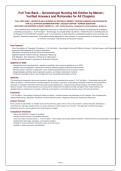
. Full Test Bank – Gerontologic Nursing 6th Edition by Meiner |
Verified Answers and Rationales for All Chapters
. FULL TEST BANK – GERONTOLOGIC NURSING 6TH EDITION BY MEINER | VERIFIED ANSWERS AND RATIONALES
FOR ALL CHAPTERS EXAMINATION PREP | 2026/2027 EDITION | VERIFIED QUESTIONS
QUESTIONS AND ANSWERS ALREADY GRADED A+ | 100% Verified Solutions | Updated Per Latest Guidelines | Graded A+
This comprehensive examination preparation document is meticulously designed for students and professional candidates
undertaking evaluation in . Full Test Bank – Gerontologic Nursing 6th Edition by Meiner | Verified Answers and Rationales for
All Chapters for the 2026/2027 academic year. It encompasses verified questions and detailed solutions covering critical core
domains, theoretical frameworks, and evidence-based applications. Each question is accompanied by an exhaustive rationale
to reinforce conceptual understanding and practical mastery.
Key Features:
Core Foundations & Theoretical Principles in . Full Test Bank – Gerontologic Nursing 6th Edition by Meiner | Verified Answers and Rationales for All
Systematic Methodologies & Procedural Workflows
Regulatory Compliance & Quality Assurance Benchmarks
Applied Analytical Problem-Solving & Diagnostic Reasoning
Risk Mitigation, Error Detection & Performance Optimization
Evidence-Based Decision Frameworks & Evaluation Protocols
Updates for 2026:
- Incorporated recent developments, regulatory standards, and curriculum guidelines up to 2026
- Updated case investigations and practical scenarios reflecting modern professional benchmarks
- Revised answer rationales to align with current evidence-based literature and consensus criteria
- Integrated digital workflow tools, diagnostic analytics, and modern data-driven methods
- Enhanced coverage of ethics, risk management, and interdisciplinary problem-solving
Abstract:
This examination preparation document provides a rigorous and comprehensive review of . Full Test Bank – Gerontologic Nursing 6th
Edition by Meiner | Verified Answers and Rationales for All Chapters, tailored to contemporary 2026/2027 academic and professional
standards. It integrates theoretical frameworks with practical applications, emphasizing systematic analysis and evidence-based
decision-making. The included questions are structured to evaluate both foundational recall and higher-order critical thinking, with
detailed solutions clarifying core concepts, rectifying misconceptions, and reinforcing mastery across all functional domains.
Keywords:
. Full Test Bank – Gerontologic Nursing 6th Edition by Meiner | Verified Answers and Rationales for All Chapters, Core Competencies,
Applied Methodology, Regulatory Standards, Evidence-Based Practice, Diagnostic Reasoning, Explanatory Rationales
Answer Format:
Each question is presented in a multiple-choice format with four options (A–D). The correct answer is clearly indicated, followed by a
comprehensive rationale explaining why it is correct and why the other options are incorrect. This approach enhances learning by
addressing common misconceptions and reinforcing key concepts.
Compliance Checklist:
Aligns with 2026/2027 academic standards
Includes verified answers and detailed rationales
Covers all major functional areas in . Full Test Bank – Gerontologic Nursing 6th Edition by Meiner | Verified Answers and Rationales for All Chapters
Updated with latest legal, regulatory, and industry changes
Suitable for self-assessment, classroom review, and final exams
Graded A+ quality assurance and validation
Page 1
,. FULL TEST BANK – GERONTOLOGIC NURSING 6TH EDITION ...
Content Area Overview:
Content Area Questions Key Topics Weight
Core Foundations & Principles 1–17 Theoretical models, foundational terminology, baseline definitions, 25%
and core standards in . Full Test Bank – Gerontologic Nursing 6th
Edition by Meiner | Verified Answers and Rationales for All
Chapters.
Methodologies & Operational 18–34 Procedural implementation, quantitative analysis, step-by-step 25%
Protocols diagnostic workflows, and testing.
Regulatory Compliance & Best 35–51 Statutory guidelines, ethical considerations, quality assurance 25%
Practices benchmarks, and safety criteria.
Advanced Synthesis & 52–68 Complex scenario evaluation, error mitigation, root-cause 25%
Problem Solving investigation, and strategic optimization.
Examination Questions & Rationales (68 Items)
Question 1.
A client admitted with acute decompensated heart failure is prescribed furosemide 40 mg IV push. Which pre-administration
clinical assessment is the HIGHEST priority for the nurse?
A) Serum potassium level and baseline blood pressure
B) 24-hour dietary sodium intake log
C) Last bowel movement and abdominal bowel sounds
D) Capillary blood glucose level
Correct Answer: A
Rationale: Furosemide is a potent loop diuretic that causes renal excretion of water, sodium, and potassium, placing the client at
acute risk for severe hypokalemia (normal: 3.5–5.0 mEq/L) and symptomatic hypotension. Administering furosemide
without assessing potassium can precipitate fatal ventricular arrhythmias. Dietary sodium, bowel sounds, and glucose
are secondary non-urgent parameters. Distractor options (B, C, D) represent clinically or methodologically incorrect
choices that fail to address the core safety and diagnostic priorities.
Question 2.
A nurse is caring for a postoperative client who underwent open abdominal surgery 6 hours ago. The client suddenly reports
sharp pleuritic chest pain and dyspnea. Pulse oximetry reveals 87% on room air, heart rate is 118 bpm, and respiratory rate
is 28 breaths/min. Which initial action should the nurse take?
A) Administer the prescribed PRN oral opioid analgesic and encourage incentive spirometry
B) Elevate the head of the bed, apply supplemental oxygen via nasal cannula, and notify the rapid response team
C) Auscultate bowel sounds and inspect surgical incision for wound dehiscence
D) Assist the client to ambulate around the nursing unit to relieve gas pain
Correct Answer: B
Rationale: The sudden onset of pleuritic chest pain, tachypnea, tachycardia, and severe hypoxemia in a postoperative client
strongly suggests acute pulmonary embolism (PE). Immediate positioning in high-Fowler, high-flow oxygenation, and
activating rapid response address life-threatening hypoxia (Airway/Breathing priority). Opioid administration without
airway stabilization risks further respiratory depression, while ambulation is strictly contraindicated in suspected
thromboembolism. Distractor options (A, C, D) represent clinically or methodologically incorrect choices that fail to
address the core safety and diagnostic priorities.
Page 2
,. FULL TEST BANK – GERONTOLOGIC NURSING 6TH EDITION ...
Question 3.
The nurse is reviewing laboratory results for a client diagnosed with diabetic ketoacidosis (DKA) who is receiving continuous
regular insulin infusion. Current labs show: blood glucose 240 mg/dL, serum potassium 3.3 mEq/L. Which prescription
should the nurse anticipate receiving from the healthcare provider FIRST?
A) Increase the regular insulin infusion rate by 2 units/hour
B) Administer sodium bicarbonate 50 mEq IV push immediately
C) Add potassium chloride to intravenous fluids and prepare to transition fluids to 5% dextrose in 0.45% saline
D) Discontinue all intravenous fluids and encourage oral electrolyte fluids
Correct Answer: C
Rationale: Insulin drives potassium into cells alongside glucose. A potassium level of 3.3 mEq/L indicates hypokalemia.
Continuing or increasing insulin without potassium replacement can precipitate lethal cardiac arrest. When glucose
drops below 250 mg/dL in DKA, dextrose must be added to IV fluids to prevent cerebral edema and hypoglycemia while
clearing ketonemia. Bicarbonate is contraindicated unless arterial pH is < 6.9. Distractor options (A, B, D) represent
clinically or methodologically incorrect choices that fail to address the core safety and diagnostic priorities.
Question 4.
A nurse in the emergency department triages four incoming clients. Which client must the nurse evaluate FIRST?
A) A 45-year-old with a fractured tibia reporting pain rated 8 out of 10 with intact distal pulses
B) A 68-year-old with chronic obstructive pulmonary disease (COPD) with baseline SpO2 of 89% on 2 L/min oxygen
C) A 22-year-old with acute gastroenteritis reporting nausea and two episodes of non-bloody vomiting
D) A 3-year-old presenting with high fever, leaning forward in a tripod position, with inspiratory stridor and drooling
Correct Answer: D
Rationale: Tripod positioning, inspiratory stridor, high fever, and drooling are classic hallmark signs of acute epiglottitis, which
constitutes an impending total airway occlusion and life-threatening pediatric emergency. The airway must be secured
immediately; examination of the pharynx with a tongue depressor is strictly prohibited. The fractured tibia, chronic
COPD baseline SpO2, and mild gastroenteritis are non-immediate stable conditions. Distractor options (A, B, C)
represent clinically or methodologically incorrect choices that fail to address the core safety and diagnostic priorities.
Question 5.
A registered nurse (RN) is planning care delegation for a medical-surgical floor. Which task is MOST appropriate to delegate
to an experienced unlicensed assistive personnel (UAP)?
A) Measure and record urine output from an indwelling Foley catheter for a stable client
B) Assess the pedal pulse amplitude and skin temperature of a client 2 hours post-femoral catheterization
C) Instruct a newly diagnosed hypertensive client on low-sodium dietary selections
D) Administer the first dose of an oral antibiotic to an admitted client
Correct Answer: A
Rationale: UAP scope of practice encompasses non-invasive, routine tasks on clinically stable clients, including measuring and
recording urine output, vital signs, and assisting with hygiene and ambulation. Initial and postoperative vascular
assessment, client teaching, and medication administration require registered nursing clinical judgment and cannot be
delegated to unlicensed personnel. Distractor options (B, C, D) represent clinically or methodologically incorrect
choices that fail to address the core safety and diagnostic priorities.
Question 6.
A client with preeclampsia at 34 weeks gestation is receiving a continuous intravenous infusion of magnesium sulfate. Which
clinical finding requires IMMEDIATE cessation of the infusion and administration of the antidote?
A) Blood pressure reading of 148/94 mmHg
B) Respiratory rate of 9 breaths/min and absent deep tendon reflexes (DTRs 0/4)
C) Urine output of 45 mL/hour over the preceding 4 hours
D) Serum magnesium level of 5.5 mg/dL (therapeutic range: 4.0–7.0 mg/dL)
Page 3
, . FULL TEST BANK – GERONTOLOGIC NURSING 6TH EDITION ...
Correct Answer: B
Rationale: Respiratory depression (< 12 breaths/min) and loss of deep tendon reflexes are cardinal indicators of life-threatening
magnesium sulfate toxicity, which can rapidly progress to cardiac arrest. The nurse must stop the infusion immediately
and administer calcium gluconate (10% IV). Urine output > 30 mL/hr and magnesium levels within 4.0–7.0 mg/dL are
acceptable parameters during therapy. Distractor options (A, C, D) represent clinically or methodologically incorrect
choices that fail to address the core safety and diagnostic priorities.
Question 7.
A nurse is preparing to administer packed red blood cells (PRBCs) to an adult client. Fifteen minutes after initiating the
transfusion at 2 mL/min, the client reports back pain, chills, and shortness of breath. The nurse notes temperature elevated
from 98.4°F to 101.8°F. Which sequence of actions is CORRECT?
A) Slow the infusion rate to 1 mL/min and administer prescribed oral acetaminophen
B) Aspirate 5 mL of blood from the line and continue monitoring vital signs every 15 minutes
C) Stop the transfusion immediately, disconnect tubing at the catheter hub, and infuse normal saline through new tubing
D) Flush the blood tubing vigorously with 0.9% sodium chloride to clear possible micro-clots
Correct Answer: C
Rationale: Acute hemolytic reaction is characterized by fever, chills, flank/back pain, dyspnea, and tachycardia. The immediate
priority is stopping the transfusion immediately and disconnecting the blood-primed IV tubing at the hub so that no
residual blood enters the circulation. Normal saline must be administered via brand new IV tubing to maintain vein
patency. Flushing the blood line or slowing the rate delivers more fatal incompatible antigens. Distractor options (A, B,
D) represent clinically or methodologically incorrect choices that fail to address the core safety and diagnostic priorities.
Question 8.
A client with bipolar disorder is maintained on lithium carbonate therapy. Which clinical manifestation should alert the nurse
to potential early-to-moderate lithium toxicity?
A) Fine transient hand tremor upon initial medication initiation
B) Mild dry mouth and polyuria that improves with adequate hydration
C) Slight weight gain of 1 pound over 3 months
D) Coarse hand tremors, persistent nausea, diarrhea, and uncoordinated muscle ataxia
Correct Answer: D
Rationale: Serum lithium has a narrow therapeutic index (0.6–1.2 mEq/L). Early toxicity (> 1.5 mEq/L) manifests with
gastrointestinal symptoms (nausea, vomiting, diarrhea) accompanied by worsening neuromuscular deficits, including
coarse tremors, ataxia, muscle hyperirritability, and slurred speech. Fine tremors upon starting therapy can be benign,
but coarse tremors with GI disturbances demand immediate serum level verification. Distractor options (A, B, C)
represent clinically or methodologically incorrect choices that fail to address the core safety and diagnostic priorities.
Question 9.
A client who sustained a complete spinal cord injury at the T4 level reports a sudden, throbbing headache and blurred vision.
The nurse observes profuse diaphoresis above the injury level, flushed facial skin, and vital signs of BP 212/116 mmHg and
HR 48 bpm. What is the nurse’s PRIORITY action?
A) Place the client in a high-Fowler sitting position and examine for bladder distension or a kinked catheter
B) Place the client in the Trendelenburg position to increase cerebral venous return
C) Administer a sublingual nitroglycerin tablet prior to checking the Foley catheter
D) Instruct the client to perform the Valsalva maneuver to lower heart rate
Correct Answer: A
Rationale: Autonomic dysreflexia is an acute, uninhibited sympathetic response triggered in spinal cord injuries at or above T6 by
noxious stimuli (most commonly acute urinary retention or bowel impaction). Elevated sitting position (high-Fowler)
induces orthostatic blood pressure reduction. Immediately identifying and relieving the trigger (e.g., untangling kinked
catheter or emptying bladder) is life-saving and resolves the hypertensive crisis. Distractor options (B, C, D) represent
clinically or methodologically incorrect choices that fail to address the core safety and diagnostic priorities.
Page 4
Verified Answers and Rationales for All Chapters
. FULL TEST BANK – GERONTOLOGIC NURSING 6TH EDITION BY MEINER | VERIFIED ANSWERS AND RATIONALES
FOR ALL CHAPTERS EXAMINATION PREP | 2026/2027 EDITION | VERIFIED QUESTIONS
QUESTIONS AND ANSWERS ALREADY GRADED A+ | 100% Verified Solutions | Updated Per Latest Guidelines | Graded A+
This comprehensive examination preparation document is meticulously designed for students and professional candidates
undertaking evaluation in . Full Test Bank – Gerontologic Nursing 6th Edition by Meiner | Verified Answers and Rationales for
All Chapters for the 2026/2027 academic year. It encompasses verified questions and detailed solutions covering critical core
domains, theoretical frameworks, and evidence-based applications. Each question is accompanied by an exhaustive rationale
to reinforce conceptual understanding and practical mastery.
Key Features:
Core Foundations & Theoretical Principles in . Full Test Bank – Gerontologic Nursing 6th Edition by Meiner | Verified Answers and Rationales for All
Systematic Methodologies & Procedural Workflows
Regulatory Compliance & Quality Assurance Benchmarks
Applied Analytical Problem-Solving & Diagnostic Reasoning
Risk Mitigation, Error Detection & Performance Optimization
Evidence-Based Decision Frameworks & Evaluation Protocols
Updates for 2026:
- Incorporated recent developments, regulatory standards, and curriculum guidelines up to 2026
- Updated case investigations and practical scenarios reflecting modern professional benchmarks
- Revised answer rationales to align with current evidence-based literature and consensus criteria
- Integrated digital workflow tools, diagnostic analytics, and modern data-driven methods
- Enhanced coverage of ethics, risk management, and interdisciplinary problem-solving
Abstract:
This examination preparation document provides a rigorous and comprehensive review of . Full Test Bank – Gerontologic Nursing 6th
Edition by Meiner | Verified Answers and Rationales for All Chapters, tailored to contemporary 2026/2027 academic and professional
standards. It integrates theoretical frameworks with practical applications, emphasizing systematic analysis and evidence-based
decision-making. The included questions are structured to evaluate both foundational recall and higher-order critical thinking, with
detailed solutions clarifying core concepts, rectifying misconceptions, and reinforcing mastery across all functional domains.
Keywords:
. Full Test Bank – Gerontologic Nursing 6th Edition by Meiner | Verified Answers and Rationales for All Chapters, Core Competencies,
Applied Methodology, Regulatory Standards, Evidence-Based Practice, Diagnostic Reasoning, Explanatory Rationales
Answer Format:
Each question is presented in a multiple-choice format with four options (A–D). The correct answer is clearly indicated, followed by a
comprehensive rationale explaining why it is correct and why the other options are incorrect. This approach enhances learning by
addressing common misconceptions and reinforcing key concepts.
Compliance Checklist:
Aligns with 2026/2027 academic standards
Includes verified answers and detailed rationales
Covers all major functional areas in . Full Test Bank – Gerontologic Nursing 6th Edition by Meiner | Verified Answers and Rationales for All Chapters
Updated with latest legal, regulatory, and industry changes
Suitable for self-assessment, classroom review, and final exams
Graded A+ quality assurance and validation
Page 1
,. FULL TEST BANK – GERONTOLOGIC NURSING 6TH EDITION ...
Content Area Overview:
Content Area Questions Key Topics Weight
Core Foundations & Principles 1–17 Theoretical models, foundational terminology, baseline definitions, 25%
and core standards in . Full Test Bank – Gerontologic Nursing 6th
Edition by Meiner | Verified Answers and Rationales for All
Chapters.
Methodologies & Operational 18–34 Procedural implementation, quantitative analysis, step-by-step 25%
Protocols diagnostic workflows, and testing.
Regulatory Compliance & Best 35–51 Statutory guidelines, ethical considerations, quality assurance 25%
Practices benchmarks, and safety criteria.
Advanced Synthesis & 52–68 Complex scenario evaluation, error mitigation, root-cause 25%
Problem Solving investigation, and strategic optimization.
Examination Questions & Rationales (68 Items)
Question 1.
A client admitted with acute decompensated heart failure is prescribed furosemide 40 mg IV push. Which pre-administration
clinical assessment is the HIGHEST priority for the nurse?
A) Serum potassium level and baseline blood pressure
B) 24-hour dietary sodium intake log
C) Last bowel movement and abdominal bowel sounds
D) Capillary blood glucose level
Correct Answer: A
Rationale: Furosemide is a potent loop diuretic that causes renal excretion of water, sodium, and potassium, placing the client at
acute risk for severe hypokalemia (normal: 3.5–5.0 mEq/L) and symptomatic hypotension. Administering furosemide
without assessing potassium can precipitate fatal ventricular arrhythmias. Dietary sodium, bowel sounds, and glucose
are secondary non-urgent parameters. Distractor options (B, C, D) represent clinically or methodologically incorrect
choices that fail to address the core safety and diagnostic priorities.
Question 2.
A nurse is caring for a postoperative client who underwent open abdominal surgery 6 hours ago. The client suddenly reports
sharp pleuritic chest pain and dyspnea. Pulse oximetry reveals 87% on room air, heart rate is 118 bpm, and respiratory rate
is 28 breaths/min. Which initial action should the nurse take?
A) Administer the prescribed PRN oral opioid analgesic and encourage incentive spirometry
B) Elevate the head of the bed, apply supplemental oxygen via nasal cannula, and notify the rapid response team
C) Auscultate bowel sounds and inspect surgical incision for wound dehiscence
D) Assist the client to ambulate around the nursing unit to relieve gas pain
Correct Answer: B
Rationale: The sudden onset of pleuritic chest pain, tachypnea, tachycardia, and severe hypoxemia in a postoperative client
strongly suggests acute pulmonary embolism (PE). Immediate positioning in high-Fowler, high-flow oxygenation, and
activating rapid response address life-threatening hypoxia (Airway/Breathing priority). Opioid administration without
airway stabilization risks further respiratory depression, while ambulation is strictly contraindicated in suspected
thromboembolism. Distractor options (A, C, D) represent clinically or methodologically incorrect choices that fail to
address the core safety and diagnostic priorities.
Page 2
,. FULL TEST BANK – GERONTOLOGIC NURSING 6TH EDITION ...
Question 3.
The nurse is reviewing laboratory results for a client diagnosed with diabetic ketoacidosis (DKA) who is receiving continuous
regular insulin infusion. Current labs show: blood glucose 240 mg/dL, serum potassium 3.3 mEq/L. Which prescription
should the nurse anticipate receiving from the healthcare provider FIRST?
A) Increase the regular insulin infusion rate by 2 units/hour
B) Administer sodium bicarbonate 50 mEq IV push immediately
C) Add potassium chloride to intravenous fluids and prepare to transition fluids to 5% dextrose in 0.45% saline
D) Discontinue all intravenous fluids and encourage oral electrolyte fluids
Correct Answer: C
Rationale: Insulin drives potassium into cells alongside glucose. A potassium level of 3.3 mEq/L indicates hypokalemia.
Continuing or increasing insulin without potassium replacement can precipitate lethal cardiac arrest. When glucose
drops below 250 mg/dL in DKA, dextrose must be added to IV fluids to prevent cerebral edema and hypoglycemia while
clearing ketonemia. Bicarbonate is contraindicated unless arterial pH is < 6.9. Distractor options (A, B, D) represent
clinically or methodologically incorrect choices that fail to address the core safety and diagnostic priorities.
Question 4.
A nurse in the emergency department triages four incoming clients. Which client must the nurse evaluate FIRST?
A) A 45-year-old with a fractured tibia reporting pain rated 8 out of 10 with intact distal pulses
B) A 68-year-old with chronic obstructive pulmonary disease (COPD) with baseline SpO2 of 89% on 2 L/min oxygen
C) A 22-year-old with acute gastroenteritis reporting nausea and two episodes of non-bloody vomiting
D) A 3-year-old presenting with high fever, leaning forward in a tripod position, with inspiratory stridor and drooling
Correct Answer: D
Rationale: Tripod positioning, inspiratory stridor, high fever, and drooling are classic hallmark signs of acute epiglottitis, which
constitutes an impending total airway occlusion and life-threatening pediatric emergency. The airway must be secured
immediately; examination of the pharynx with a tongue depressor is strictly prohibited. The fractured tibia, chronic
COPD baseline SpO2, and mild gastroenteritis are non-immediate stable conditions. Distractor options (A, B, C)
represent clinically or methodologically incorrect choices that fail to address the core safety and diagnostic priorities.
Question 5.
A registered nurse (RN) is planning care delegation for a medical-surgical floor. Which task is MOST appropriate to delegate
to an experienced unlicensed assistive personnel (UAP)?
A) Measure and record urine output from an indwelling Foley catheter for a stable client
B) Assess the pedal pulse amplitude and skin temperature of a client 2 hours post-femoral catheterization
C) Instruct a newly diagnosed hypertensive client on low-sodium dietary selections
D) Administer the first dose of an oral antibiotic to an admitted client
Correct Answer: A
Rationale: UAP scope of practice encompasses non-invasive, routine tasks on clinically stable clients, including measuring and
recording urine output, vital signs, and assisting with hygiene and ambulation. Initial and postoperative vascular
assessment, client teaching, and medication administration require registered nursing clinical judgment and cannot be
delegated to unlicensed personnel. Distractor options (B, C, D) represent clinically or methodologically incorrect
choices that fail to address the core safety and diagnostic priorities.
Question 6.
A client with preeclampsia at 34 weeks gestation is receiving a continuous intravenous infusion of magnesium sulfate. Which
clinical finding requires IMMEDIATE cessation of the infusion and administration of the antidote?
A) Blood pressure reading of 148/94 mmHg
B) Respiratory rate of 9 breaths/min and absent deep tendon reflexes (DTRs 0/4)
C) Urine output of 45 mL/hour over the preceding 4 hours
D) Serum magnesium level of 5.5 mg/dL (therapeutic range: 4.0–7.0 mg/dL)
Page 3
, . FULL TEST BANK – GERONTOLOGIC NURSING 6TH EDITION ...
Correct Answer: B
Rationale: Respiratory depression (< 12 breaths/min) and loss of deep tendon reflexes are cardinal indicators of life-threatening
magnesium sulfate toxicity, which can rapidly progress to cardiac arrest. The nurse must stop the infusion immediately
and administer calcium gluconate (10% IV). Urine output > 30 mL/hr and magnesium levels within 4.0–7.0 mg/dL are
acceptable parameters during therapy. Distractor options (A, C, D) represent clinically or methodologically incorrect
choices that fail to address the core safety and diagnostic priorities.
Question 7.
A nurse is preparing to administer packed red blood cells (PRBCs) to an adult client. Fifteen minutes after initiating the
transfusion at 2 mL/min, the client reports back pain, chills, and shortness of breath. The nurse notes temperature elevated
from 98.4°F to 101.8°F. Which sequence of actions is CORRECT?
A) Slow the infusion rate to 1 mL/min and administer prescribed oral acetaminophen
B) Aspirate 5 mL of blood from the line and continue monitoring vital signs every 15 minutes
C) Stop the transfusion immediately, disconnect tubing at the catheter hub, and infuse normal saline through new tubing
D) Flush the blood tubing vigorously with 0.9% sodium chloride to clear possible micro-clots
Correct Answer: C
Rationale: Acute hemolytic reaction is characterized by fever, chills, flank/back pain, dyspnea, and tachycardia. The immediate
priority is stopping the transfusion immediately and disconnecting the blood-primed IV tubing at the hub so that no
residual blood enters the circulation. Normal saline must be administered via brand new IV tubing to maintain vein
patency. Flushing the blood line or slowing the rate delivers more fatal incompatible antigens. Distractor options (A, B,
D) represent clinically or methodologically incorrect choices that fail to address the core safety and diagnostic priorities.
Question 8.
A client with bipolar disorder is maintained on lithium carbonate therapy. Which clinical manifestation should alert the nurse
to potential early-to-moderate lithium toxicity?
A) Fine transient hand tremor upon initial medication initiation
B) Mild dry mouth and polyuria that improves with adequate hydration
C) Slight weight gain of 1 pound over 3 months
D) Coarse hand tremors, persistent nausea, diarrhea, and uncoordinated muscle ataxia
Correct Answer: D
Rationale: Serum lithium has a narrow therapeutic index (0.6–1.2 mEq/L). Early toxicity (> 1.5 mEq/L) manifests with
gastrointestinal symptoms (nausea, vomiting, diarrhea) accompanied by worsening neuromuscular deficits, including
coarse tremors, ataxia, muscle hyperirritability, and slurred speech. Fine tremors upon starting therapy can be benign,
but coarse tremors with GI disturbances demand immediate serum level verification. Distractor options (A, B, C)
represent clinically or methodologically incorrect choices that fail to address the core safety and diagnostic priorities.
Question 9.
A client who sustained a complete spinal cord injury at the T4 level reports a sudden, throbbing headache and blurred vision.
The nurse observes profuse diaphoresis above the injury level, flushed facial skin, and vital signs of BP 212/116 mmHg and
HR 48 bpm. What is the nurse’s PRIORITY action?
A) Place the client in a high-Fowler sitting position and examine for bladder distension or a kinked catheter
B) Place the client in the Trendelenburg position to increase cerebral venous return
C) Administer a sublingual nitroglycerin tablet prior to checking the Foley catheter
D) Instruct the client to perform the Valsalva maneuver to lower heart rate
Correct Answer: A
Rationale: Autonomic dysreflexia is an acute, uninhibited sympathetic response triggered in spinal cord injuries at or above T6 by
noxious stimuli (most commonly acute urinary retention or bowel impaction). Elevated sitting position (high-Fowler)
induces orthostatic blood pressure reduction. Immediately identifying and relieving the trigger (e.g., untangling kinked
catheter or emptying bladder) is life-saving and resolves the hypertensive crisis. Distractor options (B, C, D) represent
clinically or methodologically incorrect choices that fail to address the core safety and diagnostic priorities.
Page 4


