

Rotational Motion [1]
Angular Momentum
mv
y
r
x
r
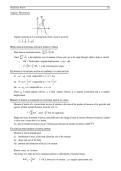
Angular momentum of a rotating body about a point is given by
r r r r r
L r p r mv
WORK DONE IN ROTATIONAL MOTION IN TERMS OF TORQUE
r r
Work done in rotational motion , ri Fi
r r
where ri Fi is the algebraic sum of moment of force and is the angle through which a body is rotated.
W Total torque angular displacement d d
d .d , is the instantaneous torque.
EQUATIONS OF ROTATIONAL MOTION AS COMPARED TO LINEAR MOTION
2 2
(i) 2 02 2 comparable to v –u = 2as
1 1
(ii) 0 t t 2 comparable to s ut at 2
2 2
(iii) 0 t comparable to v = u + at
where 0 is initial angular velocity, is final angular velocity,, is angular acceleration and is angular
displacement.
MOMENT OF INERTIA IS A MEASURE OF ROTATIONAL INERTIA OF A BODY
Moment of inertia of a system about an axis of rotation is the sum of the product of massess of its particles and
squares of their normal distances from the axis i.e.,
i n
I m i ri2 and I r 2 dm for rigid body..
i 1
Higher the value of moment of inertia, more difficult is the change of state of rotation. Moment of inertia is neither
a scalar nor a vector but it is a tensor.
S.I. unit of moment of inertia is kg m2. Dimensional formula of moment of inertia is [ML2T0].
FACTORS ON WHICH MOMENT OF INERTIA DEPEND
Moment of inertia depend upon
(i) distribution of mass of the body about the axis of the rotation
(ii) shape and size of the body
(iii) position and orientation of the axis of rotation
Kinetic enery of rotation
The energy of a body due to its rotational motion is called kinetic rotational energy.
1
K.E.rot I2 I = M.I. about axis of rotation.; = angular speed about axis.
2
, [2] Rotational Motion
Moment of inertia in terms of radius of gyration
Radius of gyration (K) : It is the perpendicular distance of which a point mass equal to mass of system for
which moment of inertia of the point mass as same as moment of inertia of the system about the axis. The
distance is called radius of gyration of the system.
r12 r22 r32 .... rn2
I = MK2 and K
n
Moment of inertia is the product of the mass of a body and the square of the radius of gyration.
Relation between moment of inertia and torque
As d d
1
d I2
d dd 2
I
dt dt dt
I
Moment of inertia of a body an axis is numerically equal to the torque acting on it when the body is rotating
with a unit angular acceleration.
r r
Vectorially, I
The above relation is called Law of rotation or basic equation of rotation
Relation between moment of inertia and angular momentum
Angular momentum of a particle is given by the product of linear momentum and perpendicular distance of the
paticle from the axis of rotation. L I
r
r dt r r d r
and Ir I
dt dt
r r
L I
Moment of inertia of a body about an axis of rotation is equal to the angular momentum of the body about the
some axis rotating with unit angular velocity.
Theorem of parallel axes
This theorem states that moment of inertia of a rigid body about an axis (I11) parallel to an axis passing through
centre of mass (ICM) of the body is equal to moment of inertia about this axis plus the product of total mass M of
the body and square of perpendicular distance (r) between these parallel axes.
A
i.e., I| | I CM Mr 2 r
m i r1
Theorem of perependicular axes
The sum of moments of inertia along two mutually perpendicular axes in a plane is equal to the moment of inertia
along the axes perpendicular to this plane
i.e. Iz = Ix + Iy
This theorem is only applicable for plane lamina (Mass is distributed along two dimension)
Moment of inertia of a thin uniform ring
(a) Moment of inertia of a thin uniform ring about an axis passing through centre of mass and perpendicular to
Angular Momentum
mv
y
r
x
r
Angular momentum of a rotating body about a point is given by
r r r r r
L r p r mv
WORK DONE IN ROTATIONAL MOTION IN TERMS OF TORQUE
r r
Work done in rotational motion , ri Fi
r r
where ri Fi is the algebraic sum of moment of force and is the angle through which a body is rotated.
W Total torque angular displacement d d
d .d , is the instantaneous torque.
EQUATIONS OF ROTATIONAL MOTION AS COMPARED TO LINEAR MOTION
2 2
(i) 2 02 2 comparable to v –u = 2as
1 1
(ii) 0 t t 2 comparable to s ut at 2
2 2
(iii) 0 t comparable to v = u + at
where 0 is initial angular velocity, is final angular velocity,, is angular acceleration and is angular
displacement.
MOMENT OF INERTIA IS A MEASURE OF ROTATIONAL INERTIA OF A BODY
Moment of inertia of a system about an axis of rotation is the sum of the product of massess of its particles and
squares of their normal distances from the axis i.e.,
i n
I m i ri2 and I r 2 dm for rigid body..
i 1
Higher the value of moment of inertia, more difficult is the change of state of rotation. Moment of inertia is neither
a scalar nor a vector but it is a tensor.
S.I. unit of moment of inertia is kg m2. Dimensional formula of moment of inertia is [ML2T0].
FACTORS ON WHICH MOMENT OF INERTIA DEPEND
Moment of inertia depend upon
(i) distribution of mass of the body about the axis of the rotation
(ii) shape and size of the body
(iii) position and orientation of the axis of rotation
Kinetic enery of rotation
The energy of a body due to its rotational motion is called kinetic rotational energy.
1
K.E.rot I2 I = M.I. about axis of rotation.; = angular speed about axis.
2
, [2] Rotational Motion
Moment of inertia in terms of radius of gyration
Radius of gyration (K) : It is the perpendicular distance of which a point mass equal to mass of system for
which moment of inertia of the point mass as same as moment of inertia of the system about the axis. The
distance is called radius of gyration of the system.
r12 r22 r32 .... rn2
I = MK2 and K
n
Moment of inertia is the product of the mass of a body and the square of the radius of gyration.
Relation between moment of inertia and torque
As d d
1
d I2
d dd 2
I
dt dt dt
I
Moment of inertia of a body an axis is numerically equal to the torque acting on it when the body is rotating
with a unit angular acceleration.
r r
Vectorially, I
The above relation is called Law of rotation or basic equation of rotation
Relation between moment of inertia and angular momentum
Angular momentum of a particle is given by the product of linear momentum and perpendicular distance of the
paticle from the axis of rotation. L I
r
r dt r r d r
and Ir I
dt dt
r r
L I
Moment of inertia of a body about an axis of rotation is equal to the angular momentum of the body about the
some axis rotating with unit angular velocity.
Theorem of parallel axes
This theorem states that moment of inertia of a rigid body about an axis (I11) parallel to an axis passing through
centre of mass (ICM) of the body is equal to moment of inertia about this axis plus the product of total mass M of
the body and square of perpendicular distance (r) between these parallel axes.
A
i.e., I| | I CM Mr 2 r
m i r1
Theorem of perependicular axes
The sum of moments of inertia along two mutually perpendicular axes in a plane is equal to the moment of inertia
along the axes perpendicular to this plane
i.e. Iz = Ix + Iy
This theorem is only applicable for plane lamina (Mass is distributed along two dimension)
Moment of inertia of a thin uniform ring
(a) Moment of inertia of a thin uniform ring about an axis passing through centre of mass and perpendicular to


