

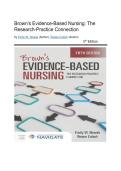
Brown's Evidence-Based Nursing: The
Research-Practice Connection
by Emily W. Nowak (Author), Renee Colsch (Author)
5th Edition
,TABLE OF CONTENTS
Part 1 Nursing Research
Chapter 1 The Research-Practice Connection
Chapter 2 Research Evidence
Chapter 3 Reading Research Articles
Chapter 4 Qualitative Research
Chapter 5 Quantitative Descriptive Research
Chapter 6 Correlational Research
Chapter 7 Experimental Research
Chapter 8 Cohort Research
Chapter 9 Systematic Reviews
Chapter 10 Evidence-Based Clinical Practice Guidelines
Part 2 Evidence-Based Practice
Chapter 11 Asking Clinical Questions
Chapter 12 Searching for Research Evidence
Chapter 13 Appraising Research Evidence
Chapter 14 Appraising Recommendations of Clinical Practice Guidelines
Chapter 15 Appraising Conclusions of Systematic Reviews with Narrative Synthesis
Chapter 16 Appraising Findings of Original Studies
Chapter 17 Evidence-Based Practice Strategies
Chapter 18 Evidence-Based Practice Participation
Chapter 19 Point-of-Care Adaptations
,Test Bank: Brown's Evidence-Based Nursing: The Research-Practice
Connection, 5th Edition (Nowak, 2024)
CHAPTER 1: Connection Between Research and Evidence-Based
Practice
Multiple Choice Questions
1. What is the primary goal of evidence-based nursing practice?
A) To conduct original research studies
B) To integrate best research evidence with clinical expertise and patient preferences
C) To replace clinical judgment with research findings
D) To follow established traditions in nursing care
Answer: B
Rationale: Evidence-based practice (EBP) integrates the best available research evidence with clinical
expertise and patient values/preferences to make clinical decisions. It does not replace clinical judgment
but rather informs it.
2. Which of the following best describes the relationship between nursing research and evidence-
based practice?
A) They are the same concept with different names
B) Research generates evidence that can be applied through EBP
C) EBP must always precede research
D) Research is only conducted in laboratory settings
Answer: B
Rationale: Nursing research generates knowledge and evidence. EBP is the process of translating and
applying that evidence into clinical practice. They are related but distinct activities.
3. Which component is NOT part of the evidence-based practice triad?
A) Best research evidence
B) Clinical expertise
C) Hospital policy
D) Patient preferences and values
Answer: C
Rationale: The EBP triad consists of best research evidence, clinical expertise, and patient
preferences/values. Hospital policy may be informed by EBP but is not one of the three core
components.
, 4. The Iowa Model of Evidence-Based Practice is primarily used to:
A) Design randomized controlled trials
B) Guide the implementation of evidence-based practice changes in clinical settings
C) Teach undergraduate statistics
D) Evaluate nursing program curricula
Answer: B
Rationale: The Iowa Model is an organizational model designed to guide nurses and healthcare
organizations through the process of implementing EBP changes, from identifying triggers to evaluating
outcomes.
5. Which of the following is a "knowledge-focused trigger" for EBP?
A) A patient falls on the unit
B) New research findings published in a nursing journal
C) An increase in hospital-acquired infections
D) A rise in patient complaints
Answer: B
Rationale: Knowledge-focused triggers stem from new knowledge or information, such as new research
findings, new practice guidelines, or new philosophies of care. The other options represent problem-
focused triggers.
6. A nurse notices that post-surgical infection rates have increased on her unit. This is an example of
which type of EBP trigger?
A) Knowledge-focused trigger
B) Problem-focused trigger
C) Theory-focused trigger
D) Policy-focused trigger
Answer: B
Rationale: Problem-focused triggers arise from clinical problems identified through quality improvement
data, risk management data, benchmarking data, or clinical observations.
7. Which of the following is the correct order of steps in the evidence-based practice process?
A) Implement, ask, acquire, appraise, apply
B) Ask, acquire, appraise, apply, assess
C) Acquire, ask, appraise, assess, apply
D) Appraise, ask, acquire, apply, assess
Research-Practice Connection
by Emily W. Nowak (Author), Renee Colsch (Author)
5th Edition
,TABLE OF CONTENTS
Part 1 Nursing Research
Chapter 1 The Research-Practice Connection
Chapter 2 Research Evidence
Chapter 3 Reading Research Articles
Chapter 4 Qualitative Research
Chapter 5 Quantitative Descriptive Research
Chapter 6 Correlational Research
Chapter 7 Experimental Research
Chapter 8 Cohort Research
Chapter 9 Systematic Reviews
Chapter 10 Evidence-Based Clinical Practice Guidelines
Part 2 Evidence-Based Practice
Chapter 11 Asking Clinical Questions
Chapter 12 Searching for Research Evidence
Chapter 13 Appraising Research Evidence
Chapter 14 Appraising Recommendations of Clinical Practice Guidelines
Chapter 15 Appraising Conclusions of Systematic Reviews with Narrative Synthesis
Chapter 16 Appraising Findings of Original Studies
Chapter 17 Evidence-Based Practice Strategies
Chapter 18 Evidence-Based Practice Participation
Chapter 19 Point-of-Care Adaptations
,Test Bank: Brown's Evidence-Based Nursing: The Research-Practice
Connection, 5th Edition (Nowak, 2024)
CHAPTER 1: Connection Between Research and Evidence-Based
Practice
Multiple Choice Questions
1. What is the primary goal of evidence-based nursing practice?
A) To conduct original research studies
B) To integrate best research evidence with clinical expertise and patient preferences
C) To replace clinical judgment with research findings
D) To follow established traditions in nursing care
Answer: B
Rationale: Evidence-based practice (EBP) integrates the best available research evidence with clinical
expertise and patient values/preferences to make clinical decisions. It does not replace clinical judgment
but rather informs it.
2. Which of the following best describes the relationship between nursing research and evidence-
based practice?
A) They are the same concept with different names
B) Research generates evidence that can be applied through EBP
C) EBP must always precede research
D) Research is only conducted in laboratory settings
Answer: B
Rationale: Nursing research generates knowledge and evidence. EBP is the process of translating and
applying that evidence into clinical practice. They are related but distinct activities.
3. Which component is NOT part of the evidence-based practice triad?
A) Best research evidence
B) Clinical expertise
C) Hospital policy
D) Patient preferences and values
Answer: C
Rationale: The EBP triad consists of best research evidence, clinical expertise, and patient
preferences/values. Hospital policy may be informed by EBP but is not one of the three core
components.
, 4. The Iowa Model of Evidence-Based Practice is primarily used to:
A) Design randomized controlled trials
B) Guide the implementation of evidence-based practice changes in clinical settings
C) Teach undergraduate statistics
D) Evaluate nursing program curricula
Answer: B
Rationale: The Iowa Model is an organizational model designed to guide nurses and healthcare
organizations through the process of implementing EBP changes, from identifying triggers to evaluating
outcomes.
5. Which of the following is a "knowledge-focused trigger" for EBP?
A) A patient falls on the unit
B) New research findings published in a nursing journal
C) An increase in hospital-acquired infections
D) A rise in patient complaints
Answer: B
Rationale: Knowledge-focused triggers stem from new knowledge or information, such as new research
findings, new practice guidelines, or new philosophies of care. The other options represent problem-
focused triggers.
6. A nurse notices that post-surgical infection rates have increased on her unit. This is an example of
which type of EBP trigger?
A) Knowledge-focused trigger
B) Problem-focused trigger
C) Theory-focused trigger
D) Policy-focused trigger
Answer: B
Rationale: Problem-focused triggers arise from clinical problems identified through quality improvement
data, risk management data, benchmarking data, or clinical observations.
7. Which of the following is the correct order of steps in the evidence-based practice process?
A) Implement, ask, acquire, appraise, apply
B) Ask, acquire, appraise, apply, assess
C) Acquire, ask, appraise, assess, apply
D) Appraise, ask, acquire, apply, assess


