

COMPREHENSIVE PSYCHIATRIC NURSING EXAMINATION SERIES
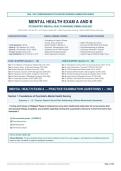
MENTAL HEALTH EXAM A AND B
PSYCHIATRIC MENTAL HEALTH NURSING (PMHN) 2026/2027
NCLEX-RN / NCLEX-PN • ATI Mental Health RN • HESI Psychiatric Nursing • BSN & MSN Clinical Curricula
EXAM SPECIFICATIONS CLINICAL DOMAINS COVERED EVIDENCE-BASED STANDARDS
• Foundations & Peplau's Phases
• Anxiety, Stress & Somatic • DSM-5-TR Diagnostic Criteria
• Total Questions: 200 Qs • Mood Disorders & Bipolar I/II • Next-Gen NCLEX (NGN) Case Studies
• Exam A: 100 Questions (Q1–Q100) • Psychosis, Schizophrenia & EPS • Psychopharmacology & Antidotes
• Exam B: 100 Questions (Q101–Q200) • Substance Use & CIWA Protocols • Involuntary Admission & Tarasoff
• Format: Multiple Choice (A–D) • Eating & Personality Disorders • Restraints/Seclusion Guidelines
• Key Distribution: 50 A, 50 B, 50 C, 50 D • Child, Adolescent & Geriatric • Suicide Triage (C-SSRS & Safety Plans)
EXAM A BLUEPRINT (Questions 1 – 100) EXAM B BLUEPRINT (Questions 101 – 200)
Sec 1: Foundations & Therapeutic Relationships (Q1–Q15) Sec 1: Therapeutic Communication & Group Dynamics (Q101–Q115)
Sec 2: Anxiety, Stress, & Somatic Disorders (Q16–Q30) Sec 2: Crisis Intervention, Trauma & PTSD (Q116–Q130)
Sec 3: Mood Disorders & Bipolar Crisis (Q31–Q45) Sec 3: Child & Adolescent Mental Health (Q131–Q145)
Sec 4: Psychotic Disorders & EPS Management (Q46–Q60) Sec 4: Geriatric Mental Health & Neurocognitive (Q146–Q160)
Sec 5: Substance Use Disorders & Addiction (Q61–Q75) Sec 5: Clinical Psychopharmacology & Antidotes (Q161–Q175)
Sec 6: Eating Disorders & Refeeding Syndrome (Q76–Q85) Sec 6: Legal, Ethical & Regulatory Issues (Q176–Q185)
Sec 7: Personality Disorders & DBT (Q86–Q95) Sec 7: Suicide & Self-Harm Risk Assessment (Q186–Q195)
Sec 8: Integrated Longitudinal Case Study (Q96–Q100) Sec 8: Integrated Longitudinal Case Study (Q196–Q200)
MENTAL HEALTH EXAM A — PRACTICE EXAMINATION (QUESTIONS 1 – 100)
Section 1: Foundations of Psychiatric-Mental Health Nursing
Questions 1 – 15 • Theories, Peplau's Nurse-Client Relationship, Defense Mechanisms, Boundaries
1. During which phase of Hildegard Peplau's interpersonal nurse-client relationship model does the nurse examine their
own personal feelings, prejudices, and anxieties regarding working with a psychiatric client prior to their first face-to-face
interaction?
[A] Pre-orientation phase [CORRECT]
[B] Orientation phase
[C] Working phase
[D] Termination phase
Correct Answer: Option [A]
Clinical Rationale: The pre-orientation phase occurs before meeting the client; the nurse engages in self-awareness and addresses personal
biases or fears to establish an objective therapeutic foundation.
Comprehensive Dual-Exam Master Review (200 Questions) • Evidence-Based Clinical Practice Page 1 of 69
,MENTAL HEALTH EXAM A & B — PSYCHIATRIC MENTAL HEALTH NURSING 2026/2027 NCLEX-RN / ATI / HESI MASTER PRACTICE
2. A newly admitted client with severe depression says, 'I don't think I can talk about my feelings today.' Which of the
following responses by the nurse represents the most therapeutic communication technique?
[A] 'Why are you feeling so uncooperative today?'
[B] 'I will sit here quietly with you for 15 minutes in case you decide you want to share.' [CORRECT]
[C] 'You should really try to talk, because you will feel much better if you do.'
[D] 'Don't worry, everyone feels a little down when they first arrive here.'
Correct Answer: Option [B]
Clinical Rationale: Offering self ('I will sit with you') demonstrates unconditional presence and support without demanding performance,
establishing trust in the orientation phase.
3. A client who was passed over for an executive promotion at work comes home and immediately begins shouting at their
spouse and children over trivial household matters. Which ego defense mechanism is this client demonstrating?
[A] Projection
[B] Sublimation
[C] Displacement [CORRECT]
[D] Reaction formation
Correct Answer: Option [C]
Clinical Rationale: Displacement involves redirecting emotional impulses and hostility from the actual source of frustration (the employer) onto a
safer, less threatening substitute target (family).
4. An adult client who has intense, unconscious feelings of hostility and resentment toward their parent acts excessively
affectionate, overly attentive, and brings lavish gifts daily. Which defense mechanism is operating?
[A] Rationalization
[B] Sublimation
[C] Undoing
[D] Reaction formation [CORRECT]
Correct Answer: Option [D]
Clinical Rationale: Reaction formation occurs when an individual manages unacceptable internal impulses or feelings by consciously expressing
the exact opposite attitude and exaggerated behavior.
Comprehensive Dual-Exam Master Review (200 Questions) • Evidence-Based Clinical Practice Page 2 of 69
,MENTAL HEALTH EXAM A & B — PSYCHIATRIC MENTAL HEALTH NURSING 2026/2027 NCLEX-RN / ATI / HESI MASTER PRACTICE
5. A client with severe alcoholism who consumes a fifth of vodka daily states, 'I don't have an alcohol problem; I just drink
occasionally to celebrate with friends.' Which defense mechanism is this client using?
[A] Denial [CORRECT]
[B] Sublimation
[C] Conversion
[D] Suppression
Correct Answer: Option [A]
Clinical Rationale: Denial is the refusal to acknowledge the existence of a real situation, fact, or the associated feelings, shielding the ego from
uncomfortable reality.
6. A client who struggles with aggressive, violent impulses channels this energy into becoming a championship
professional boxer and youth mentor. Which healthy defense mechanism is being utilized?
[A] Suppression
[B] Sublimation [CORRECT]
[C] Altruism
[D] Introjection
Correct Answer: Option [B]
Clinical Rationale: Sublimation is a mature, healthy defense mechanism wherein unacceptable drives (aggression) are channeled into
constructive, socially acceptable, and productive outlets.
7. A student who failed a major nursing pharmacology examination states, 'The teacher wrote terrible, unfair questions and
made the exam impossible for everyone.' Which defense mechanism is being exhibited?
[A] Regression
[B] Conversion
[C] Rationalization [CORRECT]
[D] Repression
Correct Answer: Option [C]
Clinical Rationale: Rationalization involves creating plausible, self-serving logical excuses to justify unacceptable outcomes or behaviors and
protect self-esteem.
Comprehensive Dual-Exam Master Review (200 Questions) • Evidence-Based Clinical Practice Page 3 of 69
, MENTAL HEALTH EXAM A & B — PSYCHIATRIC MENTAL HEALTH NURSING 2026/2027 NCLEX-RN / ATI / HESI MASTER PRACTICE
8. According to Erik Erikson's stages of psychosocial development, which developmental conflict is experienced during
late adulthood (age 65 and older)?
[A] Generativity vs. Stagnation
[B] Identity vs. Role Confusion
[C] Intimacy vs. Isolation
[D] Integrity vs. Despair [CORRECT]
Correct Answer: Option [D]
Clinical Rationale: Integrity vs. Despair characterizes late adulthood, where the individual reflects back on their life and achieves a sense of
fulfillment (integrity) or regret/bitterness (despair).
9. In Sigmund Freud's structural model of personality, which component operates entirely on the 'Reality Principle' and
functions as the realistic mediator between instinctual drives and societal moral standards?
[A] The Ego [CORRECT]
[B] The Id
[C] The Superego
[D] The Collective Unconscious
Correct Answer: Option [A]
Clinical Rationale: The Ego operates on the reality principle, utilizing rational thought and defense mechanisms to mediate between the
instinctual drives of the Id and the moral demands of the Superego.
10. During the termination phase of the nurse-client relationship, which clinical task is the primary focus of the nurse?
[A] Establishing the initial boundaries and expectations of the therapeutic contract
[B] Reviewing progress toward established goals, exploring feelings regarding separation, and synthesizing new coping skills
for the future [CORRECT]
[C] Identifying deep unconscious childhood conflicts
[D] Encouraging the client to maintain social contact with the nurse after discharge
Correct Answer: Option [B]
Clinical Rationale: The termination phase focuses on summarizing goal achievement, validating feelings of loss or separation, and reinforcing
adaptive coping mechanisms.
Comprehensive Dual-Exam Master Review (200 Questions) • Evidence-Based Clinical Practice Page 4 of 69
MENTAL HEALTH EXAM A AND B
PSYCHIATRIC MENTAL HEALTH NURSING (PMHN) 2026/2027
NCLEX-RN / NCLEX-PN • ATI Mental Health RN • HESI Psychiatric Nursing • BSN & MSN Clinical Curricula
EXAM SPECIFICATIONS CLINICAL DOMAINS COVERED EVIDENCE-BASED STANDARDS
• Foundations & Peplau's Phases
• Anxiety, Stress & Somatic • DSM-5-TR Diagnostic Criteria
• Total Questions: 200 Qs • Mood Disorders & Bipolar I/II • Next-Gen NCLEX (NGN) Case Studies
• Exam A: 100 Questions (Q1–Q100) • Psychosis, Schizophrenia & EPS • Psychopharmacology & Antidotes
• Exam B: 100 Questions (Q101–Q200) • Substance Use & CIWA Protocols • Involuntary Admission & Tarasoff
• Format: Multiple Choice (A–D) • Eating & Personality Disorders • Restraints/Seclusion Guidelines
• Key Distribution: 50 A, 50 B, 50 C, 50 D • Child, Adolescent & Geriatric • Suicide Triage (C-SSRS & Safety Plans)
EXAM A BLUEPRINT (Questions 1 – 100) EXAM B BLUEPRINT (Questions 101 – 200)
Sec 1: Foundations & Therapeutic Relationships (Q1–Q15) Sec 1: Therapeutic Communication & Group Dynamics (Q101–Q115)
Sec 2: Anxiety, Stress, & Somatic Disorders (Q16–Q30) Sec 2: Crisis Intervention, Trauma & PTSD (Q116–Q130)
Sec 3: Mood Disorders & Bipolar Crisis (Q31–Q45) Sec 3: Child & Adolescent Mental Health (Q131–Q145)
Sec 4: Psychotic Disorders & EPS Management (Q46–Q60) Sec 4: Geriatric Mental Health & Neurocognitive (Q146–Q160)
Sec 5: Substance Use Disorders & Addiction (Q61–Q75) Sec 5: Clinical Psychopharmacology & Antidotes (Q161–Q175)
Sec 6: Eating Disorders & Refeeding Syndrome (Q76–Q85) Sec 6: Legal, Ethical & Regulatory Issues (Q176–Q185)
Sec 7: Personality Disorders & DBT (Q86–Q95) Sec 7: Suicide & Self-Harm Risk Assessment (Q186–Q195)
Sec 8: Integrated Longitudinal Case Study (Q96–Q100) Sec 8: Integrated Longitudinal Case Study (Q196–Q200)
MENTAL HEALTH EXAM A — PRACTICE EXAMINATION (QUESTIONS 1 – 100)
Section 1: Foundations of Psychiatric-Mental Health Nursing
Questions 1 – 15 • Theories, Peplau's Nurse-Client Relationship, Defense Mechanisms, Boundaries
1. During which phase of Hildegard Peplau's interpersonal nurse-client relationship model does the nurse examine their
own personal feelings, prejudices, and anxieties regarding working with a psychiatric client prior to their first face-to-face
interaction?
[A] Pre-orientation phase [CORRECT]
[B] Orientation phase
[C] Working phase
[D] Termination phase
Correct Answer: Option [A]
Clinical Rationale: The pre-orientation phase occurs before meeting the client; the nurse engages in self-awareness and addresses personal
biases or fears to establish an objective therapeutic foundation.
Comprehensive Dual-Exam Master Review (200 Questions) • Evidence-Based Clinical Practice Page 1 of 69
,MENTAL HEALTH EXAM A & B — PSYCHIATRIC MENTAL HEALTH NURSING 2026/2027 NCLEX-RN / ATI / HESI MASTER PRACTICE
2. A newly admitted client with severe depression says, 'I don't think I can talk about my feelings today.' Which of the
following responses by the nurse represents the most therapeutic communication technique?
[A] 'Why are you feeling so uncooperative today?'
[B] 'I will sit here quietly with you for 15 minutes in case you decide you want to share.' [CORRECT]
[C] 'You should really try to talk, because you will feel much better if you do.'
[D] 'Don't worry, everyone feels a little down when they first arrive here.'
Correct Answer: Option [B]
Clinical Rationale: Offering self ('I will sit with you') demonstrates unconditional presence and support without demanding performance,
establishing trust in the orientation phase.
3. A client who was passed over for an executive promotion at work comes home and immediately begins shouting at their
spouse and children over trivial household matters. Which ego defense mechanism is this client demonstrating?
[A] Projection
[B] Sublimation
[C] Displacement [CORRECT]
[D] Reaction formation
Correct Answer: Option [C]
Clinical Rationale: Displacement involves redirecting emotional impulses and hostility from the actual source of frustration (the employer) onto a
safer, less threatening substitute target (family).
4. An adult client who has intense, unconscious feelings of hostility and resentment toward their parent acts excessively
affectionate, overly attentive, and brings lavish gifts daily. Which defense mechanism is operating?
[A] Rationalization
[B] Sublimation
[C] Undoing
[D] Reaction formation [CORRECT]
Correct Answer: Option [D]
Clinical Rationale: Reaction formation occurs when an individual manages unacceptable internal impulses or feelings by consciously expressing
the exact opposite attitude and exaggerated behavior.
Comprehensive Dual-Exam Master Review (200 Questions) • Evidence-Based Clinical Practice Page 2 of 69
,MENTAL HEALTH EXAM A & B — PSYCHIATRIC MENTAL HEALTH NURSING 2026/2027 NCLEX-RN / ATI / HESI MASTER PRACTICE
5. A client with severe alcoholism who consumes a fifth of vodka daily states, 'I don't have an alcohol problem; I just drink
occasionally to celebrate with friends.' Which defense mechanism is this client using?
[A] Denial [CORRECT]
[B] Sublimation
[C] Conversion
[D] Suppression
Correct Answer: Option [A]
Clinical Rationale: Denial is the refusal to acknowledge the existence of a real situation, fact, or the associated feelings, shielding the ego from
uncomfortable reality.
6. A client who struggles with aggressive, violent impulses channels this energy into becoming a championship
professional boxer and youth mentor. Which healthy defense mechanism is being utilized?
[A] Suppression
[B] Sublimation [CORRECT]
[C] Altruism
[D] Introjection
Correct Answer: Option [B]
Clinical Rationale: Sublimation is a mature, healthy defense mechanism wherein unacceptable drives (aggression) are channeled into
constructive, socially acceptable, and productive outlets.
7. A student who failed a major nursing pharmacology examination states, 'The teacher wrote terrible, unfair questions and
made the exam impossible for everyone.' Which defense mechanism is being exhibited?
[A] Regression
[B] Conversion
[C] Rationalization [CORRECT]
[D] Repression
Correct Answer: Option [C]
Clinical Rationale: Rationalization involves creating plausible, self-serving logical excuses to justify unacceptable outcomes or behaviors and
protect self-esteem.
Comprehensive Dual-Exam Master Review (200 Questions) • Evidence-Based Clinical Practice Page 3 of 69
, MENTAL HEALTH EXAM A & B — PSYCHIATRIC MENTAL HEALTH NURSING 2026/2027 NCLEX-RN / ATI / HESI MASTER PRACTICE
8. According to Erik Erikson's stages of psychosocial development, which developmental conflict is experienced during
late adulthood (age 65 and older)?
[A] Generativity vs. Stagnation
[B] Identity vs. Role Confusion
[C] Intimacy vs. Isolation
[D] Integrity vs. Despair [CORRECT]
Correct Answer: Option [D]
Clinical Rationale: Integrity vs. Despair characterizes late adulthood, where the individual reflects back on their life and achieves a sense of
fulfillment (integrity) or regret/bitterness (despair).
9. In Sigmund Freud's structural model of personality, which component operates entirely on the 'Reality Principle' and
functions as the realistic mediator between instinctual drives and societal moral standards?
[A] The Ego [CORRECT]
[B] The Id
[C] The Superego
[D] The Collective Unconscious
Correct Answer: Option [A]
Clinical Rationale: The Ego operates on the reality principle, utilizing rational thought and defense mechanisms to mediate between the
instinctual drives of the Id and the moral demands of the Superego.
10. During the termination phase of the nurse-client relationship, which clinical task is the primary focus of the nurse?
[A] Establishing the initial boundaries and expectations of the therapeutic contract
[B] Reviewing progress toward established goals, exploring feelings regarding separation, and synthesizing new coping skills
for the future [CORRECT]
[C] Identifying deep unconscious childhood conflicts
[D] Encouraging the client to maintain social contact with the nurse after discharge
Correct Answer: Option [B]
Clinical Rationale: The termination phase focuses on summarizing goal achievement, validating feelings of loss or separation, and reinforcing
adaptive coping mechanisms.
Comprehensive Dual-Exam Master Review (200 Questions) • Evidence-Based Clinical Practice Page 4 of 69


