
Questions
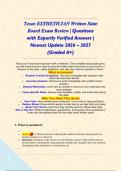
Pass your Texas licensing exam with confidence. This complete study guide gives
you the exact tools you need to pass the written state board test on your first try. It
focuses on the rules, safety guidelines, and skin care science required in Texas.
What is Included
Realistic Practice Questions: Test your knowledge with questions that
•
match the real exam format.
• Accurate Answers: Check your work immediately with verified correct
answers.
• Detailed Rationales: Learn why an answer is correct so you understand the
core concepts.
• Texas-Specific Rules: Review local sanitation, safety, and health laws set by
the state.
Why You Need This Guide
Save Time: Stop reading heavy textbooks. Focus only on high-yield facts.
•
• Reduce Stress: Know what to expect on test day so you feel calm and ready.
• Boost Your Score: Learn the tricky wording used on official state tests.
Who is this for? Student estheticians, apprentices, and beauty school graduates in
Texas who are getting ready for their state board written exam.
1. What is sanitation?
•
• Answer✅: A chemical process reducing the number of disease-causing germs on
cleaned surfaces to a safe level.
• Rationale: Sanitation is the lowest level of infection control. It physically removes
dirt and debris, substantially reducing public health risks, though it does not eliminate
all pathogens like disinfection or sterilization do.
•
1
, 2. What is sterilization?
•
• Answer✅: COMPLETELY Destroys all microbial life, including spores.
• Rationale: Sterilization is the highest level of decontamination. It eliminates all forms
of viable microorganisms, including highly resistant bacterial spores, usually via high-
pressure steam (autoclaves) or extreme chemical methods.
•
3. What is Disinfection?
•
• Answer✅: A chemical process that uses specific products to destroy harmful
organisms.
• Rationale: Disinfection kills most pathogenic bacteria, fungi, and viruses on non-
porous surfaces. It is a step below sterilization because it typically fails to destroy
stubborn bacterial spores.
•
4. What does OSHA stand for?
•
• Answer✅: Occupational Safety and Health Administration.
• Rationale: Created as part of the U.S. Department of Labor, OSHA enforces safety
regulations to protect workers from occupational hazards, injuries, and toxic chemical
exposure.
•
5. What is OSHA responsible for?
•
• Answer✅: Addresses issues relating to handling, mixing, storing, and disposing of
products.
• Rationale: OSHA mandates workplace safety protocols, which include enforcing the
use of Safety Data Sheets (SDS) to ensure employees understand the chemical
hazards and safe handling procedures of salon/spa products.
•
6. What is Fungi?
2
, •
• Answer✅: Single-celled organisms that grow in irregular masses that include molds,
mildews, and yeasts.
• Rationale: Fungi are microscopic plant parasites that can produce contagious skin
infections like ringworm or tinea, requiring strict fungicidal disinfectants to clean
implements.
•
7. What are Parasites?
•
• Answer✅: Organisms that grow, feed, and shelter on or inside another organism
while contributing nothing to the survival of that organism.
• Rationale: Parasites require a living host to survive and cause harm or disease to that
host. Examples in a spa setting include head lice (pediculosis) and scabies.
•
8. What is EPA? What do they do?
•
• Answer✅: Environmental Protection Agency. Registers all types of disinfectants
sold and used in the US.
• Rationale: The EPA assigns a registration number to chemical disinfectants only
after verifying that the manufacturer's product is safe and effective when used
according to the label instructions.
•
9. What is the Circulatory System?
•
• Answer✅: A system that controls the steady circulation of blood through the body
by means of the heart and blood vessels.
• Rationale: Also known as the cardiovascular system, it delivers oxygen, nutrients,
and hormones to cells while carrying away metabolic waste products.
•
10. What is the endocrine system?
•
3
Pass your Texas licensing exam with confidence. This complete study guide gives
you the exact tools you need to pass the written state board test on your first try. It
focuses on the rules, safety guidelines, and skin care science required in Texas.
What is Included
Realistic Practice Questions: Test your knowledge with questions that
•
match the real exam format.
• Accurate Answers: Check your work immediately with verified correct
answers.
• Detailed Rationales: Learn why an answer is correct so you understand the
core concepts.
• Texas-Specific Rules: Review local sanitation, safety, and health laws set by
the state.
Why You Need This Guide
Save Time: Stop reading heavy textbooks. Focus only on high-yield facts.
•
• Reduce Stress: Know what to expect on test day so you feel calm and ready.
• Boost Your Score: Learn the tricky wording used on official state tests.
Who is this for? Student estheticians, apprentices, and beauty school graduates in
Texas who are getting ready for their state board written exam.
1. What is sanitation?
•
• Answer✅: A chemical process reducing the number of disease-causing germs on
cleaned surfaces to a safe level.
• Rationale: Sanitation is the lowest level of infection control. It physically removes
dirt and debris, substantially reducing public health risks, though it does not eliminate
all pathogens like disinfection or sterilization do.
•
1
, 2. What is sterilization?
•
• Answer✅: COMPLETELY Destroys all microbial life, including spores.
• Rationale: Sterilization is the highest level of decontamination. It eliminates all forms
of viable microorganisms, including highly resistant bacterial spores, usually via high-
pressure steam (autoclaves) or extreme chemical methods.
•
3. What is Disinfection?
•
• Answer✅: A chemical process that uses specific products to destroy harmful
organisms.
• Rationale: Disinfection kills most pathogenic bacteria, fungi, and viruses on non-
porous surfaces. It is a step below sterilization because it typically fails to destroy
stubborn bacterial spores.
•
4. What does OSHA stand for?
•
• Answer✅: Occupational Safety and Health Administration.
• Rationale: Created as part of the U.S. Department of Labor, OSHA enforces safety
regulations to protect workers from occupational hazards, injuries, and toxic chemical
exposure.
•
5. What is OSHA responsible for?
•
• Answer✅: Addresses issues relating to handling, mixing, storing, and disposing of
products.
• Rationale: OSHA mandates workplace safety protocols, which include enforcing the
use of Safety Data Sheets (SDS) to ensure employees understand the chemical
hazards and safe handling procedures of salon/spa products.
•
6. What is Fungi?
2
, •
• Answer✅: Single-celled organisms that grow in irregular masses that include molds,
mildews, and yeasts.
• Rationale: Fungi are microscopic plant parasites that can produce contagious skin
infections like ringworm or tinea, requiring strict fungicidal disinfectants to clean
implements.
•
7. What are Parasites?
•
• Answer✅: Organisms that grow, feed, and shelter on or inside another organism
while contributing nothing to the survival of that organism.
• Rationale: Parasites require a living host to survive and cause harm or disease to that
host. Examples in a spa setting include head lice (pediculosis) and scabies.
•
8. What is EPA? What do they do?
•
• Answer✅: Environmental Protection Agency. Registers all types of disinfectants
sold and used in the US.
• Rationale: The EPA assigns a registration number to chemical disinfectants only
after verifying that the manufacturer's product is safe and effective when used
according to the label instructions.
•
9. What is the Circulatory System?
•
• Answer✅: A system that controls the steady circulation of blood through the body
by means of the heart and blood vessels.
• Rationale: Also known as the cardiovascular system, it delivers oxygen, nutrients,
and hormones to cells while carrying away metabolic waste products.
•
10. What is the endocrine system?
•
3


