

MATHEMATICS
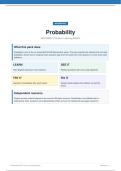
Probability
AQA 8300 | Premium Learning Edition
What this pack does
Probability is one of the six broad AQA GCSE Mathematics areas. This pack teaches the methods that sit inside
probability, shows how to recognise each question type and then builds from short practice to mixed exam-style
problems.
LEARN SEE IT
Plain-English teaching in short sections. Worked questions with every step explained.
TRY IT FIX IT
Questions immediately after each lesson. Answer sheet explains the method, not just the
result.
Independent resource
Original revision material aligned to the current AQA topic structure. ClearGrade is not affiliated with or
endorsed by AQA. Questions are independently written and are not reproduced past-paper questions.
ClearGrade GCSE | Premium Learning Edition Mathematics | 1
, Before you start
Probability is one of the six broad AQA GCSE Mathematics areas. This pack teaches the methods that sit inside
probability, shows how to recognise each question type and then builds from short practice to mixed exam-style
problems.
By the end of this pack, you should be able to:
• explain and apply probability scale and complements
• explain and apply sample spaces
• explain and apply relative and expected frequency
• explain and apply independent events
• explain and apply tree diagrams
• explain and apply without replacement
• explain and apply venn diagrams
• explain and apply conditional probability
How to use the pack
1. Read one lesson. 2. Cover the page and explain it from memory. 3. Study the worked example. 4. Attempt
the three “Your turn” questions without looking back. 5. Mark them using the explained answers at the back. 6.
Re-do every question you got wrong.
ClearGrade GCSE | Premium Learning Edition Mathematics | 2
, LESSON 1
Probability scale and complements
The idea in plain English
Probabilities run from0 to1. The complement rule is P(not A)=1-P(A).
What you need to know
• 0=impossible,1=certain.
• For equally likely outcomes, probability=favourable/total.
• All mutually exclusive exhaustive outcomes sum to1.
WORKED EXAMPLE
Question: P(A)=0.72. Find P(not A).
Step 1: A and not A cover all outcomes.
Step 2: Their probabilities sum to1.
Step 3: 1-0.72=0.28.
Step 4: Answer=0.28.
EXAM TIP COMMON MISTAKE
Write enough working that another student could Do not jump straight to a remembered shortcut if
follow your method. Calculator answers without a you cannot explain why it applies. Write the rule
setup can lose method marks. first.
YOUR TURN
1. Fair die P(even)? [1-2 marks]
2. P(rain)=0.35, P(no rain)? [2-3 marks]
3. Bag4R6B, P(R)? [3-4 marks]
LESSON 2
Sample spaces
The idea in plain English
A sample space lists all possible outcomes systematically.
What you need to know
• Use tables for two events.
• If outcomes are equally likely, count successful outcomes over total.
• Check none are missing or repeated.
ClearGrade GCSE | Premium Learning Edition Mathematics | 3
Probability
AQA 8300 | Premium Learning Edition
What this pack does
Probability is one of the six broad AQA GCSE Mathematics areas. This pack teaches the methods that sit inside
probability, shows how to recognise each question type and then builds from short practice to mixed exam-style
problems.
LEARN SEE IT
Plain-English teaching in short sections. Worked questions with every step explained.
TRY IT FIX IT
Questions immediately after each lesson. Answer sheet explains the method, not just the
result.
Independent resource
Original revision material aligned to the current AQA topic structure. ClearGrade is not affiliated with or
endorsed by AQA. Questions are independently written and are not reproduced past-paper questions.
ClearGrade GCSE | Premium Learning Edition Mathematics | 1
, Before you start
Probability is one of the six broad AQA GCSE Mathematics areas. This pack teaches the methods that sit inside
probability, shows how to recognise each question type and then builds from short practice to mixed exam-style
problems.
By the end of this pack, you should be able to:
• explain and apply probability scale and complements
• explain and apply sample spaces
• explain and apply relative and expected frequency
• explain and apply independent events
• explain and apply tree diagrams
• explain and apply without replacement
• explain and apply venn diagrams
• explain and apply conditional probability
How to use the pack
1. Read one lesson. 2. Cover the page and explain it from memory. 3. Study the worked example. 4. Attempt
the three “Your turn” questions without looking back. 5. Mark them using the explained answers at the back. 6.
Re-do every question you got wrong.
ClearGrade GCSE | Premium Learning Edition Mathematics | 2
, LESSON 1
Probability scale and complements
The idea in plain English
Probabilities run from0 to1. The complement rule is P(not A)=1-P(A).
What you need to know
• 0=impossible,1=certain.
• For equally likely outcomes, probability=favourable/total.
• All mutually exclusive exhaustive outcomes sum to1.
WORKED EXAMPLE
Question: P(A)=0.72. Find P(not A).
Step 1: A and not A cover all outcomes.
Step 2: Their probabilities sum to1.
Step 3: 1-0.72=0.28.
Step 4: Answer=0.28.
EXAM TIP COMMON MISTAKE
Write enough working that another student could Do not jump straight to a remembered shortcut if
follow your method. Calculator answers without a you cannot explain why it applies. Write the rule
setup can lose method marks. first.
YOUR TURN
1. Fair die P(even)? [1-2 marks]
2. P(rain)=0.35, P(no rain)? [2-3 marks]
3. Bag4R6B, P(R)? [3-4 marks]
LESSON 2
Sample spaces
The idea in plain English
A sample space lists all possible outcomes systematically.
What you need to know
• Use tables for two events.
• If outcomes are equally likely, count successful outcomes over total.
• Check none are missing or repeated.
ClearGrade GCSE | Premium Learning Edition Mathematics | 3


