

MATHEMATICS
Ratio, proportion and rates of
change
AQA 8300 | Premium Learning Edition
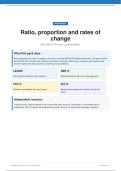
What this pack does
Ratio, proportion and rates of change is one of the six broad AQA GCSE Mathematics areas. This pack teaches
the methods that sit inside ratio, proportion and rates of change, shows how to recognise each question type
and then builds from short practice to mixed exam-style problems.
LEARN SEE IT
Plain-English teaching in short sections. Worked questions with every step explained.
TRY IT FIX IT
Questions immediately after each lesson. Answer sheet explains the method, not just the
result.
Independent resource
Original revision material aligned to the current AQA topic structure. ClearGrade is not affiliated with or
endorsed by AQA. Questions are independently written and are not reproduced past-paper questions.
ClearGrade GCSE | Premium Learning Edition Mathematics | 1
, Before you start
Ratio, proportion and rates of change is one of the six broad AQA GCSE Mathematics areas. This pack teaches the
methods that sit inside ratio, proportion and rates of change, shows how to recognise each question type and then
builds from short practice to mixed exam-style problems.
By the end of this pack, you should be able to:
• explain and apply ratio and sharing
• explain and apply unitary method and best buys
• explain and apply direct proportion
• explain and apply inverse proportion
• explain and apply percentage growth and decay
• explain and apply speed, density and pressure
• explain and apply scale factors and similarity
How to use the pack
1. Read one lesson. 2. Cover the page and explain it from memory. 3. Study the worked example. 4. Attempt
the three “Your turn” questions without looking back. 5. Mark them using the explained answers at the back. 6.
Re-do every question you got wrong.
ClearGrade GCSE | Premium Learning Edition Mathematics | 2
, LESSON 1
Ratio and sharing
The idea in plain English
A ratio compares quantities multiplicatively. To share in a ratio, add the parts, find the value of one part, then
multiply.
What you need to know
• Simplify ratios by dividing every part by the same factor.
• Keep quantities in the same units before forming a ratio.
• Check shared amounts add to the original total.
WORKED EXAMPLE
Question: Share £770 in the ratio 2:5:4.
Step 1: Total parts=2+5+4=11.
Step 2: One part=770/11=70.
Step 3: Shares:2x70=140,5x70=350,4x70=280.
Step 4: Check:140+350+280=770.
EXAM TIP COMMON MISTAKE
Write enough working that another student could Do not jump straight to a remembered shortcut if
follow your method. Calculator answers without a you cannot explain why it applies. Write the rule
setup can lose method marks. first.
YOUR TURN
1. Simplify 45:60. [1-2 marks]
2. Share £420 in2:5. [2-3 marks]
3. Ratio 3:4, first part21. Second? [3-4 marks]
LESSON 2
Unitary method and best buys
The idea in plain English
The unitary method finds the value for one unit first, then scales to the required number. Best-buy comparisons
need a common unit.
What you need to know
• Find cost per item, gram, litre or other consistent unit.
• Do not compare package prices if package sizes differ.
• State which option is better and why.
ClearGrade GCSE | Premium Learning Edition Mathematics | 3
Ratio, proportion and rates of
change
AQA 8300 | Premium Learning Edition
What this pack does
Ratio, proportion and rates of change is one of the six broad AQA GCSE Mathematics areas. This pack teaches
the methods that sit inside ratio, proportion and rates of change, shows how to recognise each question type
and then builds from short practice to mixed exam-style problems.
LEARN SEE IT
Plain-English teaching in short sections. Worked questions with every step explained.
TRY IT FIX IT
Questions immediately after each lesson. Answer sheet explains the method, not just the
result.
Independent resource
Original revision material aligned to the current AQA topic structure. ClearGrade is not affiliated with or
endorsed by AQA. Questions are independently written and are not reproduced past-paper questions.
ClearGrade GCSE | Premium Learning Edition Mathematics | 1
, Before you start
Ratio, proportion and rates of change is one of the six broad AQA GCSE Mathematics areas. This pack teaches the
methods that sit inside ratio, proportion and rates of change, shows how to recognise each question type and then
builds from short practice to mixed exam-style problems.
By the end of this pack, you should be able to:
• explain and apply ratio and sharing
• explain and apply unitary method and best buys
• explain and apply direct proportion
• explain and apply inverse proportion
• explain and apply percentage growth and decay
• explain and apply speed, density and pressure
• explain and apply scale factors and similarity
How to use the pack
1. Read one lesson. 2. Cover the page and explain it from memory. 3. Study the worked example. 4. Attempt
the three “Your turn” questions without looking back. 5. Mark them using the explained answers at the back. 6.
Re-do every question you got wrong.
ClearGrade GCSE | Premium Learning Edition Mathematics | 2
, LESSON 1
Ratio and sharing
The idea in plain English
A ratio compares quantities multiplicatively. To share in a ratio, add the parts, find the value of one part, then
multiply.
What you need to know
• Simplify ratios by dividing every part by the same factor.
• Keep quantities in the same units before forming a ratio.
• Check shared amounts add to the original total.
WORKED EXAMPLE
Question: Share £770 in the ratio 2:5:4.
Step 1: Total parts=2+5+4=11.
Step 2: One part=770/11=70.
Step 3: Shares:2x70=140,5x70=350,4x70=280.
Step 4: Check:140+350+280=770.
EXAM TIP COMMON MISTAKE
Write enough working that another student could Do not jump straight to a remembered shortcut if
follow your method. Calculator answers without a you cannot explain why it applies. Write the rule
setup can lose method marks. first.
YOUR TURN
1. Simplify 45:60. [1-2 marks]
2. Share £420 in2:5. [2-3 marks]
3. Ratio 3:4, first part21. Second? [3-4 marks]
LESSON 2
Unitary method and best buys
The idea in plain English
The unitary method finds the value for one unit first, then scales to the required number. Best-buy comparisons
need a common unit.
What you need to know
• Find cost per item, gram, litre or other consistent unit.
• Do not compare package prices if package sizes differ.
• State which option is better and why.
ClearGrade GCSE | Premium Learning Edition Mathematics | 3


