

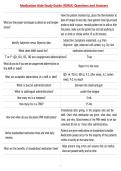
Medication Aide Study Guide (IOWA) Questions and Answers
Have the patient moisten lips, place the thermometer at
base of tongue to one side, have patient close lips around
What are the proper techniques to obtain an oral temper-
probe to hold in place, remind patient not to talk or bite
ature?
the probe, make sure the patient has not had anything to
eat or drink or smoke within 15 to 20 minutes.
Subjective: Symptoms (reported). e.g. Pain
Identify Subjective versus Objective data
Objective: signs (observed with senses) e.g. Dry skin
What does MAR stand for? medication administration record
T or F: QD, OU, OS, OD are unapproved abbreviations? True
What do you do if you see an unapproved abbreviation on
Report it to the nurse
the MAR or label?
QID- x4, TID-x3, BID-x2, P.C.-after meals, A.C.-before
What are acceptable abbreviations on a MAR or label?
meals, P.O.-by mouth
What is buccal administration? between the cheek and gum
What is sublingual administration? under the tongue
How many mL in a teaspoon? 5 mL
How many mL in a TBSP? 15 mL
Immediately after giving, in the progress note and the
MAR. Chart what medication was given, what dose, what
How and when do you document PRN medications?
time, and why. Ettectiveness of the PRN needs to be doc-
umented 30 min to 1 hour after administration.
Patients are given medications on standardized schedule.
Define standardized medication times and what daily
Medication passes occur for the majority of the patients
means.
within a facility at the same time.
Helps prevent drug errors and ensures that all medica-
What are the benefits of standardized medication times?
tions are passed safely and on time.
, Medication Aide Study Guide (IOWA) Questions and Answers
What is the timeframe the state of Iowa gives you to pass 1 hr before and after the stated due time - due time is
medications? dependent on the facilities policy.
What is military time? Add 12 to the time after noon. (1pm= 1300 and so on)
What route of medication administration can the MA com- P.O., topical, eye, ear, inhalers, nose drops/sprays, trans-
plete? dermal patches.
Administer medications, supervise the self-administering
What are the roles of the CMA and who supervises them? patient, observe and report signs and symptoms. A li-
censed nurse.
IV, IM, Sub-Q
What can you not do as a CMA? Can do Sub-Q insulin if trained and reevaluated every 6
hrs.
Who prescribes medications? Doctors, PAs, Nurse Practitioner, Dentists
What is a single order? Give only once
What is a STAT order? Give immediately
What is a Standing order? For certain number of doses/days
What is a PRN order? As needed/as desired
They must be stored under 2 locks with 2 separate keys
and counted every 8 hours by 2 people. There are only 2
What special considerations need to be in place with times you can have a controlled substance in your pos-
controlled substances? session -when administering and if they have an active
prescription. Always dispose of a controlled substance
with a witness present.
What are the three legal classifications of medications? Over-the-counter (OTC), Prescription, and Controlled
Who can receive oral medications? A patient who is alert, sitting up, and able to swallow.
What should the CMA do if a patient is having a new
tell the nurse
symptom of trouble swallowing?
Have the patient moisten lips, place the thermometer at
base of tongue to one side, have patient close lips around
What are the proper techniques to obtain an oral temper-
probe to hold in place, remind patient not to talk or bite
ature?
the probe, make sure the patient has not had anything to
eat or drink or smoke within 15 to 20 minutes.
Subjective: Symptoms (reported). e.g. Pain
Identify Subjective versus Objective data
Objective: signs (observed with senses) e.g. Dry skin
What does MAR stand for? medication administration record
T or F: QD, OU, OS, OD are unapproved abbreviations? True
What do you do if you see an unapproved abbreviation on
Report it to the nurse
the MAR or label?
QID- x4, TID-x3, BID-x2, P.C.-after meals, A.C.-before
What are acceptable abbreviations on a MAR or label?
meals, P.O.-by mouth
What is buccal administration? between the cheek and gum
What is sublingual administration? under the tongue
How many mL in a teaspoon? 5 mL
How many mL in a TBSP? 15 mL
Immediately after giving, in the progress note and the
MAR. Chart what medication was given, what dose, what
How and when do you document PRN medications?
time, and why. Ettectiveness of the PRN needs to be doc-
umented 30 min to 1 hour after administration.
Patients are given medications on standardized schedule.
Define standardized medication times and what daily
Medication passes occur for the majority of the patients
means.
within a facility at the same time.
Helps prevent drug errors and ensures that all medica-
What are the benefits of standardized medication times?
tions are passed safely and on time.
, Medication Aide Study Guide (IOWA) Questions and Answers
What is the timeframe the state of Iowa gives you to pass 1 hr before and after the stated due time - due time is
medications? dependent on the facilities policy.
What is military time? Add 12 to the time after noon. (1pm= 1300 and so on)
What route of medication administration can the MA com- P.O., topical, eye, ear, inhalers, nose drops/sprays, trans-
plete? dermal patches.
Administer medications, supervise the self-administering
What are the roles of the CMA and who supervises them? patient, observe and report signs and symptoms. A li-
censed nurse.
IV, IM, Sub-Q
What can you not do as a CMA? Can do Sub-Q insulin if trained and reevaluated every 6
hrs.
Who prescribes medications? Doctors, PAs, Nurse Practitioner, Dentists
What is a single order? Give only once
What is a STAT order? Give immediately
What is a Standing order? For certain number of doses/days
What is a PRN order? As needed/as desired
They must be stored under 2 locks with 2 separate keys
and counted every 8 hours by 2 people. There are only 2
What special considerations need to be in place with times you can have a controlled substance in your pos-
controlled substances? session -when administering and if they have an active
prescription. Always dispose of a controlled substance
with a witness present.
What are the three legal classifications of medications? Over-the-counter (OTC), Prescription, and Controlled
Who can receive oral medications? A patient who is alert, sitting up, and able to swallow.
What should the CMA do if a patient is having a new
tell the nurse
symptom of trouble swallowing?


